Ethereum Validator Exit Queue Clears as ETH Trades Near $2,000
Key Takeaways
- •Ethereum’s validator exit queue has fully cleared after reaching about 2.6 million ETH last year.
- •More than 2.5 million ETH is waiting to enter staking, creating an activation delay of nearly 44 days.
- •Total staked ETH has reached about 40.9 million coins, equal to roughly 33.6% of circulating supply.
- •ETH remains in a contested trading range, with $2,000 as immediate resistance and $1,900 as a key support level.
- •A sustained move above $2,200 would strengthen bullish momentum, while $2,400 is viewed as a broader trend reversal threshold.
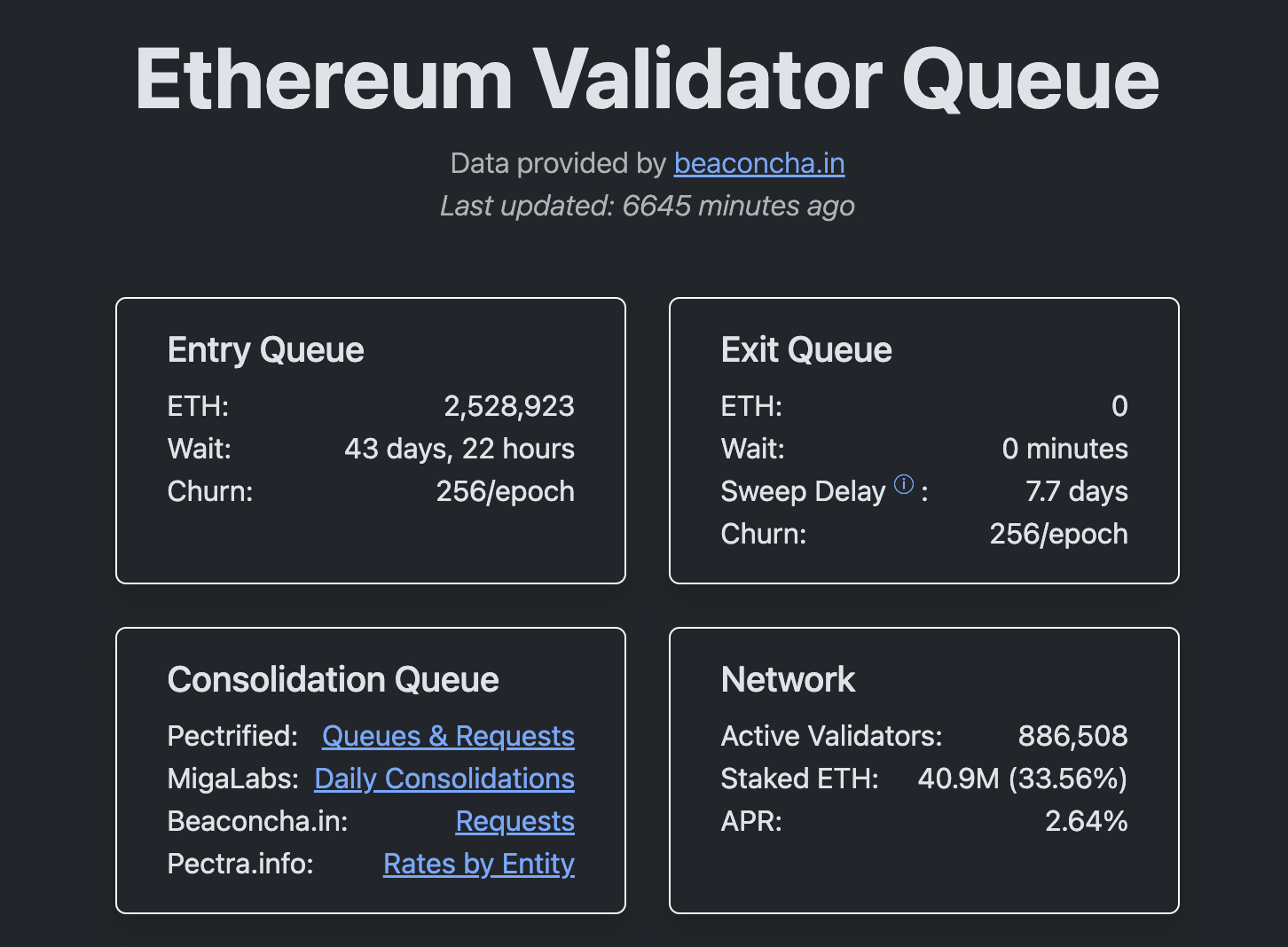
Ethereum’s validator exit queue has fallen to zero, a sharp change from the conditions that supported a bearish outlook less than a year ago. ETH is trading around the $1,950 to $1,970 area as it attempts to reclaim the $2,000 level, a key resistance zone watched by traders. The latest staking data points to stronger participation in Ethereum validation, while the price chart has not yet confirmed a clear breakout.
Data from Validator Queue shows that Ethereum’s exit queue has fully cleared after rising to roughly 2.6 million ETH last year. At that time, validators faced withdrawal waiting periods of about 45 days. The situation has since reversed: more than 2.5 million ETH is now waiting to enter staking, creating an activation delay of nearly 44 days. Ethereum’s validator entry and exit queues are shaped by protocol limits on how quickly validators can join or leave, so long waits can signal sustained pressure on one side of the staking system rather than immediate spot-market flows.
Total staked ETH has climbed to about 40.9 million coins, equal to roughly 33.6% of the circulating supply. That represents the highest staking ratio in Ethereum’s history. Nearly 887,000 active validators are currently securing the network, indicating that demand remains tilted toward long-term participation rather than exits.
Those staking conditions could affect the available supply of ETH. As a larger share of ETH remains locked in staking, less is readily available for trading. The cleared exit queue also removes one of last year’s major bearish concerns, when traders feared that a wave of unstaked ETH could move to exchanges. If staking demand remains strong, the supply backdrop may continue to be a factor in Ethereum’s recovery attempt.
ETH Holds in a Contested Range Near $2,000
ETH is consolidating near $1,970 after recovering from recent lows. Intraday trading has remained between roughly $1,880 and $1,970, showing that buyers and sellers are still competing within a contested price zone. The current market structure does not yet show a decisive directional trend.
The technical setup remains centered on a defined $1,900 to $2,200 range. Immediate resistance is near $2,000, followed by the $2,080 to $2,120 area. A sustained move above $2,200 would strengthen bullish momentum, while $2,400 remains the level many traders view as confirmation of a broader trend reversal.
For the bullish case to develop, ETH would need to reclaim and hold $2,000 before moving through resistance between $2,080 and $2,120. If buyers can maintain momentum, the next upside level would be $2,200, with $2,400 still acting as the larger breakout threshold. Recent staking queue data continues to support the longer-term supply argument, but spot price action has not yet confirmed that scenario.
The base case remains consolidation. ETH could continue trading between $1,900 and $2,200 over the next several sessions before choosing a direction. A daily close below $1,900 would shift attention toward support between $1,850 and $1,800. A move below $1,800 would weaken the short-term outlook, even if the longer-term staking thesis remains intact.
Funding rates and derivatives positioning remain important signals alongside spot price action. Together, they may show whether buyers have enough conviction to challenge resistance or whether another rejection is developing. For Ethereum, the next useful read-through is whether improving staking participation is matched by stronger spot demand, since staking data alone does not confirm a price breakout.
Maxi Doge Presale Continues During Ethereum’s Test of Key Levels
The source article also cited Maxi Doge ($MAXI), a meme token currently in presale on Ethereum as an ERC-20 asset. The project describes itself as being built around a trading community identity focused on high-conviction, high-energy market participation. It describes its mascot as “a 240-lb canine juggernaut embodying 1000x leverage trading mentality.”
POV: The government trying to work out how to tax capital gains on assets that price fluctuate pic.twitter.com/MXJPJDRzzJ — MaxiDoge (@MaxiDoge_) July 7, 2026
POV: The government trying to work out how to tax capital gains on assets that price fluctuate pic.twitter.com/MXJPJDRzzJ
https://x.com/MaxiDoge_/status/2074539042616553925?ref_src=twsrc%5Etfw
The current Maxi Doge presale price is $0.0002831, with $4.8 million raised to date. The project says it includes dynamic APY staking, holder-only trading competitions with leaderboard rewards, and a Maxi Fund treasury allocated to liquidity and partnerships. As an Ethereum-based ERC-20 presale, the project also sits within the broader network activity environment being watched alongside ETH’s staking and price data.
At the same time, Ethereum’s broader price setup remains tied to whether ETH can hold the $1,900 area and reclaim $2,000 with sustained momentum. The cleared validator exit queue and the record staking ratio provide an important supply-side backdrop, but the next confirmed price move still depends on spot demand, derivatives positioning, and whether ETH can break above its established resistance range.

