Coinbase and Robinhood Face Off in Crypto's Next Chapter as Q2 2026 Earnings Approach
Key Takeaways
- •Robinhood is expected to report Q2 2026 earnings of approximately $0.40 per share on revenue near $1.25 billion, while Coinbase is projected to post a loss of about $0.36 per share on revenue close to $1.3 billion.
- •Robinhood's quarterly trading volume surged from roughly $261 billion in early 2024 to over $704 billion in the first quarter of 2026, outpacing Coinbase's growth from approximately $185 billion to about $517 billion over the same period.
- •More than half of Coinbase's subscription and services revenue is tied to USDC, exposing the company to competitive pressure as major banks and payment firms launch their own dollar-backed stablecoins.
- •Robinhood recently launched Robinhood Chain, a Layer-2 blockchain on Arbitrum, offering tokenized U.S. equities to customers in over 120 countries and serving nearly 28 million users across 38 countries.
- •Digital assets account for only about 12% of Robinhood's revenue, with the remainder derived from brokerage services, options trading, and other product lines, contributing to its higher valuation relative to Coinbase.
Coinbase and Robinhood are set to report their second-quarter 2026 earnings this week, with results that could illuminate not only the trajectories of both companies but also the broader direction of the cryptocurrency industry. The reports arrive at a pivotal moment: institutional adoption of digital assets has accelerated through spot ETFs and tokenization pilots, yet retail engagement has cooled from post-election highs, leaving investors searching for evidence that the industry can sustain growth across market cycles.
Robinhood will report on Wednesday after the closing bell, followed by Coinbase on Thursday. Together, the two reports offer one of the clearest signals of whether digital assets remain driven primarily by speculative trading or are maturing into a more sophisticated financial infrastructure built around stablecoins, subscription services, and tokenized assets.
Two Earnings Reports the Entire Market Is Watching
Both companies went public in 2021, but through markedly different paths. Coinbase was founded as a cryptocurrency trading and custody platform, while Robinhood built its brand on commission-free stock trading before expanding into digital assets. Today, the two firms increasingly compete head-to-head in the same markets, a convergence that also places them alongside traditional brokers, exchanges, and asset managers exploring similar blockchain-based products.
Wall Street expects Robinhood to report earnings of approximately $0.40 per share on revenue of roughly $1.25 billion. Coinbase, by contrast, is projected to post a loss of about $0.36 per share on revenue near $1.3 billion.
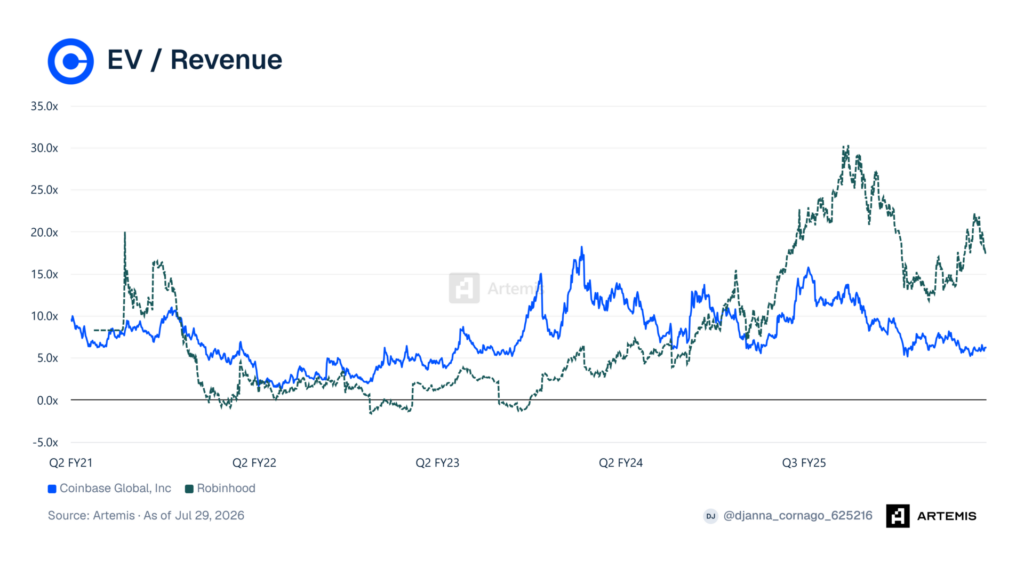
Despite generating comparable revenue, the two companies receive very different treatment from investors. Artemis data shows that Robinhood has historically commanded a higher enterprise value-to-revenue multiple than Coinbase, suggesting that investors view it more as a diversified fintech platform than a pure-play crypto trading business.
That gap has widened as several analysts have downgraded Coinbase. Mizuho analyst Dan Dolev has suggested that Robinhood could become the first "hyperscaler" in the brokerage industry, according to Fortune.
Why Retail's Retreat Matters Beyond Two Stocks
Cryptocurrency markets rallied following Donald Trump's election victory in late 2024 before pulling back as retail participation declined. The pullback has tested whether the industry's post-2022 recovery can endure without the retail-driven trading volumes that historically powered exchange revenue.
Robinhood appears to have navigated that shift more effectively. Artemis data shows that Robinhood's quarterly trading volume climbed from approximately $261 billion in early 2024 to more than $704 billion in the first quarter of 2026. Coinbase also grew during the same period, with total trading volume rising from roughly $185 billion to about $517 billion, though at a slower pace.
The disparity suggests Robinhood has captured a larger share of retail trading activity. Investors, however, will be looking beyond raw trading volumes to assess whether these gains are translating into sustainable profitability.
Both companies have invested heavily in tokenized equities, betting that blockchain technology will enable traditional financial instruments to merge with cryptocurrency markets. The strategy reflects a broader push to develop durable revenue streams beyond transaction fees, and one that aligns with parallel efforts by major asset managers and clearinghouses exploring distributed-ledger settlement.
Coinbase's Stablecoin Engine Faces New Competition
Coinbase has steadily reduced its dependence on trading commissions over the past several years. According to Artemis data, its subscription and services revenue grew from roughly $103 million in mid-2021 to nearly $747 million by the third quarter of 2025. Stablecoin revenue followed a similar upward trajectory, rising from approximately $77 million in late 2022 to over $364 million before easing slightly this year.
These segments have helped cushion the impact of softer trading activity, and customer assets held on the exchange remain above bear-market lows despite recent market fluctuations.
Concentration risk, however, remains a concern. In its first-quarter shareholder letter, Coinbase disclosed that more than half of its subscription and services revenue is tied to USDC. That segment could face pressure as major banks and payment processors roll out their own dollar-backed stablecoins, a shift that could reshape the competitive landscape for digital dollar settlement and erode the market share that Circle's USDC and Tether's USDT have long dominated.
CEO Brian Armstrong has also refocused Coinbase's strategy on financial infrastructure after the company's earlier attempt to build a social network on its Base blockchain did not succeed.
Robinhood's Global Expansion
Robinhood is pursuing many of the same initiatives but scaling them through a broader consumer platform.
Earlier this month, the company announced the launch of Robinhood Chain, a Layer-2 blockchain built on Arbitrum, along with tokenized U.S. equities available to clients in more than 120 countries. Robinhood says it now serves nearly 28 million customers across 38 countries.
CEO Vlad Tenev has described tokenization as a potential "supercycle" for capital markets, pointing to growing institutional interest in blockchain-based settlement and digital securities.
Unlike Coinbase, however, Robinhood is far less dependent on cryptocurrency. Digital assets account for only about 12% of its revenue, with the remainder coming from brokerage services, options trading, prediction markets, and other product lines.
That diversification helps explain why investors continue to assign Robinhood a higher valuation than Coinbase, even though both companies generate similar top-line revenue. As the two firms report this week, market participants will be watching not only headline revenue and earnings but also regulatory developments, stablecoin market dynamics, and the pace at which tokenized-asset adoption moves beyond early pilots.

