CLARITY Act Unlikely to Pass Before August Recess, Says Senate Leader Thune
Key Takeaways
- •The CLARITY Act would create the first comprehensive US federal framework for digital assets, assigning oversight of decentralized tokens to the CFTC and investment contract tokens to the SEC.
- •The legislation requires 60 Senate votes to advance, but with Republicans holding 53 seats, no Democrats have currently indicated they will vote in favor.
- •Over 200 crypto industry organizations and the National Fraternal Order of Police, representing more than 382,000 officers, have endorsed the amended bill.
- •Disputes over President Trump's approximately $1.4 billion in disclosed crypto-related earnings and contested ethics provision loopholes led two Democratic senators to withdraw their support.
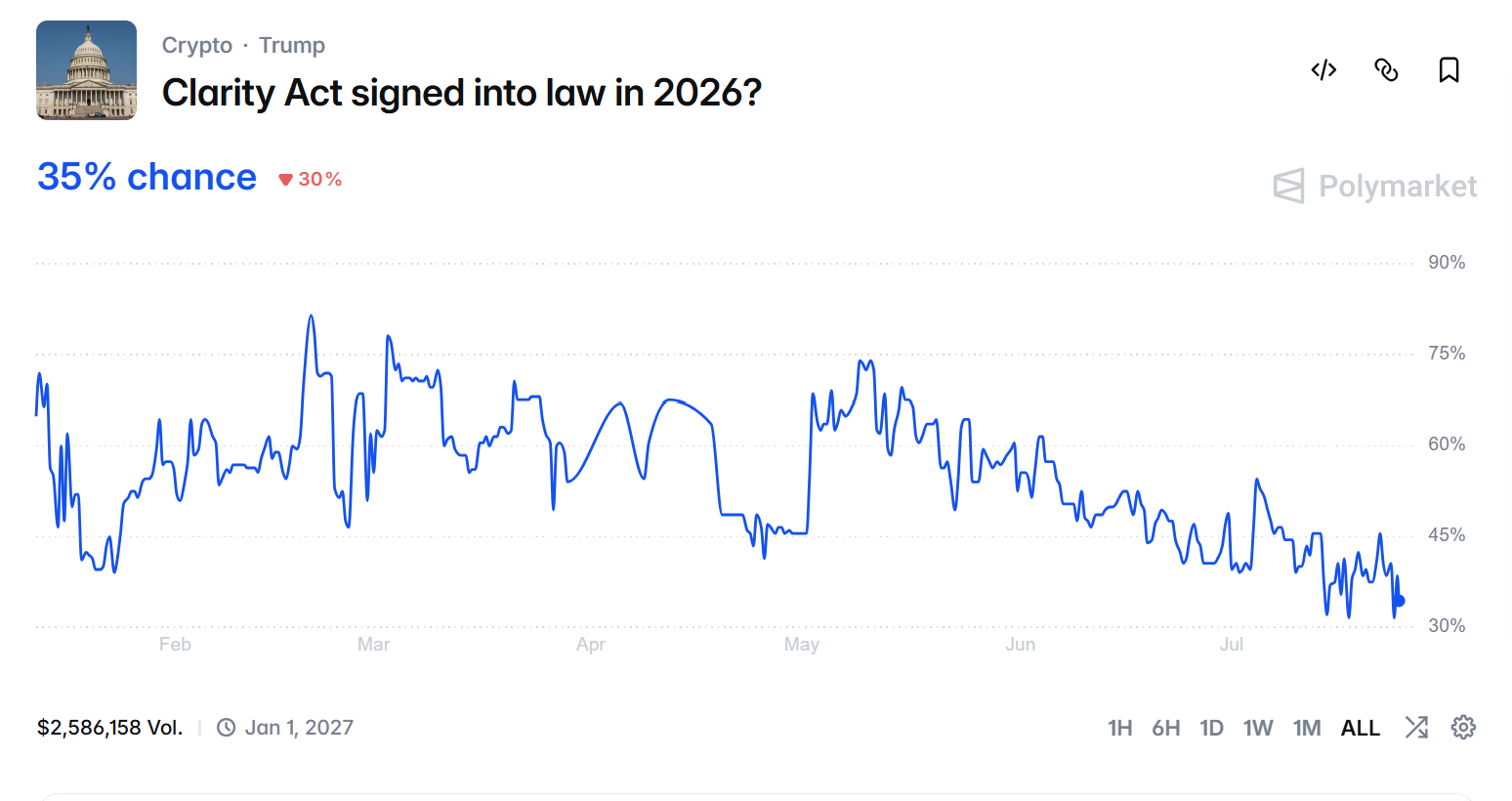
- •Prediction markets and research firms have significantly reduced passage probability estimates, with Polymarket odds falling to approximately 37 percent from above 80 percent in the spring.
Momentum behind the CLARITY Act is accelerating, but Senate leadership indicated the cryptocurrency legislation will most likely not reach a final vote before the chamber's August recess.
The bill would establish the first comprehensive federal regulatory framework for digital assets in the United States, determining which agency oversees which types of tokens. The European Union implemented its Markets in Crypto-Assets (MiCA) regulation in 2024, giving European firms unified rules while US companies have operated under shifting agency guidance and enforcement actions. While supporters have garnered the broad backing they sought, they still face a shortage of both time and bipartisan votes.
Industry and Law Enforcement Support Builds
More than 200 crypto industry groups have urged the Senate to act, including the Blockchain Association, the Crypto Council for Innovation, and the Digital Chamber. In a joint letter, the organizations called for swift passage, arguing that clear rules would prevent crypto firms from relocating outside the United States.
Strong support continues to flow in for the Clarity Act. I wonder who else will come out in support of the bill today… 🤔 — Patrick Witt (@patrickjwitt) July 24, 2026
The legislation gained additional strength this week when Senator Cynthia Lummis released updated bill text enhancing customer protections. The revised language would ensure that investors retain ownership of their crypto assets if an exchange fails — a safeguard that was absent when Celsius and Voyager collapsed in 2022, leaving customers without access to their funds for years and recovering only partial reimbursements.
Law enforcement support has also expanded. Following an initial endorsement from one police organization last week, the National Fraternal Order of Police (FOP), representing more than 382,000 officers, endorsed the amended bill on Friday.
🚨🚨 National Fraternal Order of Police Endorse Clarity Act "…. the FOP's initial concerns have been satisfactorily addressed and we look forward to working with you to get the amended bill passed." pic.twitter.com/GzrhQXnlDv — Senator Cynthia Lummis (@SenLummis) July 24, 2026
The FOP stated that its "initial concerns have been satisfactorily addressed" after lawmakers revised the developer protection provisions.
Senate Vote Count Falls Short
The bill requires 60 votes to advance in the Senate. Republicans hold 53 seats, meaning at least seven Democrats would need to support the measure. Currently, none have indicated they will vote yes.
The House of Representatives passed the legislation in July 2025, with 78 Democrats voting in favor. The bill would assign most crypto oversight authority to the Commodity Futures Trading Commission (CFTC), a market regulator that already supervises commodity derivatives, rather than the Securities and Exchange Commission (SEC). Under the bill, tokens certified as sufficiently decentralized would be treated as digital commodities under CFTC jurisdiction, while tokens functioning as investment contracts would remain SEC-regulated securities.
The central political dispute revolves around President Donald Trump, who disclosed approximately $1.4 billion in crypto-related earnings last year, according to his own financial disclosure. The majority of those earnings came from his $TRUMP meme coin and his firm World Liberty Financial. Democrats have characterized this as a conflict of interest.
Republicans added new ethics provisions to address those concerns, but Democrats argue the rules contain significant loopholes. Enforcement would fall exclusively under Trump's Justice Department, whose acting head, Todd Blanche, previously served as Trump's personal defense attorney. State authorities would be preempted from taking action.
Additionally, a carve-out protects coins created before an official assumes office — a provision that covers the $TRUMP coin, which was launched days before Trump's inauguration. The ethics rules would also expire in 2029.
As a result, the two Democrats who previously supported the bill have withdrawn their backing. One of them, Senator Angela Alsobrooks, called the proposal "wild and unserious and stone crazy." Senate Majority Leader Chuck Schumer has also directed Democrats to focus on Trump-related issues ahead of the elections, raising the political cost of a yes vote.
Time Constraints and Diminishing Odds
The legislative calendar offers little room. The Senate is scheduled to work one additional week in August before recessing until September 14, after which budget and defense appropriations bills will dominate the agenda.
Senate leader John Thune told Punchbowl News he hopes to at least begin floor proceedings but does not expect a final vote before the recess. "I don't think we'll be able to get them done," he told reporters.
Betting markets reflect waning confidence. On Polymarket, the odds of the bill's passage this year fell to approximately 37% on Friday, down from above 80% in the spring. Research firm Galaxy also reduced its probability estimate to 50% from 75% in May, and further cut it to 30% in a Friday update.
Some industry insiders remain cautiously optimistic, attributing delays to banking-sector lobbying. They believe the bill's strongest chance lies after the November elections.
"The votes are there, but the election politics are louder. The latter will dissipate after November and that's a narrow but very possible window," Fortune reported, citing Ron Hammond, head of policy at trading firm Wintermute.
Until the CLARITY Act becomes law, US crypto regulation rests on executive orders that a future president could revoke. The outcome of the November midterm elections could also shift the Senate's partisan balance, altering both the vote math and the political dynamics surrounding the bill. The next two weeks may determine whether the Senate can act in time.

