Cardano Holds Range as ADA Trades Near $0.166 After Van Rossem Upgrade
Key Takeaways
- •ADA traded at $0.166 after a 2.72% 24-hour gain, while Bitcoin rose 0.61% over the same period.
- •The Van Rossem hard fork introduced Protocol Version 11, a new Plutus cost model, native array types, better multi-asset handling, and faster cryptographic operations.
- •The upgrade was Cardano’s first network change approved fully through on-chain governance by delegated representatives, stake pool operators, and the Constitutional Committee.
- •ADA needs to move above $0.170 to target $0.175 and potentially the $0.180–$0.190 area.
- •A drop below $0.160 could bring $0.156 back into focus, followed by $0.150 as the next support area.
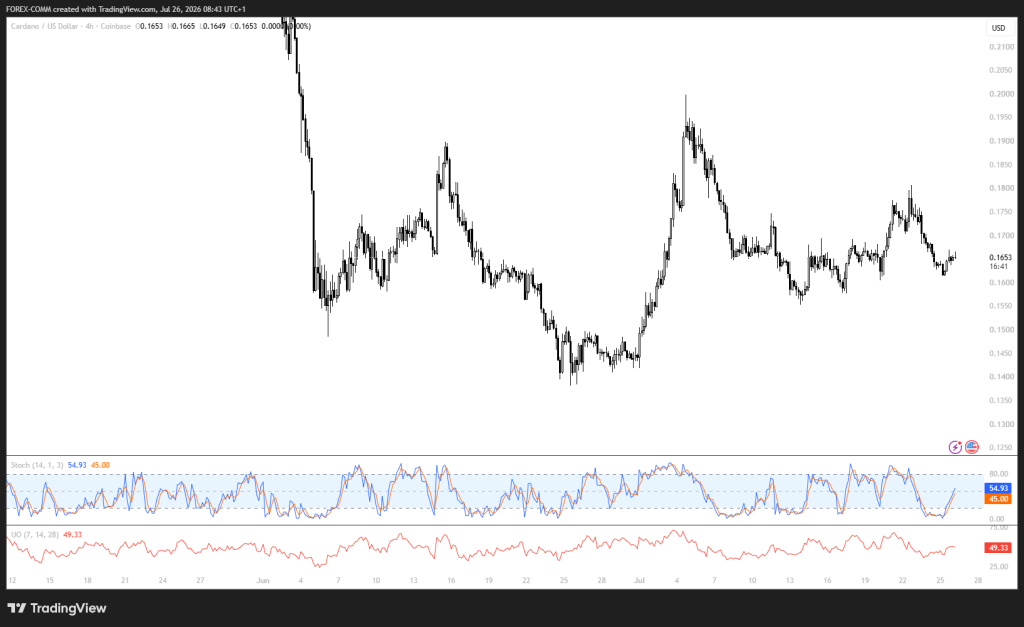
Cardano’s ADA entered the week still trading inside the range highlighted in the previous weekly outlook, after neither a bullish breakout nor a bearish breakdown materialized.
The earlier analysis said ADA would need to move above $0.168–$0.170 to extend its climb, with $0.190 identified as the next upside area. It also noted that a loss of $0.160 would weaken that view and open the way toward $0.156, followed by $0.150. Instead, Cardano held the $0.160 area but failed to clear resistance, leaving the token locked in the same broad range.
ADA was up 2.72% over the past 24 hours to $0.166, outperforming Bitcoin’s 0.61% gain over the same period. Attention around the token has increased amid Charles Hoskinson’s latest comments about Ethereum and Cardano’s recent network upgrade.
Van Rossem hard fork remains a key focus
The Van Rossem hard fork is the main development currently drawing attention to Cardano. The upgrade moved the network to Protocol Version 11 and introduced a new cost model intended to make Plutus smart contracts cheaper to run.
That matters because Plutus is the smart contract framework used by Cardano applications, and execution costs are a practical consideration for developers building decentralized exchanges, NFT platforms, lending tools, and other on-chain services. Lower costs do not automatically translate into higher usage, but they can reduce friction for teams that need to run more complex transactions.
The upgrade also added native array types, improved handling for multiple assets, and faster cryptographic operations. If developers rebuild applications using these tools, Cardano could become more competitive across decentralized finance, NFTs, and real-world asset use cases because applications may become cheaper and faster to operate.
Van Rossem also marked Cardano’s first network upgrade approved fully through on-chain governance. Delegated representatives, stake pool operators, and the Constitutional Committee all voted in favor after the required approval thresholds were met.
That milestone shows Cardano’s governance model functioning as designed without relying only on Input Output to coordinate protocol upgrades. For a network that has emphasized formal governance and decentralization, future protocol changes will be watched for whether the same process continues to operate smoothly.
Hoskinson also renewed debate across the crypto industry after accusing Ethereum developers of borrowing ideas from Cardano’s Extended UTXO model following Ethereum’s native UTXO research proposal.
Separately, comments from ARK Invest’s Head of Digital Asset Research questioning Cardano’s relevance weighed on sentiment. Hoskinson responded publicly, while ARK’s proposed crypto ETF still includes ADA, leaving institutional recognition in place despite the criticism.
Cardano chart remains range-bound
ADA remains in the same broad trading range it has occupied since being rejected from the $0.175–$0.178 area earlier this month.
Buyers have held the $0.160–$0.162 zone several times, and the latest candles show the token attempting to recover toward $0.168.
Momentum indicators remain balanced. The Stochastic rose to 54.93 after previously being oversold, while the Ultimate Oscillator stood at 49.33, indicating little separation between buyers and sellers.
Conditions have improved slightly in recent days, but ADA still needs to move through $0.170 for buyers to take control of the short-term direction.
Key ADA levels for the week
For further upside, buyers would need to push ADA above $0.170. If that level breaks, ADA could move toward $0.175, with $0.180–$0.190 as the next area to watch, particularly as discussion continues around the Van Rossem upgrade and Cardano’s governance milestone.
If ADA fails to break out, the token may remain between $0.160 and $0.170, as it has for much of July. That would suggest traders are waiting for a stronger catalyst before committing to a directional move.
The downside case begins if ADA loses $0.160. A break below that level could put $0.156 back in focus, followed by $0.150 as the next area buyers would need to defend.
The recent 2.72% 24-hour gain came as investors reacted to the Van Rossem hard fork, Cardano’s first fully on-chain governed network upgrade, and renewed discussion around Hoskinson’s comments on Ethereum’s proposed UTXO model.
The Van Rossem hard fork is viewed as a positive technical development because it reduces Plutus smart contract execution costs, adds new developer tools, and represents the first Cardano upgrade approved entirely through on-chain governance. The next practical test is whether builders adopt the new tooling in live applications, while traders continue to watch whether ADA can break from its current $0.160–$0.170 range.

