Bitcoin Whales Return to Profit as Short-Term Holder Metrics Weaken
Key Takeaways
- •Wallets holding between 100 and 1,000 BTC have returned to a state of unrealized profit after Bitcoin's recent price recovery.
- •The short-term holder market capitalization dropped to $236.2 billion on July 25, breaking below the previous low recorded in October 2024.
- •Bitcoin's total realized capitalization experienced a three-day decline, falling to approximately $1.061 trillion and indicating weak capital formation.
- •Derivatives funding turned negative while exchange netflows increased, suggesting a buildup in short positioning and leveraged exposure.
Bitcoin Whale Cost Basis Improves, but New Demand Remains Unconfirmed
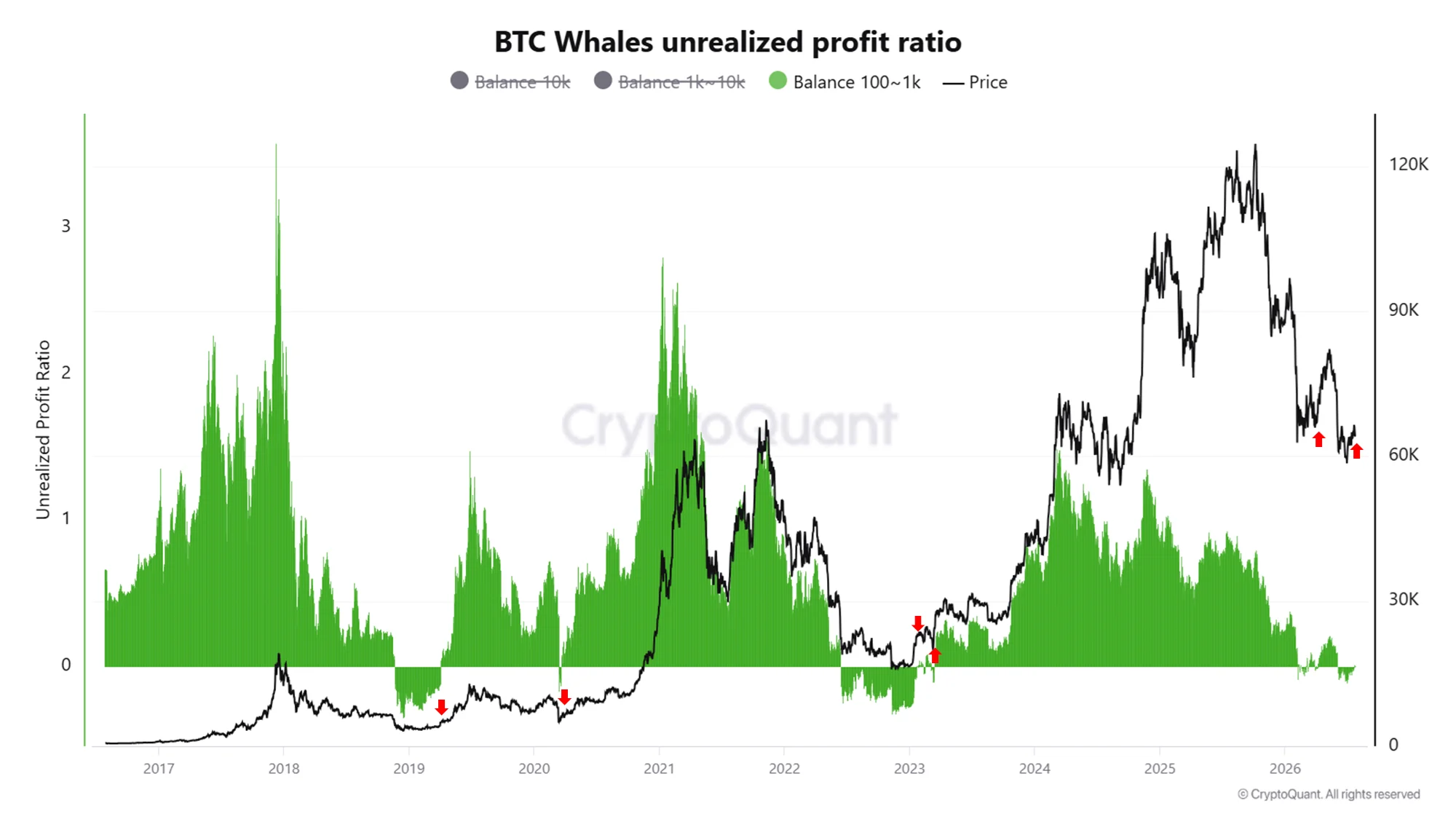
Wallets holding between 100 and 1,000 BTC have returned to unrealized profit after Bitcoin’s recent rebound, according to a CryptoQuant analysis of whale unrealized profits:
The move above the cohort’s aggregate cost basis means market price has risen above the level reflected by the indicator. Holders in this group are no longer carrying the same unrealized losses, reducing one potential source of selling pressure that can emerge when large holders are forced or encouraged to sell into market weakness.
The 100 to 1,000 BTC range is a large-holder cohort rather than a complete measure of all whale activity. It excludes smaller balances and the largest wallet categories, so the signal is useful as one cost-basis gauge but not as a full map of institutional or exchange-related positioning.
The signal does not show that these wallets added more Bitcoin. It only indicates that their existing holdings have moved back into profit as price recovered. That can occur without substantial new capital entering the market, especially when a rebound begins from depressed price levels.
CryptoQuant said similar transitions appeared in March and April and were followed by short-term advances. Those comparisons support the possibility of another relief move, but they do not establish its scale or duration. Two recent precedents are too limited to make the threshold a reliable cycle signal.
Short-Term Holder Market Cap Falls Below Its 2024 Low
Broader short-term holder data remains weaker than the whale cost-basis signal.
Bitcoin’s short-term holder market capitalization fell to $236.2 billion on July 25, according to a separate CryptoQuant analysis of the cohort: CryptoQuant said this was only the second move below the level recorded on October 3, 2024, which had been the lowest reading of that year.
The decline should not be read as $236.2 billion entering or leaving Bitcoin. Short-term holder market cap measures the current market value of coins classified within that cohort. The metric can fall for several reasons.
A lower Bitcoin price reduces the value of coins already held by short-term holders. Supply can also leave the cohort as BTC acquired earlier ages into the long-term holder classification. In addition, fewer coins may be acquired or moved by newer market participants.
Each mechanism has different implications. Coins aging into long-term ownership reduce the supply associated with more price-sensitive holders, which can strengthen the underlying ownership structure. A contraction caused by weak new demand is less constructive, because recent buyers often provide the marginal capital needed to sustain a recovery.
The market cap figure alone cannot distinguish between those causes, but loss data points to pressure rather than a quiet transition into long-term ownership. Short-term holders realized approximately $1.75 billion in losses on July 13, about $340 million, or 24%, above the $1.41 billion recorded on June 2.
Loss realization had eased by July 25, but short-term holder market cap remained near an unusually depressed level. Lower loss-taking means fewer holders are capitulating with the same intensity. It does not show that new demand has arrived to replace them.
Exchange Netflow Turns Positive as Leverage Builds
The near-term market structure is becoming more dependent on derivatives, according to CryptoQuant’s combined market analysis:
Bitcoin exchange netflow reached a positive 5,044 BTC, marking a 91% daily increase and the third-largest single-day figure in the previous 31 days. Positive netflow means more BTC entered labeled exchange wallets than left them during the measured period.
That increases the amount of Bitcoin potentially available for trading or sale, but it does not confirm that every deposited coin will be sold. Some BTC may be moved for collateral, internal portfolio management or derivatives activity. Even so, the transfer creates a less favorable supply position than an equivalent net outflow, because the coins have moved closer to liquid markets.
Derivatives positioning shifted at the same time. Funding moved from 0.003826 to -0.001371, the only negative reading in the supplied 31-day period. Negative funding indicates that short positioning has become more dominant in perpetual futures, with short traders paying traders on the opposing side.
Open interest rose 0.69% to approximately $22.5 billion and stood 4.59% above its 30-day average. More derivatives exposure is being added while the market leans bearish, increasing the amount of leveraged positioning vulnerable to liquidation in either direction.
Perpetual funding and open interest can change quickly, so they are best read as near-term positioning indicators rather than evidence of lasting spot demand. Their importance increases when they move alongside exchange inflows, because leverage can amplify reactions to relatively small changes in available supply.
A further decline could validate those short positions and add pressure. An unexpected price increase could force traders to close short positions, accelerating a short squeeze.
Realized Cap Shows Limited Capital Formation
Total Bitcoin realized capitalization declined for three consecutive days to approximately $1.061 trillion.
Unlike standard market capitalization, which values circulating supply at the latest market price, realized cap values each coin at the price when it last moved. CryptoQuant’s user guide describes capitalization models here: Realized cap is commonly used as an estimate of the value stored in the network based on on-chain cost basis.
A small three-day decline does not establish a large capital exodus. Realized cap can fall when coins acquired at higher prices move at lower prices, replacing a more expensive cost basis with a cheaper one. It can rise when BTC changes hands above its previous recorded value.
The direction of the metric remains important. A sustained recovery would require new transactions at stronger valuations, capital remaining in the network and demand absorbing any additional exchange supply. The latest decline does not show those conditions developing.
Short Covering Would Not Confirm a Durable Recovery
The clearest near-term catalyst is in derivatives data rather than the spot market.
Bitcoin could rise sharply if negative funding persists while price does not decline. Traders holding short positions would face growing pressure as the market moves against them, and forced closures could add buying demand to the rebound.
A decline in open interest during a price increase would support that interpretation. It would show that positions are being closed as Bitcoin rises, consistent with short covering rather than a broad expansion of risk-taking.
That would still leave the source of the move unresolved. Liquidation-driven demand fades once vulnerable positions have been removed.
A more durable recovery would need confirmation from spot and on-chain data. Exchange netflow would need to turn negative or at least retreat from the current inflow, showing that immediately available supply is no longer increasing. Realized cap would need to stabilize and resume expanding, indicating that the network’s recorded capital base is growing again.
Short-term holder market cap would also need to recover, although that signal requires interpretation alongside other metrics. A higher Bitcoin price can lift the metric without proving that a meaningful number of new buyers has entered. Growth accompanied by realized-cap expansion would carry more weight.
Demand Failure Would Risk Putting Whales Back Underwater
The bearish scenario does not require exchange deposits to become immediate market sales.
Pressure would build if netflows remained positive while Bitcoin failed to advance, particularly if open interest continued to rise. That would indicate the market is absorbing more potentially tradable supply while leveraged exposure grows.
A further decline in realized cap would strengthen the conclusion that the rebound is not drawing new capital into the network. Another increase in short-term holder losses would show that recent buyers are returning to active capitulation rather than merely remaining underwater.
The whale metric provides a clear invalidation point. If the unrealized profit ratio for wallets holding 100 to 1,000 BTC falls back below zero, the cohort’s brief recovery would have failed, restoring the pressure that the rebound temporarily removed.
Bitcoin currently sits between an improving cost-basis signal and a weak flow structure. The latest data does not confirm a broad recovery, but it also does not support treating the market as uniformly bearish. Until realized cap expands and exchange flows improve, the rebound is better described as capable of producing a squeeze but still unconfirmed by demand.
Methodology: Whale unrealized profit, short-term holder market cap, exchange netflow, funding, open interest and realized cap figures are sourced from CryptoQuant analyses published July 25, 2026. Metric definitions follow CryptoQuant’s published user guide.

