Bitcoin Policy Institute Joins U.S. State Department Freedom Tech Initiative
Key Takeaways
- •The Bitcoin Policy Institute is listed among participants in a U.S. State Department freedom technology effort.
- •The State Department’s Global Partnerships Unit maintains the referenced catalog of current partnerships with outside organizations.
- •No official launch date, funding amount or detailed program scope has been confirmed for the institute’s involvement.
- •The institute’s role has not been defined as advisory, technical, educational or policy-focused.
- •The development reflects Bitcoin’s growing institutional presence but does not establish a regulatory or policy outcome.
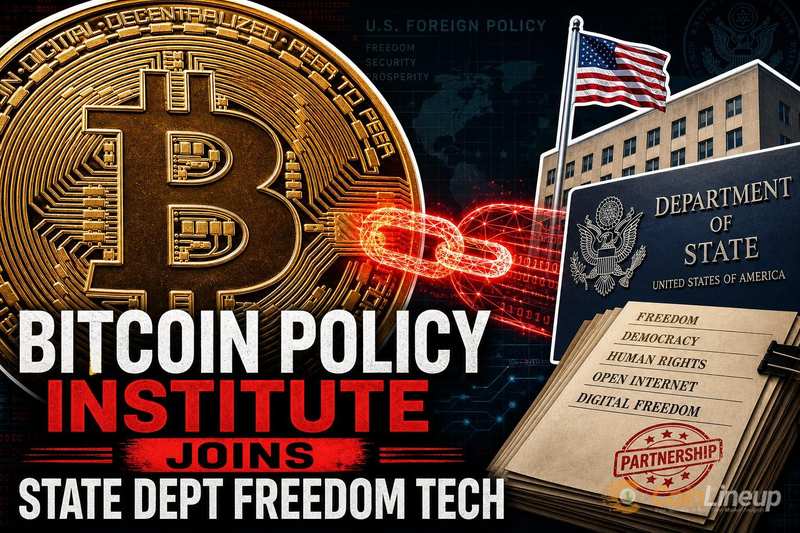
The Bitcoin Policy Institute has joined a U.S. State Department freedom technology initiative, connecting a Bitcoin-focused policy and advocacy organization with a federal program centered on technologies associated with digital rights.
What the announcement confirms
The confirmed development is specific in scope: the Bitcoin Policy Institute, an organization focused on Bitcoin policy research and advocacy, is now listed among participants linked to a State Department freedom technology effort.
The relevant reference is the U.S. State Department’s Global Partnerships Unit, which maintains a catalog of the agency’s current partnerships with outside organizations:
For now, the participation itself is the central fact. No confirmed launch date, funding amount, or detailed program scope has been attached to the pairing. Those details should not be assumed unless and until they are published through official channels.
Why the pairing is notable
The significance lies in the combination of a Bitcoin policy organization and a U.S. government initiative framed around freedom technology. In this context, freedom technology refers to tools that support open communication, privacy, and resistance to censorship.
That framing matters because Bitcoin is often discussed in policy debates through financial regulation, market structure, taxation, sanctions compliance, or consumer protection. A freedom technology setting places the conversation closer to questions about access, censorship resistance, privacy, and civil liberties, while still leaving the exact role of Bitcoin Policy Institute undefined.
Participation in a government-facing program can increase Bitcoin’s visibility in policy settings, shifting discussion from industry events and advocacy forums into formal public-sector environments. That represents a change in venue, not a confirmed change in law, regulation, or government policy.
The development also fits within a broader pattern of Bitcoin-related organizations pursuing more structured relationships with institutions. One recent example cited in related coverage was Strategy’s launch of a Bitcoin Security Consortium to coordinate industry-level work. The common feature is the effort by Bitcoin-focused groups to build formal institutional links rather than operate only at the edges of policy and industry discussions.
It is important to distinguish between signal and outcome. The listing indicates that Bitcoin policy voices are being included in a government-linked program. It does not, by itself, establish a regulatory shift, a policy result, or any market impact.
What remains unclear
The main unanswered issue is the role the Bitcoin Policy Institute will play in the initiative. Future official statements may clarify the program’s stated goals, the full list of participants, and how the institute’s involvement is defined.
A central question is whether the role is advisory, technical, educational, or directly policy-focused. Each would imply a different level and type of involvement, and the current information does not resolve that question.
The practical importance of the development will depend on concrete outputs, such as published programs, named partnerships, official deliverables, or additional public documentation. Until those are available, the institute’s participation should be viewed as a starting point rather than a completed policy result.
The development comes as institutional activity around Bitcoin continues across several areas, including ETF flows led by BlackRock’s IBIT and product moves such as Samsung Wallet adding native stablecoin support. A government-facing policy role sits alongside those developments as another example of Bitcoin’s expanding institutional presence, but its significance will depend on what the initiative publishes next.

