Bitcoin Miner Selling Slows as Exchange Flows Stay in Long-Term Downtrend
Key Takeaways
- •Miners sent 4,841 BTC to Binance over the past 30 days, accounting for 98.66% of miner transfers to exchanges.
- •Miner exchange flows have risen from recent lows but remain within a broader descending trend.
- •Bitcoin’s 2024 halving reduced block rewards, contributing to lower miner transfers by reducing new BTC issuance.
- •Larger mining companies may rely more on financing tools such as debt, equity offerings, hedging, and private liquidity instead of public exchange sales.
- •Analysts say subdued transfers would be more meaningful if miner reserves stabilize, while a breakout in flows with falling reserves could signal renewed sector pressure.
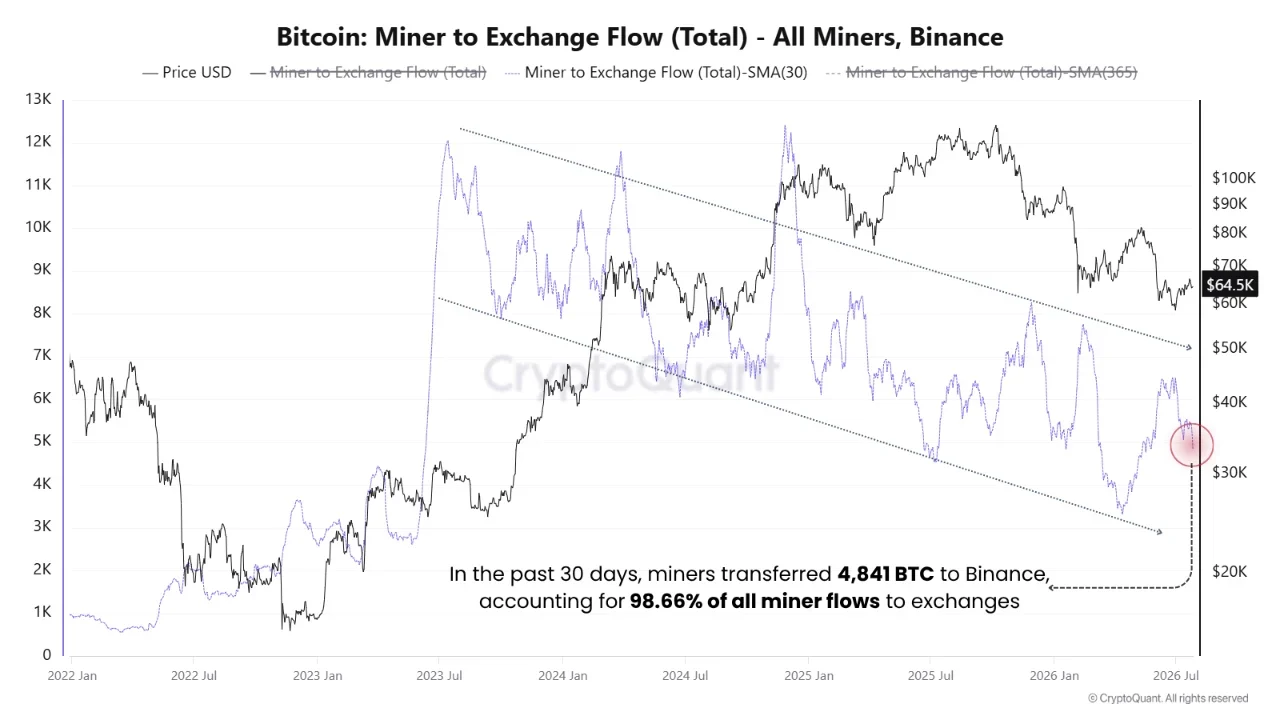
Bitcoin miner selling remains in a long-term downward trend, even after a recent increase in transfers to exchanges. On-chain data shows miners sent 4,841 BTC to Binance over the past 30 days, accounting for 98.66% of all miner transfers to exchanges during that period.
While exchange-bound flows have rebounded from recent lows, the broader pattern still indicates reduced miner-driven selling pressure. Miner exchange deposits are closely watched because mining companies receive newly issued BTC and often sell some coins to cover power, equipment, and financing costs. The data suggests miners are sending fewer coins to public exchanges while Bitcoin trades below recent highs, limiting the amount of new supply moving into the spot market. Analysts caution, however, that lower exchange flows alone do not confirm a bullish market and should be evaluated alongside other on-chain indicators, since exchange deposits do not always translate directly into immediate sales.
Bitcoin’s 2024 Halving Continues to Affect Miner Behavior
Part of the long-term decline in miner exchange transfers reflects the effect of Bitcoin’s 2024 halving. After block rewards were cut in half, miners began producing fewer BTC for the same amount of computational work. Because of that, lower transfers to exchanges are an expected consequence of reduced issuance and should not automatically be read as a sign of stronger confidence among mining companies.
The data also shows miner transfers have stayed within a descending channel despite several short-term increases. Recent flows rose from around 3,500 BTC toward 6,000 BTC as Bitcoin rebounded, suggesting some operators sold part of their production to meet operating costs. That increase faded quickly and did not break the broader downtrend.
The decline may also point to structural changes in the mining industry. Larger mining companies now have broader access to financing options, including debt, equity offerings, production hedging, and private liquidity arrangements. These funding channels can help operators pay expenses without immediately selling newly mined Bitcoin on public exchanges.
Lower available inventories may be another factor. Some miners have already distributed sizable portions of their holdings during earlier market rallies, leaving fewer coins available for future exchange deposits. Together, these developments suggest a more mature mining sector that relies less on continuous spot-market selling.
Why Miner Exchange Flows Matter for Bitcoin
The continued decline in miner selling is significant because it reduces one source of supply entering the market. Lower miner distribution can ease immediate selling pressure when investor demand remains stable, though it does not guarantee higher prices.
Analysts say the signal would become more meaningful if miner reserves stabilize while exchange transfers remain subdued. That combination would indicate miners are retaining a larger share of production rather than selling into market strength.
Conversely, a breakout above the descending channel, paired with falling miner reserves and weaker Bitcoin prices, would point to renewed financial pressure across the mining sector. Such a shift could force operators to increase exchange deposits and add fresh selling pressure to the market.
For now, Bitcoin miner selling continues to follow its broader downward trajectory despite recent market volatility. The latest data indicates miners remain under less pressure to distribute coins through public exchanges, leaving market structure more balanced as investors watch whether the trend continues.

