Zach Dell's Base Power Raises $1 Billion at $13 Billion Valuation as Home Battery Business Scales
Key Takeaways
- •Base secured $1 billion in a Series D round co-led by Ribbit Capital, Addition, Valor Equity Partners, and JP Morgan Chase's Strategic Investment Group, elevating the company's valuation to $13 billion in less than a year.
- •The company operates a membership-based model with a maximum $695 installation fee and a $19 monthly subscription, positioning itself as an infrastructure firm that earns revenue through wholesale power market operations rather than high-margin hardware sales.
- •Base has scaled to over 100 daily installations serving more than 30,000 customers and opened its first proprietary manufacturing facility in Austin, with a larger second plant slated for completion in 2027.
- •Base's in-house battery stores 39.2 kilowatt-hours of electricity and is specifically engineered as a grid resource, differing from systems designed primarily for electric vehicle charging.
- •The company has expanded from Texas into Illinois and intends to enter additional U.S. states next year while also targeting international markets including the U.K., Germany, and Australia.
Zach Dell has set an ambitious goal: installing a Base Power home battery system in every backyard across America—and eventually in Europe and beyond. With the U.S. residential retail electricity market valued at roughly $200 billion, the growth runway is substantial.
The son of Dell Technologies founder Michael Dell, Zach has carved out his own path in the energy sector. Just weeks shy of his 30th birthday, his company Base—co-founded in 2023—has secured $1 billion in a Series D funding round. The round pushed Base's valuation from $4 billion to $13 billion in less than a year.
"We want to bring Base to every neighborhood in America over time," Zach Dell told Fortune. "The scale of the opportunity is just massive and, of course, we do have global ambitions. We think markets like the U.K., Germany, Australia, and potentially others are attractive as well."
In three years, Base has scaled from installing one battery system per day to more than 100 daily, serving over 30,000 customers with that figure climbing steadily. Earlier this year, the company opened Base Factory 1, its own battery manufacturing plant in Austin, Texas. A significantly larger second facility is under construction and scheduled for completion in 2027.
Austin-based Base launched in Texas and recently expanded into Illinois. The company plans to enter additional states next year, operating either in deregulated electricity markets or through partnerships with monopoly utilities, a sign that its business model is being positioned for multiple market structures rather than a single state-by-state rollout.
A Membership Model for Home Power
Base's business model offers customers an all-in-one solution: electricity service and backup power delivered through a battery storage system rather than a conventional gas generator. Instead of paying $15,000 or more for a traditional backup power system, Base charges an installation fee of no more than $695 and a flat monthly membership of $19—an approach Dell compares to the Costco model. He argues that overall electricity costs are typically lower on average because the batteries generate savings by feeding power back to the grid.
During power outages, the battery—or an upgraded dual-battery system—keeps the lights on, provided the outage does not extend beyond two or three days. That combination of lower upfront cost and backup coverage helps explain why home batteries are drawing attention beyond early adopters, especially as more households look for ways to manage reliability without installing a conventional generator.
"Our business model, which is very unique, is that we're really an infrastructure company," Dell said. "We own and operate the assets in the wholesale power markets. That's really where we make our money, not by trying to sell the consumer something at a really high-margin upfront cost."
Investor Lineup
The Series D round was co-led by four firms: Ribbit Capital, Addition, Valor Equity Partners, and JP Morgan Chase's Strategic Investment Group. Dell confirmed that Base's other major existing investors also participated, including Thrive Capital, a16z, Lightspeed, Trust Ventures, CapitalG, and others.
"All the investors are really long-term oriented thinkers, given the size of the opportunity and the time it will take to kind of execute into it," Dell said. "We've made a lot of progress but, in the grand scheme of things, we're really just getting started."
Zach Dell's father, Michael Dell, is not directly involved in Base but serves as a mentor. The family name recognition has not hurt fundraising efforts—Michael Dell currently ranks as the fifth-wealthiest person in the world, behind Elon Musk, Jeff Bezos, and the Google co-founders, and just ahead of Mark Zuckerberg.
Building Batteries in House
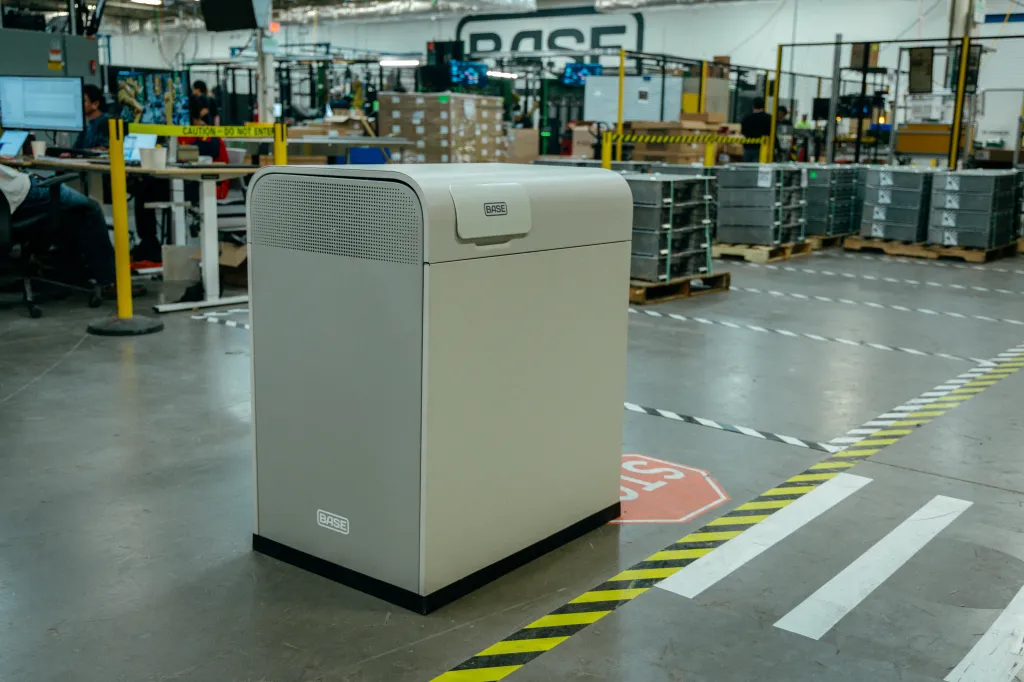
Before this year, Base relied on third-party batteries for its installations. The company now manufactures its own systems, designed specifically for powering homes and returning electricity to the grid—distinct from systems built primarily for charging electric vehicles.
"This battery is designed to be a grid resource," Dell said. "It's bigger, it installs faster, it switches over cleaner, it's more powerful, it has more duration."
Base offers a streamlined product lineup: one- or two-battery home systems. "Most people actually want two, but not everyone has room on the side of their house for two," Dell noted.
The new battery stores 39.2 kilowatt-hours of electricity, notably more than most competing products on the market.
As electricity demand surges amid the AI boom and grids across the country face mounting strain, Dell argues that Base benefits customers by strengthening local power infrastructure while maintaining electricity supply during grid failures. The company is also trying to use pricing to speed adoption in newer markets: with its expansion into Illinois, Base is testing promotional installation pricing of $95 for some prospective customers—well below the standard $695 fee.
"We're charging the batteries when prices on the grid are low, and we're discharging the batteries with demand when prices on the grid are high," he explained.
"We'll likely experiment with pricing based on market signals as we enter different markets," Dell said.
Source: Fortune
