Zcash Ironwood Upgrade to Lock Orchard Pool at Block 3,428,143
Key Takeaways
- •Ironwood will lock Zcash’s Orchard shielded pool, preventing transactions within it while allowing funds to exit.
- •The affected pool contains 3.76 million ZEC, or about 22% of the circulating supply, valued at roughly $1.89 billion.
- •The upgrade responds to a previously patched flaw that could have allowed undetected creation of fake ZEC.
- •Users are advised to enable network-level privacy tools before migration because public exit amounts could be linked to IP addresses.
- •Node operators must install Zebra 6.0.0 before the activation point, while some exchanges may pause deposits or withdrawals during the upgrade.
Zcash’s Ironwood upgrade is scheduled to go live on Tuesday at block 3,428,143, locking the network’s largest private pool. Funds held in that pool will remain safe, but users will only be able to move ZEC out of it, not transact within it.
The pool contains 3.76 million ZEC, valued at about $1.89 billion, or roughly 22% of all ZEC in circulation. Developers say most holders do not need to take immediate action before the upgrade.
Zcash uses shielded pools to support private transactions, with Orchard serving as the pool affected by Ironwood. Because shielded pools hide transaction amounts, upgrades that affect supply accounting carry operational and privacy implications beyond a normal wallet software update.
What Changes for ZEC Holders
For ZEC holders, the main message from developers is not to rush. Balances held in the locked pool remain intact, and existing addresses will continue to work because the new pool reuses them.
Wallet providers are still building the tooling needed to move funds from the old pool. Until a user’s wallet supports the migration process, funds in that balance may appear unable to move.
Node operators face a firm deadline. They must install the Zcash Foundation’s Zebra 6.0.0 release before Tuesday because that release sets the network’s switch-over point.
Some exchanges may temporarily pause deposits or withdrawals during the transition. Developers say such pauses would indicate that an exchange is behind on the upgrade process, not that the Zcash network itself is broken.
The new pool also introduces a quantum-related safeguard from ZIP 2005. If quantum computers eventually break today’s cryptographic assumptions, funds in the new pool could be rescued. Coins left in older pools could not. Developers have also stressed that this is not yet full quantum protection.
Network Privacy Risk During Migration
Moving funds out of the old pool is public. Observers can see the amount being moved, though they cannot see who sent it or who received it.
The risk comes from the network layer. A wallet communicates with a server, and that server can see the user’s IP address. If the public migration amount is linked with that network information, someone could connect a balance to a user.
“So for every user, the number one most important issue is having network-level privacy (i.e. Tor or Nym) before migrating,” Zooko Wilcox, who founded Zcash, wrote in the project’s user guidance.
Wilcox’s guidance is to enable Tor or Nym before migrating and then wait until the wallet provider says it is safe to move funds.
ZCASH IRONWOOD IS ALMOST HERE On 28 July, migrating your shielded ZEC can link your IP address to your balance. Strong on-chain privacy. Undone at the network layer. The Nym fix is here. 🧵👇 $ZEC #Zcash pic.twitter.com/I57kFjuDTY — Nym (@nym) July 27, 2026
Wilcox also warned users about scammers. Some are already pretending to offer Ironwood migration support.
Why Zcash Is Locking the Old Pool
The Ironwood upgrade follows the discovery of a bug in May. Taylor Hornby, a researcher at Shielded Labs, identified a flaw in the mathematics used to prove that Orchard payments are valid.
The vulnerability could have allowed someone to create fake ZEC without detection. ZODL, the Zcash Open Development Lab, patched the issue within days. Even so, ZEC fell more than 30% after the counterfeiting bug became public, dropping as low as $385.80.
A larger issue remained. Because Orchard hides every amount, nobody could prove that fake coins had never been created before the patch.
Ironwood addresses that by requiring funds to leave the old pool only through the turnstile. The turnstile functions as a counter and does not allow more ZEC to leave than entered. If fake coins exist, they are trapped inside the old pool forever.
That makes the migration both a user-facing wallet event and a supply-integrity check for the shielded pool. The more ZEC that exits through the turnstile, the clearer the public accounting becomes for coins that were previously represented inside Orchard’s private state.
“However, rather than merely asking users to migrate away from a deprecated pool, we are effectively forcing wallets to conduct Orchard transactions in the new pool,” Sean Bowe and Dev Ojha wrote in a joint statement from Project Tachyon and Valar Group.
The fix is supported by outside auditors and formal verification work, according to the source article.
Zcash Faced a Similar Issue in 2018
This is not the first time Zcash has dealt with a fake-coin vulnerability. In March 2018, cryptographer Ariel Gabizon found a counterfeiting bug in Sprout, Zcash’s first private pool.
The company kept the issue confidential for 11 months and included the fix in the Sapling upgrade that October. It published the full account in February 2019.
That earlier fix stopped new fake coins from being created, but it could not prove that old ones had never been made. Sprout was closed and left behind.
Eight years later, 22,747 ZEC still remain in Sprout. Nobody has ever broken the turnstile. The absence of such evidence is now treated as the strongest indication that nothing was counterfeited.
Ironwood follows a different approach. Instead of merely asking users to leave the old pool, it removes the practical reason to stay there.
What to Watch Over the Next 30 Days
The migration can now be monitored publicly. ZODL’s Ironwood dashboard shows funds leaving Orchard block by block.
If users migrate slowly, a significant amount of private ZEC could remain unusable for a period. If many users move at once, the supply check becomes stronger, but privacy may be reduced because more migration activity is visible at the same time.
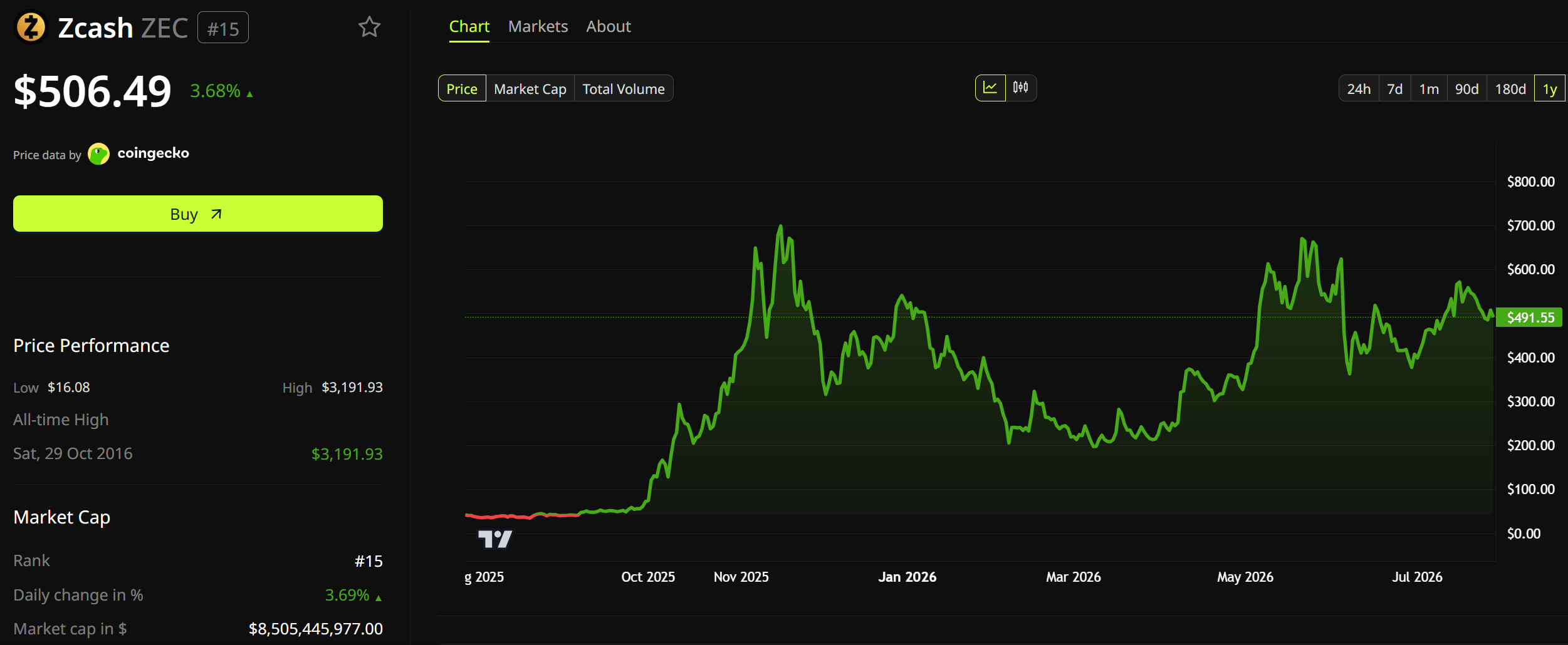
ZEC traded near $506 on Monday. It was up about 4% over 24 hours and 22% over one month, according to current Zcash price data cited by BeInCrypto. Over the past year, ZEC has gained more than 1,100%, a move that placed it in Forbes’ 2026 top 10.
The upgrade code appears ready, while exchange readiness remains an operational point to monitor.

