ChatGPT and Claude AI Say XRP Could Overtake Ethereum Before 2030, but Path Remains Unlikely
Key Takeaways
- •XRP would need to close a market capitalization gap of more than $150 billion to match Ethereum's current valuation, and would need to surpass whatever valuation Ethereum reaches by 2030.
- •ChatGPT estimates a 60% probability that Ethereum remains comfortably ahead, with only a 15% to 20% probability that XRP overtakes Ethereum temporarily or permanently.
- •Ripple's monthly escrow releases add 200 million to 400 million XRP to circulating supply, creating persistent selling pressure that demand must absorb for meaningful price appreciation.
- •Claude AI identified recurring institutional settlement volume as the most important catalyst for XRP, noting that partnerships and product announcements alone are insufficient for durable valuation growth.
- •Both AI models agreed that Ethereum's established decentralized finance ecosystem, developer network, and institutional infrastructure represent durable advantages that would be difficult for XRP to displace.
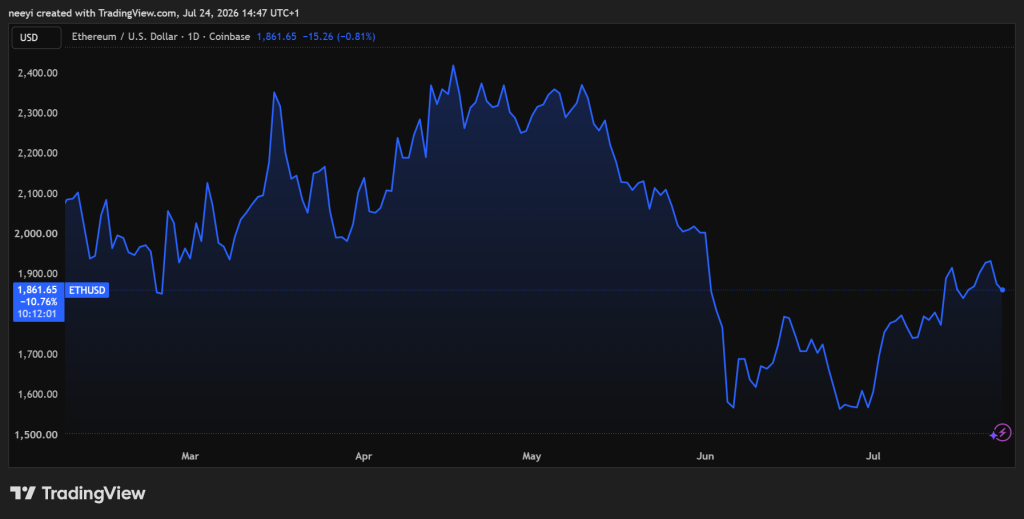
XRP trades near $1.11 with a market capitalization of about $69 billion, while Ethereum trades near $1,885 and is valued at roughly $227 billion. That leaves XRP needing to close a gap of more than $150 billion before considering any further growth in Ethereum's valuation.
ChatGPT and Claude AI were asked whether XRP could overtake Ethereum before 2030. Both models described scenarios in which such a move could happen, but neither identified it as the most likely outcome. The question touches on a theme familiar to the crypto community: the so-called "flippening," a term originally popularized during earlier cycles when observers speculated about Ethereum overtaking Bitcoin. Applying it to XRP and Ethereum highlights how much the competitive landscape has shifted as institutional adoption, regulation, and Layer 2 scaling have reshaped the market.
Ethereum Outlook Depends on Network Growth and Institutional Demand
Ethereum is trading near $1,885, around 62% below its all-time high of $4,953.73 recorded on August 24, 2025. The broader crypto market cooled after that peak, and profit-taking added pressure to ETH's price.
Spot Ethereum ETFs, which began trading in the United States in mid-2024, initially attracted new capital into ETH, but weaker winter inflows later reduced part of that institutional support.
Ethereum's Layer 2 expansion has also created a challenge for the main network. Rollups have reduced transaction costs across the ecosystem, but they have shifted some activity away from Layer 1. Lower Layer 1 usage has reduced fee burning and eased deflationary pressure on ETH supply. Since Ethereum's EIP-1559 upgrade introduced fee burning in 2021, lower base-layer activity directly translates into less ETH being removed from circulation.
Ethereum's chart shows support forming near $1,850. The price structure also resembles a possible W pattern, although ETH would need stronger buying activity to confirm a recovery.
The planned Glamsterdam upgrade could support Ethereum later in 2026. The upgrade is expected to introduce enshrined proposer-builder separation and expand Ethereum's Layer 1 capacity.
Tokenized real-world assets and institutional applications could also support Ethereum's broader ecosystem through 2030. Standard Chartered has maintained a $7,500 ETH price target for the end of 2026, a level that would require a major recovery from current prices.
XRP Outlook Depends on Demand Absorbing Escrow Releases
XRP trades around $1.11, nearly 70% below its July 17, 2025 peak of $3.65. Anticipation surrounding the expected resolution of Ripple's legal dispute with the SEC helped push XRP to that high. The SEC filed its original lawsuit against Ripple in December 2020, alleging that XRP was an unregistered security—a case that shaped the token's trajectory for years.
The token later entered a steep correction because much of the legal optimism had already been priced in. XRP eventually moved back toward the $1.10 area and has spent much of mid-2026 between roughly $1.10 and $1.15.
Ripple's monthly escrow releases remain a key factor in XRP's outlook. Estimates indicate that about 200 million to 400 million XRP can enter circulation each month. Ripple locks 1 billion XRP in escrow on the first of each month and releases whatever is not used back into a new escrow, but the net tokens entering circulation still add to available supply.
Transaction fees on the XRP Ledger remove a small number of tokens from circulation, but that amount remains too limited to offset the added supply from escrow releases. As a result, XRP demand must grow enough to absorb those tokens.
Large-wallet accumulation has reportedly increased during the correction, although broader demand remains subdued. Clearer digital-asset rules could improve that backdrop.
The CLARITY Act could give financial institutions more confidence in using XRP and Ripple's services in the United States. Legislative delays or restrictive provisions could instead keep XRP trapped in its current range for longer.
XRP Would Need to Beat Ethereum's Future Valuation
XRP does not only need to exceed Ethereum's current $227 billion market capitalization. It would need to overtake whatever valuation Ethereum reaches before 2030.
Analysts have presented XRP price targets between $5 and $28 under highly optimistic conditions. The lower end of that range could challenge Ethereum only if ETH remains weak. The upper end becomes necessary if Ethereum approaches a valuation near $1 trillion or more.
Circulating supply will affect the exact XRP price required. A future supply between roughly 62 billion and 100 billion tokens creates a wide range of possible outcomes.
For XRP to overtake Ethereum, several major conditions would likely need to align:
- Ripple secures a measurable share of global cross-border settlement activity.
- The CLARITY Act or similar legislation is approved and successfully implemented.
- Regulated XRP investment products record sustained institutional inflows.
- RLUSD creates recurring activity across Ripple's wider ecosystem.
- Developers build useful applications on XRPL sidechains.
- Demand absorbs XRP released from Ripple's escrow holdings.
XRP would not need to replace SWIFT entirely. SWIFT processes millions of financial messages daily connecting more than 11,000 institutions worldwide. Even a measurable share of major settlement corridors could strengthen XRP utility and support a much larger valuation.
Three Scenarios for an XRP-Ethereum Flippening
Different Ethereum outcomes would produce very different XRP price requirements. A strong Ethereum recovery would make the flippening much harder, while prolonged ETH weakness would lower the target substantially.
A Best-Case Scenario Requires Broad XRP Financial Integration
A broad crypto bull market could lift both assets before 2030. Under this scenario, Ethereum could reach $10,000, placing its market capitalization near $1.2 trillion.
XRP would need an exceptional adoption cycle to exceed that valuation. The CLARITY Act would need to pass, Ripple would need major banking integrations, and XRP-powered settlement would need to capture more than 5% of global interbank transaction volume.
Depending on circulating supply, an XRP price between approximately $20 and $23 could produce a valuation above $1.2 trillion. This scenario gives XRP its strongest fundamental case, but it depends on several major developments happening together.
A Rough Scenario Combines XRP Adoption With Ethereum Stagnation
Ethereum could remain near $3,000 if Layer 1 costs, Layer 2 fragmentation, regulatory restrictions, and rival networks weaken its growth. At that ETH price, Ethereum's market capitalization would be about $360 billion.
During the same period, XRP could benefit from clear legal treatment and wider institutional settlement use. Spot XRP products would likely need more than $5 billion in sustained inflows alongside measurable Ripple payment activity.
An XRP price near $6 to $7 could challenge a $360 billion Ethereum valuation. This route appears more achievable than the best-case scenario, but it relies heavily on Ethereum failing to regain stronger growth.
A Slim Scenario Depends on a Severe Ethereum Crisis
A serious code exploit or failure involving a major Ethereum protocol could damage confidence across the network. In an extreme case, ETH could fall toward $1,000, reducing Ethereum's market capitalization to about $120 billion.
Under those conditions, Ripple would not need to replace global banking infrastructure. RLUSD could instead process more than $2 trillion in annual network volume, while XRP could benefit from stronger regulatory treatment.
An XRP price between $2 and $2.50 could exceed a weakened Ethereum valuation near $120 billion. Any flippening driven mainly by an Ethereum crisis could be temporary, because an ETH recovery would quickly raise the XRP valuation needed to remain ahead.
ChatGPT Sees a Credible but Unlikely Path for XRP
ChatGPT considers an XRP flippening possible before 2030, but not the central expectation. Ethereum still has a larger developer community, deeper decentralized finance markets, stronger institutional infrastructure, and broader network demand.
A higher XRP price alone would not be enough. XRP's market capitalization would need to grow faster than Ethereum's valuation throughout the remaining years before 2030.
ChatGPT grouped the estimated outcomes into three broad categories:
- A 60% probability that Ethereum remains comfortably ahead of XRP.
- A 20% to 25% probability that XRP closes much of the valuation gap.
- A 15% to 20% probability that XRP overtakes Ethereum temporarily or permanently.
Those percentages are scenario estimates, not statistical forecasts. Regulatory decisions, institutional demand, network development, and broader market conditions remain difficult to predict several years in advance.
ChatGPT Places the Earliest Plausible Window Around 2028
ChatGPT identifies 2028 as the earliest plausible window for XRP to overtake Ethereum. A result in 2029 or 2030 appears more realistic because institutional adoption typically requires time to translate into recurring network demand.
An earlier outcome would require several developments in a compressed period. XRP ETFs would need strong inflows, Ripple would need major banking integrations, RLUSD usage would need rapid expansion, and Ethereum would need to underperform.
ChatGPT expects Ethereum could reach a market capitalization between $600 billion and $1.2 trillion under moderate conditions by 2030. If ETH supply remains near current levels, that range could imply an ETH price between approximately $5,000 and $10,000.
A weaker Ethereum outcome could leave its valuation between $300 billion and $500 billion. That would create an easier path for XRP, although ETH would likely need persistent network or regulatory problems.
ChatGPT's XRP Price Scenarios Range From $0.70 to $28
ChatGPT outlined four possible XRP price ranges based on different adoption outcomes.
An XRP price near $6 to $7 could overtake Ethereum if Ethereum's valuation remains close to $360 billion. XRP could need approximately $20 to $23 if Ethereum reaches a market capitalization near $1.2 trillion.
ChatGPT ultimately expects Ethereum to remain ahead through 2030. XRP still has a credible opportunity to reduce the gap if Ripple can convert institutional partnerships into recurring XRP demand.
Obstacles Could Limit ChatGPT's Bullish XRP Scenario
Regulatory clarity alone may not generate enough demand for XRP. Financial institutions could use Ripple's software without using large amounts of the token.
RLUSD growth may increase XRP Ledger activity, but that activity may not translate directly into a higher XRP price. Banks could also choose stablecoins, tokenized deposits, central bank digital currencies, or competing settlement networks.
Continued escrow releases create another hurdle. The market must absorb additional XRP supply before price appreciation becomes easier to sustain.
Ethereum could also address many of its current weaknesses. Network upgrades, greater tokenization activity, deeper decentralized finance markets, and stronger institutional products could preserve Ethereum's lead.
Claude AI Rejects Precise Odds but Reaches a Similar View
Claude AI considers an XRP flippening unlikely because several low-probability events would need to occur together. Ripple would need major institutional settlement activity, favorable regulation, and measurable XRP usage. Ethereum would also need to stagnate or suffer a major setback.
Claude declined to assign a specific probability to the event. Its reasoning was that a percentage such as 12% would create false precision around a complex mix of political, regulatory, technological, and financial variables.
Future market capitalization estimates face the same problem. Ethereum could range from $120 billion under an extreme crisis to $1.2 trillion under a strong growth scenario. XRP could therefore need anywhere from approximately $2 to $23, depending on Ethereum's performance.
Claude views that wide range as evidence of uncertainty rather than a reliable price forecast.
Claude Says Recurring XRP Usage Matters More Than Announcements
Claude identified institutional settlement volume as the most important catalyst for XRP. Partnerships, pilot programs, and product announcements can influence XRP's price temporarily, but durable valuation growth requires recurring use.
Three developments could provide that recurring demand:
- Regulatory clarity reduces legal risks for financial institutions.
- Ripple secures real transaction volume from global settlement corridors.
- RLUSD and XRPL sidechains produce consistent activity across the network.
Claude also noted that Ethereum has several durable advantages. Its decentralized finance ecosystem, application base, institutional products, and developer network would be difficult for another blockchain to replace.
Ethereum's technical roadmap could address lower Layer 1 fee burning and other current weaknesses. Its established position in tokenization and smart contracts gives ETH additional network effects that can expand over time.
Both AI Models Say Ethereum Remains the Favorite
ChatGPT and Claude AI used different approaches, but their conclusions were broadly aligned. Both said XRP has a possible route to overtaking Ethereum before 2030, but both also said Ethereum remains the more likely leader.
The outcome would depend on regulation, institutional demand, Ripple's ability to generate recurring XRP usage, Ethereum's network development, and the valuation Ethereum reaches over the rest of the decade.

