Tether’s XAUt Gold Token Receives Shariah Certification From Amanah Advisors
Key Takeaways
- •Amanah Advisors certified Tether’s XAUt token as aligned with key Shariah finance requirements.
- •Tether says each XAUt token represents one troy ounce of physical gold held in vaults in Switzerland.
- •Tether reported that XAUt was backed by more than 707,000 troy ounces of gold worth over $3.3 billion as of March 31.
- •RWA.xyz data cited in the article shows XAUt’s onchain asset value increased from about $700 million in July 2025 to roughly $2.5 billion.
- •The certification could reduce access barriers in Islamic finance markets such as the Gulf Cooperation Council, South Asia and parts of Africa.
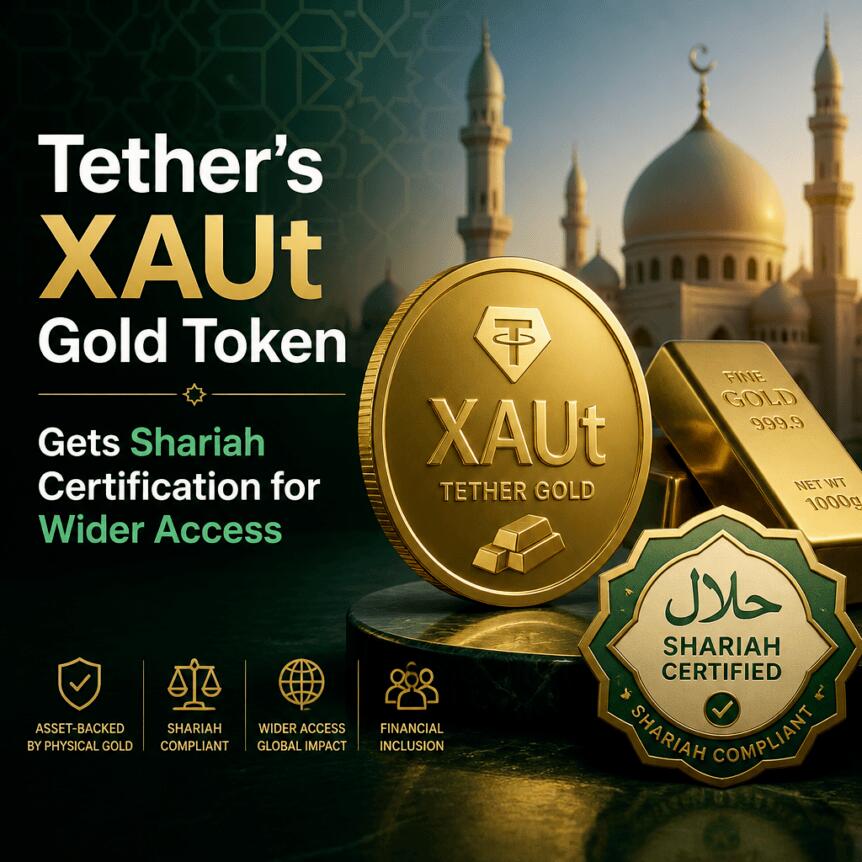
Tether’s gold-backed token XAUt has received Shariah certification from Amanah Advisors, a move the company says could broaden access to its tokenized gold product among Islamic financial institutions and investors seeking Shariah-compliant exposure to physical gold.
According to Tether, the certification found that XAUt’s structure is aligned with central requirements in Islamic finance. The company said the token is fully backed by physical gold, does not use interest-based mechanics, avoids leverage, and provides transparent reserve disclosures. Tether states that each XAUt token represents one troy ounce of physical gold held in vaults in Switzerland.
Shariah certification and tokenized gold
For investors and institutions that operate under Shariah principles, the key issue is often not whether gold itself is permissible, but whether the financial product used to access it is structured in an acceptable way. Islamic finance generally places restrictions on interest, excessive uncertainty, and speculative leverage, all of which can influence whether a tokenized product is considered compliant.
Tether’s certification is aimed at addressing that threshold issue. By obtaining formal Shariah certification for the structure of XAUt, the company is presenting its tokenized gold model as one designed for decision-makers governed by Shariah standards. Tether says this could reduce barriers in markets where Shariah compliance is a requirement rather than an optional feature.
In its announcement, Tether said it expects the certification to support adoption in regions where Islamic finance is widely used, including the Gulf Cooperation Council, South Asia, and parts of Africa. The certification may also matter for institutions that require external Shariah review before they can evaluate a product for custody, distribution, or balance-sheet use.
XAUt reserves and onchain growth
Tokenized gold products depend on whether the underlying metal is securely held and regularly disclosed. Tether points to reserve reports published on its website as evidence of XAUt’s backing and transparency.
In its most recent reserve reporting, Tether said XAUt was backed by more than 707,000 troy ounces of physical gold as of March 31, with a value of more than $3.3 billion. That reserve figure is significant because Shariah certification does not, by itself, resolve the operational question of whether a tokenized asset has sufficient physical backing for the tokens in circulation.
Onchain activity also indicates increased use of the product. Data cited from RWA.xyz shows XAUt’s onchain asset value rising from about $700 million in July 2025 to roughly $2.5 billion. Onchain valuations are not a substitute for verification of physical reserves, but they can indicate how broadly a tokenized asset is being held and used across blockchain-based venues.
Shariah-compliant digital assets develop into structured products
Digital assets have long been examined by Islamic scholars over whether they can comply with Shariah principles. Much of the debate has centered on whether participation in a given asset introduces prohibited elements such as interest, excessive uncertainty, or speculation.
More recently, structured digital asset products have emerged that attempt to address those issues directly rather than leaving compliance to individual interpretation. The trend reflects efforts across parts of the industry to design tokens around asset backing, transparent reserve models, and reduced exposure to interest-like returns. In that context, gold-backed tokens occupy a different category from unbacked crypto assets because their compliance case depends heavily on the treatment, custody, and disclosure of the underlying physical commodity.
Earlier coverage from Cointelegraph noted that Shariah-compliant approaches have been pursued in several ways. One example cited was AlAbraaj Restaurants Group, a Bahrain-based group that adopted a Bitcoin treasury strategy and said it planned to develop Shariah-compliant financial instruments to broaden access to Bitcoin across the Islamic world.
Palm Azgar Finance also expanded its Shariah-compliant PUSD stablecoin to ADI Chain, positioning the product for participation in what it described as the $3 trillion Islamic finance market. PUSD is designed to allow transactions to settle using either a dollar-linked asset or a dirham-denominated token on the same infrastructure.
Regulatory clarity has also played a role in regional expansion. Dubai has been described as a leading crypto hub in the Middle East as it continues to expand its regulated digital asset framework. Cointelegraph previously reported that Dubai’s Virtual Assets Regulatory Authority, or VARA, issued its 50th virtual asset service provider license earlier this month, exceeding the number of licensed crypto firms in Hong Kong and Singapore.
Adoption questions after certification
Following Amanah Advisors’ certification, the next issue is whether Islamic banks, funds, and Shariah-governed investors will translate compliance approval into measurable purchasing activity or integrations for XAUt.
Further announcements from Tether or ecosystem partners may clarify where XAUt will be made available, how it could be distributed through compliant channels, and whether ongoing reserve reporting continues to meet the transparency expectations that support Shariah assessments.

