Ghanaian Developer Builds AI-Powered Assistive Technology Designed for African Users
Key Takeaways
- •Steward Vision Assistant includes AI-powered smart glasses for recognizing currency, reading text, and describing environments, plus a handheld ultrasonic device that detects obstacles a white cane cannot reach.
- •The platform is tailored to African users by supporting the Ghanaian cedi and Ghanaian accents, with plans to add local languages such as Twi, Ga, Hausa, and Swahili.
- •The WHO estimates over 200 million people across the African region need at least one assistive product, a figure projected to double by 2050, yet only 5 to 15 percent of those in need in low- and middle-income countries currently have access.
- •Quartey self-funded early prototypes by teaching STEM classes, later winning Ghana's Disability Inclusive Hackathon in November 2024 with partner Angela Kona, reinvesting all prize money into product development.
- •User feedback from the Ghana Blind Union directly shaped multiple design iterations, including making the glasses lighter and repositioning the handheld device as a companion to the white cane rather than a replacement.
In February 2024, Emmanuel Quartey temporarily lost hearing in one ear. Everyday conversations became frustrating, and even routine interactions required noticeably more effort. The experience gave him a brief but vivid understanding of how the loss of a single sense can reshape daily life. A friend then posed a question that would alter his trajectory as an engineer: "Imagine it was your eyes. What would you do?"
At the time, Quartey was a second-year Information Technology student at Pentecost University in Ghana, where he was experimenting with computer vision and artificial intelligence. He had already spent years developing automation systems, robotics projects, and agricultural technologies. Assistive technology had never been on his radar — but the question lingered.
As he continued his work with computer vision, he began exploring how it could address challenges faced by people with disabilities. Days later, a friend cancelled a meeting to accompany her visually impaired friend, Angela Kona, to the hospital. When they eventually met, Quartey demonstrated a computer vision project capable of recognising currency and extracting printed text. Watching Kona use it convinced him he was onto something meaningful.
"That was when I realised this shouldn't remain just a project," he recalls.
Two years later, that experiment has grown into Steward Vision Assistant, an AI-powered platform that enables blind and visually impaired users to recognise currency, identify objects, read printed text, and navigate their surroundings more independently.
Building for African Realities
Steward arrives at a moment when artificial intelligence is transforming assistive technology. Capabilities that once demanded years of specialised engineering — including optical character recognition (OCR), computer vision, scene description, and speech recognition — can now be layered onto existing AI models. This allows smaller teams to concentrate on tailoring technology to local needs rather than building every feature from the ground up.
The need is substantial and growing. The World Health Organisation (WHO) estimates that more than 200 million people across the African region need at least one assistive product, a figure expected to double by 2050. Among them, an estimated 26 million people live with some degree of visual impairment, many relying on assistive technologies to read, navigate, and interact with greater independence. The WHO has also noted that across low- and middle-income countries, only an estimated 5 to 15 percent of people who need assistive products actually have access to them.
Ghana passed its own Persons with Disability Act (Act 715) in 2006, establishing a legal framework for accessibility and inclusion. Yet the availability of affordable, locally relevant assistive devices has not kept pace with the policy intent, leaving a gap that homegrown innovators are increasingly attempting to fill.
Despite the scale of demand, most advanced assistive technologies have been designed for users in developed markets, and importing them can cost thousands of dollars. AI-powered devices such as Envision Glasses, which start at approximately $1,900, can read printed text, recognise faces, identify objects, and describe a user's surroundings. Navigation aids like WeWalk, priced above $600, combine AI and sensors to help blind users move more safely. Free smartphone applications such as Be My Eyes, which connects blind users with sighted volunteers through live video calls, and Microsoft's Seeing AI, which narrates the visual world, have further broadened access — though both depend on consistent smartphone ownership and reliable internet connectivity that remain uneven across many African communities.
While these products and apps have expanded possibilities for blind users globally, Quartey saw room for adaptation to African contexts. Rather than replicating existing devices, he set out to build a platform shaped by the lived realities of its intended users.
"When we looked at some of the existing smart glasses, the currency detection didn't even include the Ghanaian cedi," he says. "If a Ghanaian bought those glasses, one of the most important features simply wouldn't work."
The same gap extended to speech recognition. Voice models trained primarily on American or British accents frequently struggle with African speech patterns. Quartey says his team has begun training its models to recognise Ghanaian accents and is exploring support for regional languages such as Hausa and Swahili. The team also plans to add Ghanaian languages, including Twi and Ga.
For Olamide Daniel, a disability inclusion consultant, that local focus is what gives products like Steward their significance. He notes that Africa has long depended on imported assistive technologies that are expensive and not always suited to the realities of users on the continent.
"It's encouraging to see people thinking about building assistive technology for local use," Daniel says. "Many of the products we use come from abroad, and they're expensive to bring in. Envision AI, for example, offers similar capabilities, but it's beyond the reach of many ordinary Africans. If Steward can deliver on what it promises and remain affordable, it could make a real difference."
From Prototype to Practical Tool
Steward currently consists of two devices designed for blind and visually impaired users.
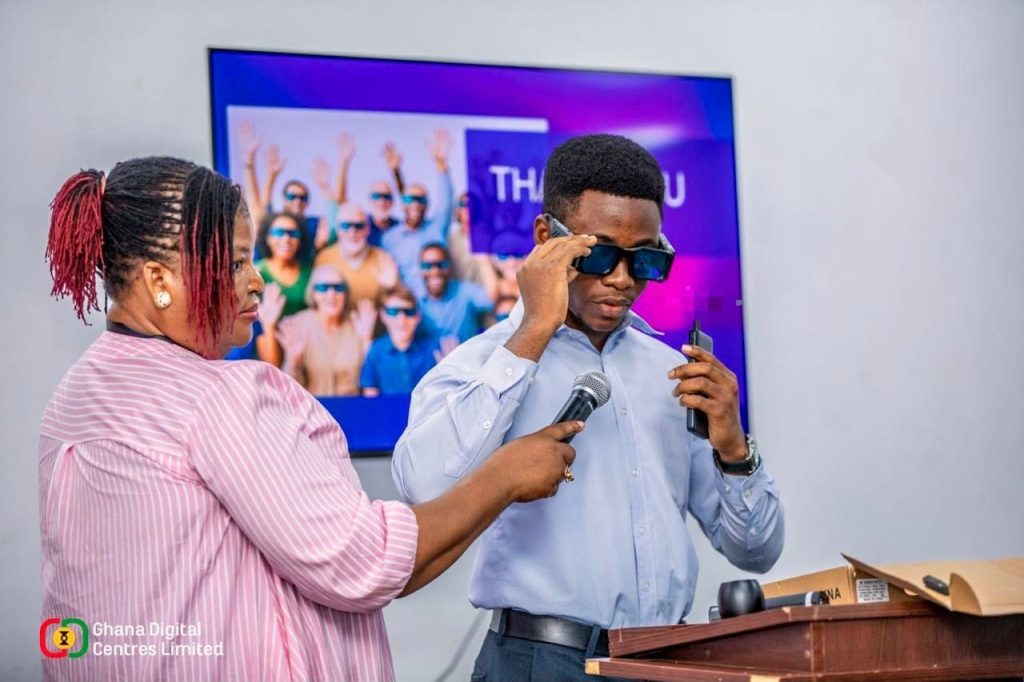
The first is a pair of AI-powered smart glasses combining a camera, computer vision, and generative AI to interpret visual information. Users point the glasses at printed text, currency, everyday objects, or unfamiliar environments, and the system analyses what the camera captures before delivering spoken descriptions through audio. It can also condense lengthy documents into shorter explanations, making printed information more accessible. Quartey says the text-reading feature was inspired in part by visits to schools for blind students, where he found Braille libraries stocked with outdated materials while newer textbooks remained unavailable.
The second device is handheld and uses ultrasonic sensors to detect obstacles above ground level. As users approach an object, the device responds with progressively stronger vibrations, alerting them to hazards such as hanging items, signposts, and tables that a white cane might not immediately catch.
This was not Quartey's original plan. "When I started building it, I thought I could replace the white cane," he says. "But when I engaged with visually impaired users, I realised the white cane actually does much more than I thought. It gives tactile feedback that technology cannot easily replace."
Those conversations reshaped Steward's design. Rather than replacing the white cane, Quartey repositioned the handheld device as a companion tool, detecting obstacles beyond the cane's reach while preserving a mobility aid users already trusted.
Feedback also drove hardware changes. During early testing with members of the Ghana Blind Union, participants reported that the first glasses prototype was too heavy and suggested refinements to frame size and button placement. Quartey says those discussions informed multiple design iterations before arriving at the current version.
William, a visually impaired user who tested Steward, says the object detection feature made a strong first impression. "It was able to detect things in my room, and it was lovely," he says. "I give it a pass. The first prototype was quite heavy, but it has improved. If it can become even lighter and more comfortable for extended use, it would be better."
User testing also surfaced an unexpected use case. While Quartey anticipated that practical features like currency recognition and text reading would be the main draws, many users gravitated toward the environment description tool. During one session, members of the Ghana Blind Union used it to hear descriptions of friends they had met only after losing their sight.
"They started using it to describe what their friends looked like," Quartey says. "Some of them had imagined their friends looked different."
Funding and Iteration
Before attracting institutional support, Quartey financed Steward's earliest prototypes by teaching robotics and STEM classes at private schools.
"I realised that if I waited until I had funding, I would never start," he says.
His experience reflects a broader challenge for assistive technology innovators across Africa, where funding remains one of the most significant barriers to moving products from prototype to market. According to AT4D, an initiative supporting assistive technology innovation, a large percentage of assistive technology entrepreneurs identify funding as their biggest obstacle to market entry. Venture capital flows on the continent have also tended to concentrate in sectors like fintech, leaving health and accessibility startups with fewer avenues for early-stage investment.
Those constraints were visible in Steward's earliest prototype. Unable to source suitable frames for the smart glasses, Quartey improvised with PVC pipes. The device functioned but was bulky and uncomfortable. Early testers said they would struggle to wear it for extended periods. Rather than settle, Quartey taught himself 3D modelling and printing to produce a lighter, more ergonomic frame. Each round of user feedback shaped the next iteration, reinforcing his conviction that effective assistive technology must be built with its users, not merely for them.
Steward's development also benefited from opportunities outside the lab. In November 2024, Quartey partnered with Kona — the same person whose early interaction with his computer vision project had convinced him it could become more than an academic exercise. Competing as Team CodeCraft Mavericks, they won Ghana's Disability Inclusive Hackathon. Quartey says every cedi of the prize money went back into improving the product's design, functionality, and user experience.
Affordability has since become a core principle. Rather than selecting premium materials or expensive components, Quartey says the team deliberately balances performance with cost to keep the technology within reach of its intended users.
William believes affordability will ultimately determine whether products like Steward can reach those who need them most. "I told him the price is not that much," he says. "But in Africa, where people struggle to pay for a lot of things, getting 2,000 cedis is quite a lot." He hopes Steward can partner with governments, disability organisations, and other institutions to subsidise the cost, broadening access across the region.
Looking Ahead
As Steward continues its pilot in Ghana, Quartey says the team's immediate priorities are refining existing features, improving the speed and performance of its AI models, and expanding language support. Although the platform already recognises Ghanaian accents, the team is working to add local languages including Twi and Ga, and is exploring support for other widely spoken African languages as it prepares to expand beyond Ghana.
Securing the funding required to transition from pilot testing to wider deployment remains another priority. Over the next year, Quartey aims to reach at least 1,500 users, beginning in Ghana before expanding into other West African countries, with Nigeria next on the roadmap.
For Quartey, Steward is about more than building another AI product. It is about demonstrating that assistive technology for African users should be designed around their realities rather than adapted as an afterthought.
"If technology is supposed to improve people's lives," he says, "then it should improve life for everyone."

