SpaceX Shares Drop 10% as $18.37 Billion Capital Spending Weighs on First Post-IPO Earnings
Key Takeaways
- •SpaceX's second-quarter revenue rose 92% year-over-year to $7.81 billion, exceeding Wall Street's consensus estimate of approximately $6.9 billion.
- •Capital expenditure reached $18.37 billion during the second quarter, with AI infrastructure alone accounting for $15.83 billion of that total.
- •Starlink subscribers doubled to 12 million, though average revenue per user declined 22.4% to $66 per month as the customer base expanded into broader markets.
- •The AI segment posted its first positive adjusted EBITDA of $1.15 billion but still fell short of covering its $1.89 billion in depreciation charges.
- •Up to 911.5 million shares could become eligible for trading on August 6, an amount exceeding the current tradeable float and potentially increasing market supply.
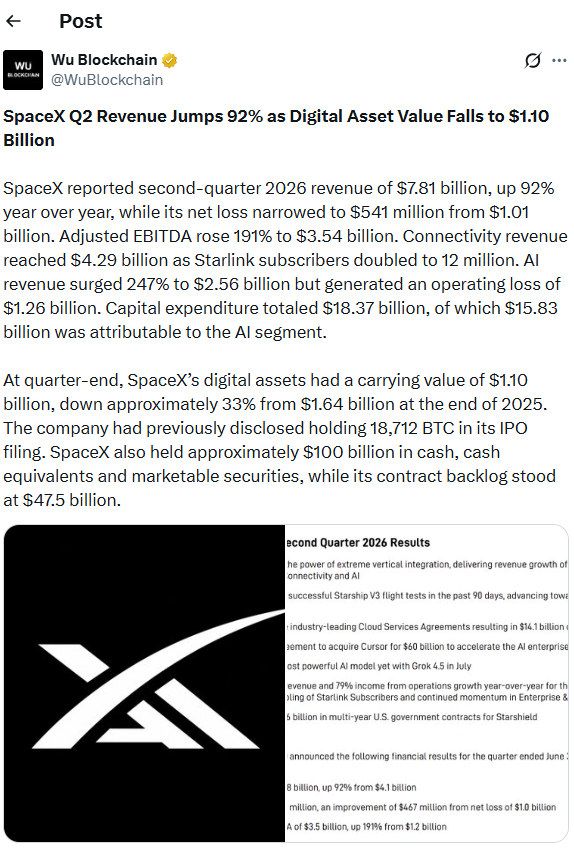
SpaceX stock declined sharply on Wednesday as investors digested the company's first quarterly earnings report since its public listing, focusing on a surge in capital expenditure that overshadowed stronger-than-expected revenue growth.
SPCX traded near $112.69 during the session, down approximately 10%. The shares had already fallen 7% in after-hours trading following Tuesday's earnings release. The stock also slipped below its $135 initial public offering price and remained well off its June record high of $225.64.
Q2 Revenue More Than Doubles but Spending Climbs Higher
SpaceX reported second-quarter revenue of $7.81 billion, up 92% from $4.07 billion in the same period a year earlier. The result surpassed Wall Street's consensus estimate of approximately $6.9 billion. The company posted a loss of 9 cents per share, narrower than the expected 26-cent loss.
Adjusted EBITDA rose 191% year-over-year to $3.54 billion. SpaceX also reduced its net loss from $1.01 billion to $541 million.
However, operating expenses and non-cash charges kept the company in the red. Depreciation and amortization totaled $2.85 billion, while share-based compensation reached $831 million. SpaceX also recorded $289 million in net interest expenses, $86 million in other expenses, and $23 million in taxes.
Capital expenditure climbed to $18.37 billion, up from $10.11 billion in the first quarter. Artificial intelligence infrastructure accounted for $15.83 billion of the quarterly total, meaning SpaceX spent more than twice its quarterly revenue on computing capacity, equipment, and other capital projects. At this scale, the company's capital deployment more closely mirrors the infrastructure spending profiles of major cloud computing platforms than those of traditional aerospace and defense contractors, which typically reinvest a modest fraction of revenue into property and equipment.
Traders Reprice the Gap Between EBITDA and Capex
The market reaction centered on the widening gap between adjusted EBITDA and capital expenditure. SpaceX generated $3.54 billion in adjusted EBITDA but allocated $18.37 billion to capital projects, leaving a quarterly shortfall of roughly $14.83 billion before other financing needs.
Management indicated that similar spending levels would continue through the third and fourth quarters. If that guidance holds, full-year capital expenditure could approach $65 billion. Investors will be watching whether that buildout translates into sustained AI segment operating income, given that the unit's positive adjusted EBITDA quarter has not yet covered its own depreciation charges.
SPCX opened near $112.69 and traded as much as 11.9% lower during the morning session, adding to a 7.6% after-hours decline following the earnings release.
Starlink Drives Profitability as Subscriber Base Doubles
SpaceX's Connectivity segment, which includes Starlink, delivered the strongest operating performance among the company's divisions. The unit generated $4.29 billion in revenue and $1.66 billion in operating income. Adjusted EBITDA for the segment reached $2.60 billion against capital expenditure of $1.37 billion, producing a quarterly cash surplus of approximately $1.23 billion before corporate costs.
Starlink subscribers doubled to 12 million, with more than 1.7 million users added during the quarter. Enterprise and government revenue also rose sharply.
At the same time, average revenue per user declined 22.4% to $66 per month, down from $85. The decline is consistent with the typical pattern seen when subscription services rapidly expand their user base into broader consumer and international markets, where per-user pricing tends to be lower than early adopter cohorts. The Space and AI segments posted operating losses of $542 million and $1.26 billion, respectively.
AI Expansion and Share Unlock Add Further Pressure
SpaceX intends to continue expanding its AI capacity through new computing projects and cloud agreements. The AI segment reported its first positive adjusted EBITDA quarter at $1.15 billion, though that figure remained below the unit's depreciation charge of $1.89 billion, meaning the business has not yet covered the cost of its deployed infrastructure.
The company also faces a significant share unlock on August 6. Up to 911.5 million shares could become eligible for trading, representing approximately 6.9% of total shares outstanding. That amount exceeds the current tradeable float and could increase market supply if early investors choose to sell. Post-IPO lockup expirations are a standard mechanism in public markets, and the resulting expansion of tradeable supply is closely tracked by investors as an indicator of insider sentiment.
SpaceX ended the quarter with $100 billion in cash and marketable securities against $39.4 billion in debt, providing management with flexibility to fund expansion, raise additional capital, or moderate spending.
