SpaceX Q2 2026 Earnings: $7.8 Billion Revenue Beat Meets an $18.4 Billion Capex Shock
Key Takeaways
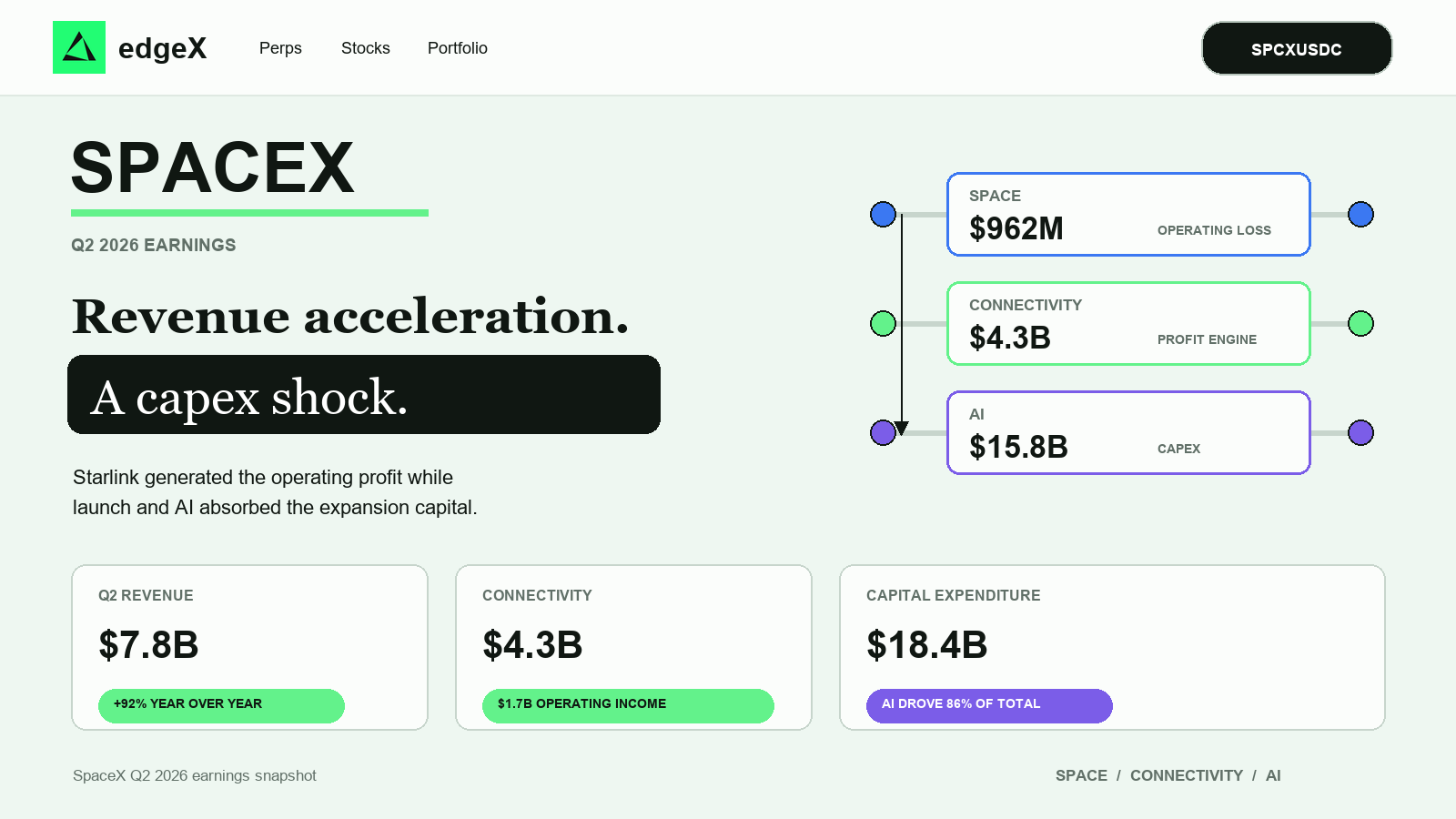
- •SpaceX’s Q2 revenue reached $7.814 billion, above analyst expectations and up from $4.071 billion a year earlier.
- •The company reported a $143 million operating loss and a $541 million net loss, both improved from the prior-year quarter.
- •Connectivity was the only profitable segment, producing $4.291 billion of revenue and $1.656 billion of operating income.
- •The AI segment generated $2.561 billion of revenue but accounted for $15.828 billion of capital expenditure, or roughly 86% of total capex.
- •SpaceX shares fell about 8% in after-hours trading after the earnings release, according to CNBC, as investors focused on higher-than-expected capital spending.
SpaceX's First Public Earnings Changed the Investor Story
SpaceX entered public markets with three businesses moving at very different speeds. Its first quarterly report since the June listing made those differences impossible to ignore. Revenue for the quarter ended June 30 reached $7.814 billion, up from $4.071 billion a year earlier. The operating loss narrowed to $143 million from $970 million, while the net loss improved to $541 million from $1.008 billion.
The headline beat was substantial. CNBC, citing LSEG, reported that analysts expected $6.93 billion of revenue and a loss of $0.26 per share. SpaceX delivered $7.81 billion and a loss of $0.09 per share. Yet the shares fell about 8% in after-hours trading, according to CNBC, as investors focused on capital expenditure that ran well beyond expectations.
That reaction captures the tension now facing SPCX shareholders. This is no longer only a launch company with a fast-growing satellite network. SpaceX is attempting to operate a launch platform, a global communications utility and an AI-computing business at the same time. Q2 offered evidence that the portfolio can grow rapidly. It did not settle whether the returns from the newer investments will justify their scale.
The Numbers Behind SpaceX Q2 2026 Earnings
The consolidated figures show a company approaching operating break-even while spending at a far greater rate than its income statement alone suggests.
| Metric | Q2 2026 Result | Investor Read |
|---|---|---|
| Revenue | $7.814 billion | Up 92% year over year and above consensus |
| GAAP operating loss | $143 million | Narrowed from a $970 million loss |
| GAAP net loss | $541 million | Improved from a $1.008 billion loss |
| Diluted loss per share | $0.09 | Better than the $0.26 consensus cited by CNBC |
| Adjusted EBITDA | $3.538 billion | Up 191%, led by Connectivity and AI adjustments |
| Capital expenditure | $18.369 billion | More than six times the prior-year level |
| Cash and marketable securities | About $100 billion | Reinforced by IPO and debt financing |
| Contracted backlog | $47.5 billion | Future demand indicator, not recognized revenue |
One precision point matters. The $143 million figure is the operating loss, not the net loss. The official net loss was $541 million. Likewise, the $18.369 billion figure is capital expenditure, not total operating spending. Treating either number loosely would distort the economics of the quarter.
Starlink Became the Profit Engine
Connectivity generated $4.291 billion of revenue, $1.656 billion of operating income and $2.597 billion of adjusted EBITDA. No other segment reported an operating profit. Starlink subscribers reached 12 million, double the year-earlier count, while average revenue per user was $66 per month.
Scale is turning network reach into earnings
The result suggests Starlink is moving beyond a subscriber-growth story. A satellite network requires heavy upfront investment in spacecraft, launches, ground equipment and customer terminals. Once coverage and capacity are in place, however, additional subscribers can improve network economics if service revenue grows faster than the cost of expanding and maintaining the constellation.
That operating leverage is visible in Q2. Connectivity supplied more than half of consolidated revenue and enough operating income to offset losses elsewhere. It also gives SpaceX a recurring relationship with consumers, enterprises and governments, making the company less dependent on the timing of individual launches.
Starlink carries concentration and execution risk
The same figures reveal concentration. The broader company remained loss-making even though Connectivity earned $1.656 billion at the operating line. Service quality, terminal economics, spectrum access, regulatory approvals and competition therefore matter to the entire investment case, not just one division.
Subscriber growth also cannot be evaluated in isolation. Investors should track average revenue per user, churn, regional mix, constellation replacement costs and capacity per satellite. A network can add users while returns weaken if pricing falls or capital needs rise faster than service revenue.
Launch Operations Remained Strategically Essential and Unprofitable
The Space segment reported $962 million of revenue, a $542 million operating loss and a $205 million adjusted EBITDA loss. Capital expenditure was $1.174 billion. Those numbers look modest beside the AI buildout, but they remain central to the company's strategic architecture.
Vertical integration lowers dependence on outside launch providers
SpaceX can place Starlink satellites into orbit using its own rockets, coordinate launch schedules with network needs and retain economics that would otherwise go to a third party. The launch business also serves commercial and government customers, diversifying demand and reinforcing technical credibility.
The trade-off is that development programs can consume capital before they support regular revenue. Starship is expected to expand payload capacity and lower launch costs if it reaches reliable operations, but Q2 did not eliminate schedule, engineering or regulatory risk. The value of the Space segment depends on converting technical progress into repeatable missions and better unit economics.
The launch loss is easier to tolerate when Connectivity compounds
Investors may accept losses in launch development when those investments protect and expand a profitable communications network. That logic becomes less comfortable if Starlink growth slows or launch milestones slip. SpaceX's integrated model is a strength only when the parts reinforce one another economically, not merely technologically.
AI Revenue Arrived, but Capital Intensity Dominated the Quarter
The AI segment reported $2.561 billion of revenue, a $1.257 billion operating loss and $1.146 billion of adjusted EBITDA. It ended the quarter with 1.4 gigawatts of compute capacity and $14.1 billion of contracted cloud sales. Those figures establish that SpaceX's computing effort is already commercially meaningful.
$15.8 billion of AI capex raised the valuation hurdle
AI capital expenditure reached $15.828 billion, accounting for roughly 86% of companywide capex. That is the number that changed the market's reading of the revenue beat. Compute infrastructure can produce long-lived revenue, but it requires processors, power, cooling, networking and facilities before the contracted sales convert into cash returns.
Contracted cloud sales provide visibility, not certainty. Investors need to know the duration of those commitments, customer quality, pricing, utilization and the operating costs required to fulfill them. A backlog can support a bullish case while still producing weak returns if the assets are expensive or become obsolete quickly.
The proposed Cursor deal adds another layer of risk
SpaceX disclosed a proposed $60 billion acquisition of Cursor, extending the strategy from physical compute infrastructure toward software. The combination could create a more complete AI platform, but it would also increase integration and valuation risk. Shareholders must judge whether SpaceX has a genuine advantage in linking orbital communications, data infrastructure and AI services, or whether the company is stretching management attention across too many capital-intensive markets.
Adjusted EBITDA and GAAP Tell Different Parts of the Truth
Adjusted EBITDA rose to $3.538 billion from $1.214 billion, an impressive increase that shows the earning power management sees before interest, taxes, depreciation, amortization and selected adjustments. The measure is especially useful for comparing segment momentum when depreciation from large infrastructure investments can obscure current operating trends.
It is not a proxy for cash left over for shareholders. SpaceX still posted a $541 million GAAP net loss, and capital expenditure exceeded adjusted EBITDA by almost $15 billion. Depreciation may be non-cash in the current quarter, but the assets being depreciated required cash to build and may require further spending to replace.
The most balanced interpretation is that operations are scaling faster while free-cash-flow pressure remains intense. Investors should resist both extremes: the GAAP loss does not erase the progress in Connectivity, and adjusted EBITDA does not erase the cost of the expansion.
The Balance Sheet Buys Time, Not Automatic Returns
SpaceX ended June with $93.522 billion in cash and $6.487 billion in marketable securities. Current debt and finance-lease obligations were $2.525 billion, while long-term debt and finance leases totaled $36.839 billion. The company received approximately $85.7 billion of net IPO proceeds and issued $25 billion of bonds in June.
Financing capacity supports a multi-year buildout
During the first half, operating activities generated $3.466 billion of cash, investing activities used $34.487 billion, and financing activities supplied $100.291 billion. The balance sheet can therefore absorb spending that would be impossible for a smaller company. It also reduces the risk that SpaceX must curtail projects after one weak quarter.
That cushion should not be confused with economic proof. IPO and bond proceeds are financing, not operating performance. If investment outflows persist near the current pace, the market will eventually demand clearer evidence of utilization, margins and cash conversion from the AI assets.
The Bull Case, Bear Case and Middle Path for SPCX
The bull case is that Starlink becomes a global cash engine while launch improvements lower the cost of expanding it. AI capacity then opens a third growth curve, supported by contracted demand and a network advantage that conventional cloud providers cannot easily reproduce. Under that outcome, today's capex creates infrastructure with durable pricing power.
The bear case is that SpaceX is using the proceeds of a landmark listing to pursue too many ambitions at once. AI hardware depreciates quickly, the Cursor transaction adds execution risk, launch development remains loss-making, and Connectivity must carry the portfolio. Revenue can grow rapidly in that scenario without producing an adequate return on invested capital.
The middle path is a long transition. Starlink remains profitable, launch operations improve unevenly, and AI revenue grows while margins lag investment. SPCX could then trade less like a mature communications company and more like a capital-cycle stock, sensitive to backlog conversion, funding costs and every revision to expected capex.
What SpaceX Investors Should Watch Next
The next report should be read through five connected checkpoints: Starlink subscriber growth and average revenue per user, Connectivity operating margin, launch cadence and Starship milestones, AI utilization and contracted-sales conversion, and total capital expenditure against operating cash flow.
Investors should also watch how management finances the proposed Cursor transaction and whether it provides segment-level detail sufficient to assess returns. The $47.5 billion backlog is encouraging, but the quality and timing of that revenue matter as much as the headline amount.
Q2 showed that SpaceX can produce exceptional top-line growth and a powerful recurring-profit engine. It also showed that the company is willing to spend far ahead of current earnings. The next phase of the SPCX story will be determined by whether that spending builds a defensible platform or simply raises the amount of capital required to keep the vision moving.
Trade SpaceX Stock 24/7 with Perpetual Futures on edgeX
SpaceX earnings, launch milestones and AI announcements can change expectations outside regular U.S. market hours. edgeX gives eligible traders access to crypto, commodity and stock-linked perpetual markets through a self-custodial trading platform.
Access the SPCXUSDC market
The SPCXUSDC perpetual market provides a SpaceX-linked contract for expressing long or short views. Traders should check the product page for current leverage, funding, fees, liquidity, order availability and contract specifications before opening a position.
Understand the instrument and its risks
Perpetual futures are derivatives, not SpaceX common stock. They do not provide ownership, voting rights, dividends or other shareholder rights. Leverage magnifies gains and losses and can lead to liquidation. Availability varies by jurisdiction, and self-custody does not remove market, smart-contract, liquidity or execution risk.
Frequently Asked Questions
When did SpaceX release its Q2 2026 earnings?
SpaceX released its second-quarter results on August 4, 2026. The quarter ended June 30, and the report was the company's first quarterly earnings release after its June IPO.
What was SpaceX's Q2 2026 revenue?
SpaceX reported revenue of $7.814 billion, up 92% from $4.071 billion in the prior-year quarter.
Was SpaceX profitable in Q2 2026?
No. SpaceX reported a $143 million GAAP operating loss and a $541 million GAAP net loss. Adjusted EBITDA was positive at $3.538 billion, but that measure excludes several costs and should be considered alongside GAAP results and capital expenditure.
How much did SpaceX spend on capital expenditure?
Total Q2 capital expenditure was $18.369 billion. The AI segment accounted for $15.828 billion, or roughly 86% of the total.
Which SpaceX segment was profitable?
Connectivity was the only segment with positive operating income. It generated $1.656 billion of operating income on $4.291 billion of revenue.
Why did SPCX shares fall after the earnings release?
CNBC reported that the stock fell about 8% after hours as investors focused on capital expenditure that exceeded expectations, even though revenue and the per-share loss were better than consensus.
Is the SpaceX share price in this article live?
No. Verify the latest SPCX quote through Nasdaq, a broker or a real-time market-data service before making a trading decision.

