Wall Street Keeps Buy Ratings on IonQ, Rigetti and D-Wave as Money-Flow Data Weakens
Key Takeaways
- •Wedbush and other analysts maintain buy ratings on IonQ, Rigetti, and D-Wave despite recent stock price drops of 24% to 36%.
- •Options traders are showing increased bullish sentiment for these quantum computing stocks, but Chaikin Money Flow indicators remain negative, signaling institutional selling.
- •Insiders across the three companies have sold approximately $988 million in stock since 2021 with virtually no purchases.
- •IonQ reported a 755% increase in first-quarter revenue and a 554% jump in its order backlog.
- •D-Wave Quantum holds buy ratings from ten analysts with targets up to $43, even as a technical model indicates a 72% Strong Sell signal.
Wedbush, a multibillion-dollar US investment firm, continues to rate three of the market’s closely watched quantum computing stocks as buys, even as recent trading data points to pressure from larger holders.
IonQ (NYSE: IONQ), Rigetti Computing (NASDAQ: RGTI), and D-Wave Quantum (NYSE: QBTS) have each corrected sharply this month, falling between 24% and 36%. Despite those declines, buy ratings issued earlier in the spring remain in place and have not been lowered to hold or sell. At the same time, money-flow indicators show a different picture from the one suggested by analyst targets and options activity.
The split matters because listed quantum companies are still being valued on a mix of early revenue, order pipelines, government support and expectations for future technical progress. In that kind of market, analyst ratings, options positioning, insider activity and money-flow data can point to different time horizons rather than a single consensus view.
IonQ (NYSE: IONQ)
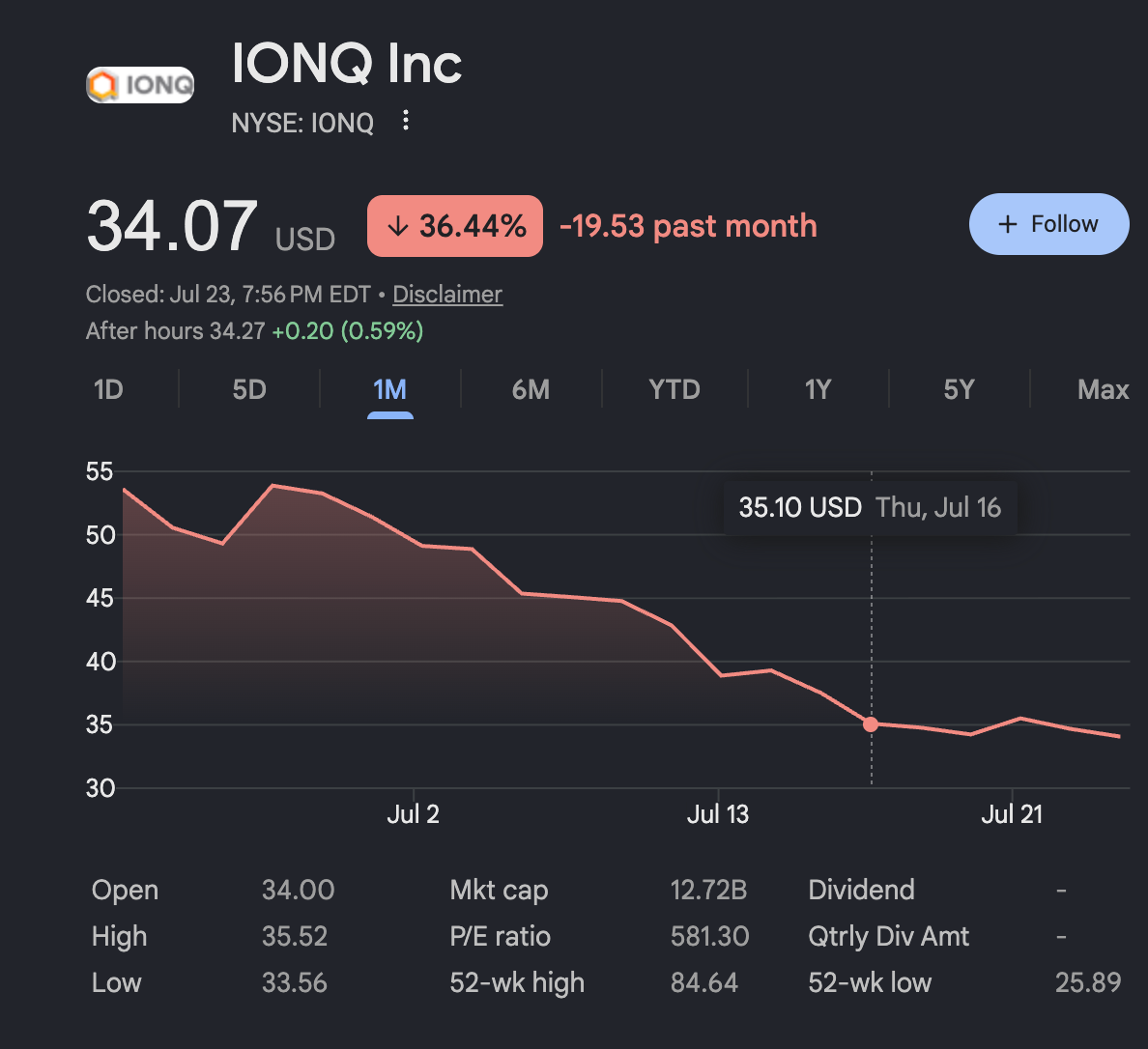
IonQ shares have dropped 36% this month to $34.07, well below the stock’s $84.64 high. Even after that decline, IonQ remains the largest of the three companies by market value, at about $12.7 billion.
The company’s business has also been expanding quickly. IonQ reported that first-quarter revenue rose 755% to $64.7 million. Its order backlog, meaning work sold but not yet delivered, increased 554% to about $470 million, and the company said it held roughly $3.1 billion in cash. IonQ also said it sold its first 256-qubit quantum computer to the University of Cambridge.
Analysts have kept their calls unchanged following the decline. Rosenblatt maintains a buy rating with a target near $100, Wedbush has a $75 target, and Northland has a $70 target. Those targets date to May and June.
Dan Ives, the widely followed former Wedbush analyst whose AI ETF surpassed $500 million within months of launch, has been one of the most prominent voices on the sector. He has described quantum computing as a derivative play on the AI boom and has said he expects the Trump administration to take an equity stake in companies such as IonQ. Those drivers are somewhat dated, although more recent signals have not necessarily contradicted them.
Wedbush still runs and manages the IVES ETF despite Daniel Ives’ departure.
IonQ’s put-call ratio, which compares bearish put bets with bullish call bets, fell from 2.69 on July 16 to 0.45 by July 23. That shift indicates that options traders became sharply more bullish over the period.
However, Chaikin Money Flow, a commonly used proxy for institutional buying and selling, remained deeply negative at around -0.46. The contrast suggests that traders may be positioning for a near-term catalyst, while money-flow data indicates that larger holders have been selling. Because options markets can reflect short-term speculation or hedging, the divergence does not automatically invalidate the analyst targets, but it does show that the stock’s near-term trading tone is weaker than the headline ratings imply.
I've never seen $IONQ Net Options Sentiment above 70 before.. something is happening! pic.twitter.com/mIY9zKCAcW — Cori Arnold (@iamcoriarnold) July 23, 2026
I've never seen $IONQ Net Options Sentiment above 70 before.. something is happening! pic.twitter.com/mIY9zKCAcW
One tracked account also flagged IonQ options sentiment above 70 for the first time.
Rigetti Computing (NASDAQ: RGTI)
Rigetti Computing has fallen 24% this month to $14.85. Compared with the other names, the company relies more heavily on government funding than on sales.
Rigetti said it secured $100 million from the US Department of Commerce over three years as part of a broader federal package, in exchange for a small ownership stake. The company also launched a 108-qubit quantum computer, called Cepheus-1, on major cloud platforms.
Analyst coverage remains limited, but buy ratings near $40 from Rosenblatt and Wedbush remain in place, with no downgrade following the stock’s decline.
The same divide appears in Rigetti’s trading data. Its put-call ratio fell from 1.09 on July 16 to 0.48 on July 23, showing a clear bullish tilt in options trading.
Yet Rigetti’s Chaikin Money Flow also stayed negative, near -0.24. That means the outflows conflict with the optimism visible in options positioning.
The pattern again indicates that institutional investors are not currently providing the same support for quantum stocks that options traders appear to be signaling. For Rigetti, the next financial test is also different from IonQ’s: investors are weighing federal funding and platform availability against a smaller commercial revenue base.
D-Wave Quantum (NYSE: QBTS)
D-Wave Quantum shares have fallen 26% this month to $17.10, although the company already generates revenue from paying customers.
The company reported first-quarter revenue from more than 100 customers, most of them businesses. New orders increased about 2,000% to $33.4 million, even as revenue fell 81% to $2.9 million. D-Wave’s machines are designed for optimization problems, such as scheduling, rather than code-breaking. That distinction shows that the current wave of interest in quantum stocks is not centered on breaking Bitcoin.
The tension between analyst views and market indicators is clearest in D-Wave’s case. Ten analysts maintain buy ratings with targets as high as $43, with no hold or sell ratings. However, Barchart’s own technical model shows a 72% Strong Sell signal. Wedbush is again among the firms with a buy rating.
That bearish technical signal aligns with the money-flow data. D-Wave’s Chaikin Money Flow is negative near -0.24, while its put-call ratio eased only from 1.19 on July 17 to 0.76 on July 23. That was the weakest bullish shift among the three stocks.
As a result, D-Wave’s older buy ratings appear the most extended relative to current trading indicators.
Part of the bullish argument for quantum companies is that the underlying science continues to advance. Google Research said last week that it improved quantum error correction by 3.5 times, a step toward quantum machines that can operate more reliably.
Today we announce a new paradigm for quantum control. By integrating reinforcement learning with quantum error correction, we enabled a quantum computer to continuously adapt to drift, stabilizing the system during computation. This improved logical stability 3.5x. Learn more:… pic.twitter.com/R6u32w47tf — Google Research (@GoogleResearch) July 22, 2026
Today we announce a new paradigm for quantum control. By integrating reinforcement learning with quantum error correction, we enabled a quantum computer to continuously adapt to drift, stabilizing the system during computation. This improved logical stability 3.5x. Learn more:… pic.twitter.com/R6u32w47tf
Scientific progress is relevant to the sector, but it is not the same as near-term revenue conversion for any single public company. That is why earnings reports, backlog updates, order quality and customer adoption remain important alongside technical milestones.
Still, a similar concern applies across all three companies. Insiders have sold about $988 million of stock since 2021, with almost no buying, even as retail options positioning has turned more bullish.
Quantum Computing Stocks IonQ, Rigetti, and D-Wave Are Sending Shockwaves Through Wall Street With This $988 Million Warning — The Right News, Right Now. (@BradPorcellato) July 22, 2026
Quantum Computing Stocks IonQ, Rigetti, and D-Wave Are Sending Shockwaves Through Wall Street With This $988 Million Warning
The result is a split signal: analyst buy ratings and bullish options positioning point in one direction, while insider selling and institutional money-flow indicators point in another. Whether these quantum stocks can sustain their gains likely depends on earnings growth arriving before investor patience fades.

