Pi Network Price Forecast Tracks Volatile PI Trading Through 2032
Key Takeaways
- •PI traded at $0.0813 on July 25, 2026, down 1.98% over 24 hours, with sellers still controlling the broader trend.
- •The token’s key near-term support was around $0.080, while resistance levels were identified near $0.085 and $0.090.
- •Cryptopolitan forecast PI to trade between $0.07845 and $0.3695 in 2026, with an average price of about $0.2239.
- •Pi Network has introduced ecosystem updates including Pi2Day products, Pi App Studio enhancements, Protocol v25 and SLICE testnet token distribution.
- •The source cited major risks including enclosed mainnet limitations, ongoing token unlocks, monthly supply inflation and concentrated token holdings.
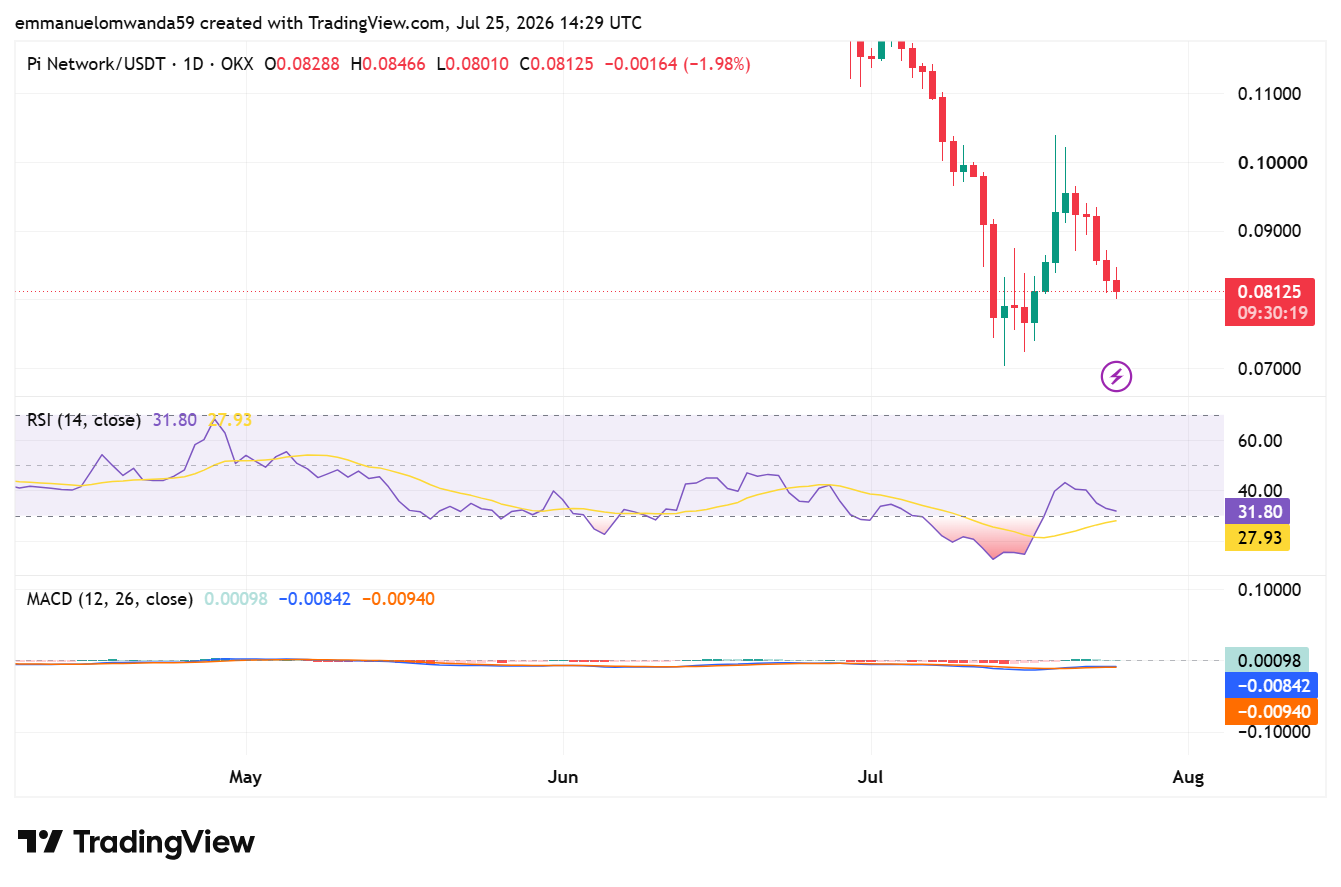
Pi Network price analysis points to continued volatility below $0.110, with Cryptopolitan’s forecast placing PI’s maximum price at $0.3695 in 2026 and $1.71 in 2032.
Pi Network was launched in 2019 as a mobile-first cryptocurrency designed to make digital assets accessible to average users. PI reached an all-time high of $2.98 in February 2025, according to the source, before a prolonged decline. In July 2026, the token fell to a new all-time low of $0.0805 amid increased selling pressure.
The project has recently focused on ecosystem growth and infrastructure upgrades, including Protocol v24 improvements, Pi Nodes update expansion, and Pi2Day products such as PiVerify, Pi Sign-in, and SoloHost. These products were introduced to expand practical utility across the Pi ecosystem. For readers following PI, those upgrades matter because the token’s longer-term valuation case is tied less to short-term chart signals alone and more to whether the network can support usable applications, verified users, and external integrations.
Pi Network technical analysis
As of July 25, 2026, Pi Network was under bearish pressure after buyers failed to maintain a recent recovery. At the time of writing, PI traded at $0.0813, down 1.98% over the previous 24 hours. The source said sellers remained in control of broader price action.
On the daily chart, PI had given back part of the previous week’s recovery after failing to hold above resistance at $0.090. Sellers pushed the token back toward the $0.080 support zone, keeping the trend bearish. Immediate support stood at $0.080, while resistance was around $0.090. A loss of support could lead PI to retest recent lows, while a move above $0.090 could allow buyers to challenge the $0.100 psychological level.
Trading activity had slowed, with 24-hour volume falling to $9.01 million. PI also remained below the 50-day simple moving average at $0.1394 and the 200-day simple moving average at $0.1728, which the analysis said confirmed that the longer-term trend continued to favor sellers.
The relative strength index fell to 31.80, just above the oversold region. The reading indicated that selling pressure remained strong, while also approaching levels where buyers could begin looking for a short-term recovery. The MACD stayed bearish despite early signs of stabilization. The histogram had started to flatten, but the MACD line remained below the signal line.
Four-hour chart analysis
The four-hour chart showed PI trading under short-term bearish pressure near $0.082. Buyers were attempting to defend the current support zone, while sellers continued to limit recovery attempts. Although the recent decline had slowed, PI was still trading below recent swing highs, leaving the short-term trend tilted downward.
The first resistance level was around $0.085, with immediate support near $0.080. A move above $0.085 could allow PI to test $0.090 again. A break below $0.080 could take the token back toward recent lows.
The four-hour RSI recovered to 35.09 after rising from oversold conditions, but it remained below the neutral 50 level. The source said this showed that selling pressure had eased slightly, though not enough to shift momentum toward buyers. The MACD also remained bearish, with the MACD line below the signal line. However, the gap between the two lines was narrowing and the histogram was flattening, suggesting bearish momentum was easing and the market could stabilize if buying interest strengthened.
Support, resistance and short-term outlook
Traders also use Fibonacci retracement and other technical indicators with exponential moving averages to assess support, resistance, and possible pullbacks over the coming days or the next week. These tools are backward-looking market indicators rather than guarantees, so the cited levels are best read as reference points used by traders to frame risk and momentum.
PI was expected to remain under pressure while trading below $0.085 resistance, with $0.080 serving as the key support level. A break above resistance could trigger a recovery toward $0.090, while a loss of support could lead PI to retest recent lows.
The source said PI was down 1.65% over 24 hours as weakness across the altcoin market continued to weigh on sentiment, even as the broader crypto market posted modest gains. If PI failed to hold the $0.08 support level, it could retest recent lows. Holding above that level could allow the token to consolidate in the near term.
Investment risk and long-term factors
Cryptopolitan characterized PI as unsuitable for cautious investors and described Pi Network as a high-risk, speculative asset that could offer upside if its ecosystem grows and adoption increases. The source also noted that price volatility remains high and dependent on overall market conditions.
The project’s long-term success was described as depending largely on Mainnet adoption, developer activity, ecosystem utility, exchange accessibility, and the network’s ability to attract and retain active users. Recent developments, including Pi App Studio enhancements, protocol upgrades, and expanding exchange support, were described as strengthening the project’s fundamentals.
The source also identified several risks. Current trading for PI remains limited because of the project’s enclosed mainnet. Supply expansion was cited as a major risk, with token inflation running at approximately 20% monthly, or about 174 million PI, which places pressure on price alongside market sentiment challenges. Limited external trading and ongoing unlocks also make liquidity, circulating supply, and price discovery especially important metrics to watch alongside headline user counts.
Could PI reach $5 or $10?
The source said a $5 PI price was unlikely in the near term at the current pace of development, given the token’s total supply and a circulating supply of more than 8 billion PI. Pi Network’s long-term value was described as depending largely on user base growth and broader acceptance of cryptocurrencies in mainstream finance.
Pi Network was described as comparing unfavorably with more established blockchain networks in current adoption and practical utility, even though its mobile-first model has attracted broad early interest. The maximum supply of Pi tokens is 100 billion, and ongoing unlocks create selling pressure that must be absorbed by demand. Ecosystem growth was described as high risk unless developers and users create real utility through DApps or merchant integrations.
The source said multiple technical quantitative indicators and fundamental factors, including delayed mainnet launch and maximum supply constraints, suggest that PI could fluctuate within lower ranges before any major uptrend. It added that real-world utility will be crucial for supporting demand and determining whether PI can reach higher price targets. A $5 target would require sustained adoption, significant on-chain activity, and strong market demand that the source said is not yet present.
A $10 price would represent a large increase in Pi’s market capitalization and was not expected soon under current crypto market conditions, according to the source. The $10 level was described as an upper price target or the high end of speculative forecasts. One forecast model placed Pi Network between $0.14 and $0.56 by the end of 2026, based on current market conditions and technical analysis. The source said even optimistic forecasts put the $10 milestone more than a decade away, if at all.
Long-term outlook
Pi Network’s long-term prospects depend on whether it can convert its claimed base of more than 60 million total users into active ecosystem participants. The project puts its KYC-verified community at 11 million pioneers, while some reports cite 18.1 million KYC-verified users.
If developer adoption, merchant integration, and real-world use cases continue to expand, the project could strengthen its position within the cryptocurrency market. The source also said engagement and retention remain important because sentiment can influence long-term adoption. Investors were also advised by the source to consider risks related to token supply growth, market competition, regulatory developments, and overall crypto market conditions.
Recent Pi Network developments
Kraken listed PI for trading on March 13, 2026, marking one of the clearest exchange efforts to list PI. The related X post is available at https://x.com/krakenlistings/status/2031945185685618881.
On June 28, Pi Network celebrated its annual Pi2Day by launching three products aimed at extending its services to external developers and businesses. The releases were SoloHost, a framework for locally run AI apps; Pi Sign-in, a decentralized login system; and PiVerify, a KYC verification service for external clients. The Core Team’s theme was “Extending Pi Resources outside the Pi Ecosystem.” The related X post is available at https://x.com/PiCoreTeam/status/2071594541195333753.
Recent on-chain analysis from PIScan highlighted a concentration of PI tokens. Only 21 wallets held more than 10 million PI each, while the Pi Foundation’s largest wallet reportedly controlled more than 52 billion PI. In contrast, more than 80% of the 16.7 million migrated users held fewer than 10 tokens. The source said this disparity challenged the project’s narrative of accessibility and decentralization.
Pi Network announced that Pi App Studio introduced a new App Planning Phase feature using AI to help creators refine app ideas before generation. The feature asks users for more details about the app’s main idea, goals, design, and user experience, making the app creation process more interactive and structured.
The new App Planning Phase feature in Pi App Studio allows creators to develop their ideas with the help of AI before App Studio generates the app. For example, App Studio may ask for more detail about the app’s: – Main idea – Goal – Design – User experience This helps guide… pic.twitter.com/XeuuVTOIcq — Pi Network (@PiCoreTeam) July 10, 2026
The related X post is available at https://x.com/PiCoreTeam/status/2075705925302673434 and https://x.com/PiCoreTeam/status/2075705925302673434?ref_src=twsrc%5Etfw.
Pi Network confirmed that Protocol v25 would launch on July 22, with improvements focused on network stability, reliability, and support for privacy-preserving smart contracts through BN254 cryptography and Poseidon hashing. The upgrade was scheduled to roll out first on the testnet and was designed to support future node enhancements, open-source development, and the network’s planned decentralized exchange ecosystem.
On July 22, Pi is scheduled to upgrade to Protocol v25, which primarily focuses on improving network stability and reliability, and supports new capabilities for more efficient, privacy-preserving smart contracts. Go to the Pi mining app to learn more! pic.twitter.com/Btg8aEFAFh — Pi Network (@PiCoreTeam) July 15, 2026
The related X post is available at https://x.com/PiCoreTeam/status/2077512388727751100 and https://x.com/PiCoreTeam/status/2077512388727751100?ref_src=twsrc%5Etfw.
Pi Network completed distribution of its second testnet token, SLICE, through Pi Launchpad. The testing phase ran from June 12 to June 28, 2026, after an initial launch on PiDay, March 14. Nearly 480,000 users participated, leading to a simplified process. The new Launchpad app now provides allocation details, token pricing, and access to a liquidity pool for testing.
Pi Launchpad has completed the distribution of its second Testnet token, SLICE! Explore the post-launch experience and see how liquidity pools work through the new price tracking feature! The Launchpad app in Pi Browser shows individual allocation details, the launch and… pic.twitter.com/9N0RmQz6UG — Pi Network (@PiCoreTeam) July 24, 2026
The related X post is available at https://x.com/PiCoreTeam/status/2080799784923799950 and https://x.com/PiCoreTeam/status/2080799784923799950?ref_src=twsrc%5Etfw.
Pi price prediction for July 2026
For July 2026, the source projected that PI could average around $0.0906 as bearish market sentiment and weak demand continued to pressure the token after its recent all-time low. A short-term recovery toward $0.1201 could occur if buying activity improved, while continued selling pressure could push PI toward a monthly low near $0.0797. Based on short-term data, Pi Network’s price was predicted to decrease to $0.08754 by July 29, 2026.
Pi price prediction for 2026
For 2026, Pi Network was projected to trade between $0.07845 and $0.3695, with an average annualized price of around $0.2239. Based on the current price, that range implied both downside risk toward the low end and upside potential toward the high end if market sentiment and ecosystem growth improved during the year.
Pi price predictions for 2027 to 2032
In 2027, PI was expected to reach a minimum of $0.0897. The price could climb to a maximum of $0.3127, with an average trading price of $0.1814 for the year.
In 2028, PI was forecast to trade at a minimum value of $0.1078. The price could reach a maximum of $0.2074, while the average trading price could settle around $0.1462.
In 2029, PI was projected to reach a minimum of $0.1296. The token could rise to a maximum of $0.2656, with an average trading price of $0.2124 during the year.
In 2030, PI was expected to trade at a minimum of $0.1490. The price could reach a maximum of $0.5547, with an average forecast price of $0.4216.
In 2031, PI was forecast to hold a minimum value of $0.5825. The price could climb to a maximum of $1.16, with an average trading value of $1.07.
In 2032, PI was expected to reach a minimum price of $1.34. The price could rise to a maximum of $1.71, with an average value of $1.52.
Cryptopolitan forecast
Cryptopolitan said it remained cautiously bullish on the long-term outlook for Pi Network despite recent volatility in the cryptocurrency market. Its forecast said the current price could gradually recover as ecosystem adoption, trading volume, market capitalization, and utility continue to grow. Earlier pre-launch Pi values were described as reflecting derivatives-style trading rather than true price discovery.
Cryptopolitan’s forecast placed PI between $0.07845 and $0.3695, with an average price of $0.2239. The source said future price movements would depend on market sentiment, circulating supply growth, technical indicators, how Pi Network trades in live market conditions rather than enclosed-network conditions, and the network’s ability to attract users, developers, and real-world applications.
Historical PI price context
Pi Network launched in 2019 with mobile mining and operated in a closed ecosystem with no official market price because tokens could not be traded externally.
Between 2023 and 2024, PI remained unlisted, with speculative prices ranging between $0.60 and $1.00 in unofficial markets.
In 2025, Pi Network rose to its all-time high of $2.98 in February before entering a prolonged decline that pushed the price to $0.1585 by October. The token later stabilized between $0.20 and $0.26 toward the end of the year.
From January to March 2026, Pi Network fell to a new all-time low of $0.1312 before gradually recovering toward the $0.17 to $0.19 range as market stability improved.
By May 2026, Pi Network had declined from the $0.17 to $0.18 range to around $0.1439, as weak market momentum and continued selling pressure weighed on the token throughout the month.
By June 30, 2026, Pi Network hit a new all-time low of $0.1127. By July 2026, it had fallen to a fresh all-time low of $0.1025, extending a prolonged downtrend as persistent selling pressure and weak market sentiment pushed the token below the key $0.11 support level. The source also reported a later July 2026 low of $0.0805.

