Nokia Stock Falls to Lowest Close Since April Despite Q2 Earnings Beat
Key Takeaways
- •Nokia's second-quarter operating profit reached €434 million, an 18% year-over-year increase that exceeded the analyst consensus of €382 million.
- •Sales to AI and cloud customers doubled to €446 million, with new orders from the segment hitting a record €2.8 billion.
- •CEO Justin Hotard warned that memory component shortages, driven by AI companies consuming DRAM supply, could extend into 2027 and raise costs across the telecom equipment supply chain.
- •Fixed Networks revenue declined 13% as telecom operators postponed spending, adding to pressure alongside similar memory cost concerns raised by Ericsson.
- •Nokia's stock has fallen approximately 44% from its June peak of $17.45, with the next technical support target at $8.50.
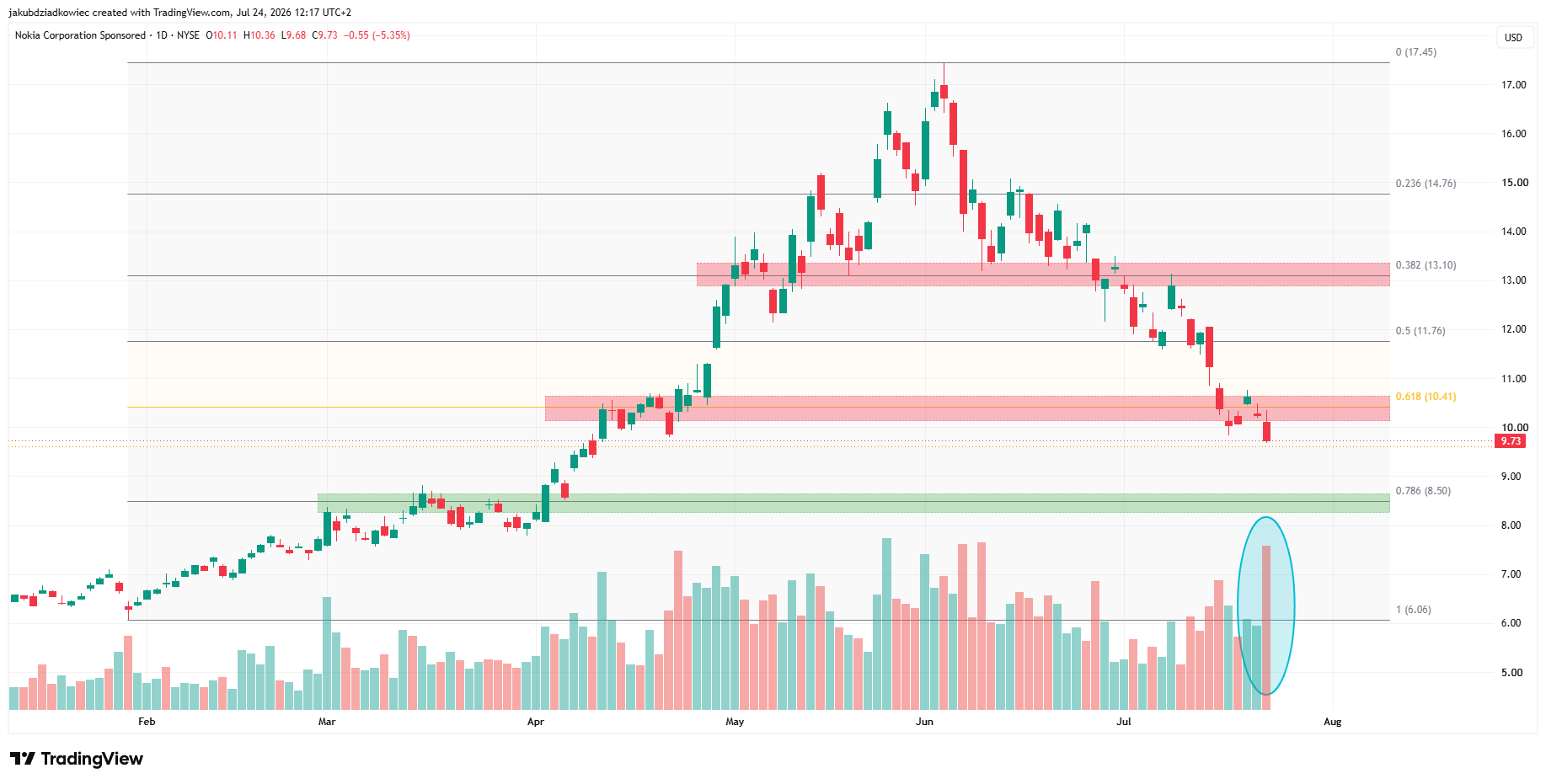
Nokia shares closed at $9.73 on Thursday, July 24, 2026, marking a 5.35% decline and the stock's lowest close since April. The drop broke below the 0.618 Fibonacci golden pocket at $10.41, extending a slide that began in early June. The selloff came despite a second-quarter earnings report that surpassed analyst estimates but paired strong AI-driven demand with cautionary signals about memory component shortages. NOK now sits approximately 44% below its June peak of $17.45.
Strong Q2 Results Overshadowed by Forward Guidance
Nokia's second-quarter performance was robust on paper. Comparable operating profit climbed 18% year-over-year to €434 million, comfortably exceeding the €382 million analyst consensus. Net sales rose 9% to €4.82 billion.
Sales to AI and cloud customers doubled to €446 million, and new orders from the segment reached a record €2.8 billion. This growth reflects how hyperscalers' data-center build-outs for AI training and inference workloads are driving demand for high-capacity optical transport — a shift that has allowed Nokia to tap infrastructure spending beyond its traditional telecom carrier customer base. Nokia had positioned itself for this growth following a strong first quarter, when hyperscaler spending first boosted its optical networking business.
However, market attention shifted to the outlook rather than the results. CEO Justin Hotard cautioned that memory shortages could extend into 2027, driven by AI companies consuming the industry's DRAM supply and pushing component costs higher. The constraint reflects a broader industry bottleneck: AI accelerators require substantial high-bandwidth memory and DRAM, tightening supply for adjacent hardware categories and raising input costs across the telecom equipment supply chain.
"That's probably the one that we see as most significant," Hotard said regarding memory constraints during the earnings call.
Legacy segment weakness continued to weigh on the business. Fixed Networks revenue declined 13% as telecom operators postponed spending. Nokia also guided third-quarter operating profit to be broadly flat compared with Q2.
The broader sector environment compounded the pressure. Ericsson dropped nearly 12% on July 14 after highlighting the same memory cost inflation, pulling telecom equipment peers lower. Weakness in memory stocks and wider AI-sector profit-taking added further strain on a stock that had been up roughly 85% year-to-date as recently as mid-July.
Technical Breakdown: Golden Pocket Turns Into Resistance
On the daily chart, Nokia stock has been in decline since June 3. A Fibonacci retracement drawn from the January low of $6.06 to the June high of $17.45 frames the downward move.
NOK initially lost the 0.382 level at $13.10 in early July. This week, the stock broke below the golden pocket — the 0.618 retracement at $10.41. That zone had functioned as support in April, and its breach suggests it may now act as resistance.
The volume surge accompanying the latest drop signals conviction among sellers, which supports the case for further downside.
The next technical target sits at the 0.786 retracement of $8.50, approximately 12.6% below Thursday's closing price. This level also coincides with a consolidation zone from March and April, potentially reinforcing it as an area of demand. Conversely, a daily close back above $10.41 would negate the bearish setup.
RSI Confirms Bearish Momentum Shift
The daily Relative Strength Index (RSI) corroborates the technical breakdown. Nokia's RSI had held an ascending support trendline dating back to November 2025, with successful tests in February and twice in June.
The indicator broke below that line in late June. A subsequent July rebound was rejected exactly at the trendline's underside, confirming the former support as new resistance. Both price and RSI have fallen sharply since that rejection.
The RSI currently reads near 32, just above the oversold threshold of 30. A move below 30 could trigger a short-term bounce, consistent with patterns seen in other oversold semiconductor names during the recent chip selloff. Nonetheless, the momentum structure remains bearish as long as the broken trendline continues to cap recoveries.
For now, the path of least resistance points toward $8.50. The record €2.8 billion in AI/cloud orders provides visibility into potential revenue once memory supply conditions normalize, though the timing of that normalization remains uncertain. Easing memory costs or strong second-half execution could reinvigorate Nokia's AI growth narrative, though a break below $8.50 would expose the January anchor low of $6.06.
Source: BeInCrypto

