Saylor Teases Another Bitcoin Color as Strategy Ends Four-Week Buying Pause
Key Takeaways
- •SEC filings for June 29, July 6, July 13 and July 20 reported no Bitcoin purchases under Strategy’s regular acquisition programs.
- •Michael Saylor posted Strategy’s Bitcoin accumulation chart on X with the caption “We’re gonna need another color,” marking his fifth such post since the last confirmed purchase.
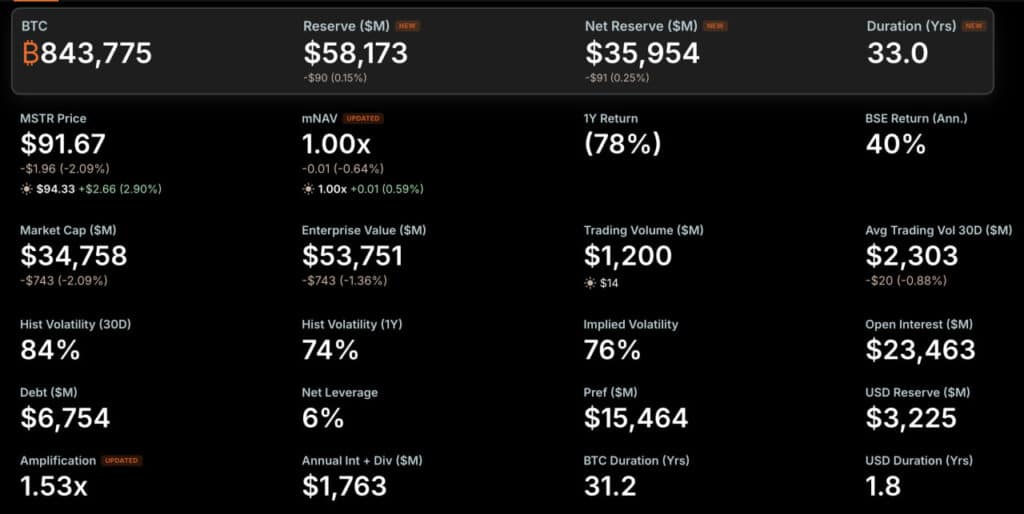
- •Strategy’s mNAV fell to about 0.99 in late June and has since recovered to around 1.03, still below the company’s stated breakeven level of about 1.22.
- •The company sold 3,588 BTC between June 29 and July 5 for about $216 million, using the proceeds for preferred dividends and cash reserves.
- •Latest SEC filings showed $263.5 million of MSTR share sales, bringing Strategy’s cash reserve to $3.225 billion instead of adding to Bitcoin holdings.
MicroStrategy has gone four consecutive weeks without buying a single satoshi of Bitcoin, marking its longest buying freeze in two years, while Michael Saylor continues to post Strategy’s accumulation charts on X with the caption, “We’re gonna need another color.”
The company now holds $3.225 billion in cash, MSTR is down roughly 33% year to date, and second-quarter earnings are due Thursday after the U.S. market close. For investors following Strategy’s Bitcoin-backed balance-sheet model, the question is straightforward: will the company resume dip-buying today, or is it still prioritizing liquidity after a stretch of heavier obligations?
MicroStrategy and Bitcoin: Four Weeks of Silence, Five Teases
The details of the freeze are clear. SEC filings on June 29, July 6, July 13 and July 20 each reported no Bitcoin purchases under Strategy’s standing acquisition programs. The filings covering June 29, July 6, July 13 and July 20 all gave the same answer: nothing.
The silence stands in contrast to Saylor’s activity on X. On Sunday, July 27, he posted Strategy’s color-coded Bitcoin accumulation chart with the caption, “We’re gonna need another color,” a reference to the distinct color bubble assigned to each new purchase tranche on the chart.
We’re gonna need another color. pic.twitter.com/AqZO5UeXDx — Michael Saylor (@saylor) July 26, 2026
We’re gonna need another color. pic.twitter.com/AqZO5UeXDx
— Michael Saylor (@saylor) July 26, 2026
According to the primary source, it was his fifth such post since the last confirmed purchase. No transaction has been confirmed for the current week.
The pattern is intentional. Saylor has repeatedly used these posts to signal that Bitcoin accumulation remains the company’s strategic direction, even while the balance sheet is being actively adjusted.
Whether the message is a prelude to a purchase or simply an effort to manage market expectations during a liquidity pause is the issue the market is weighing now.
DISCOVER: The Next 1000x Crypto Gem Before It Lists on Binance
The mNAV Flywheel and Why It Matters
The freeze matters more than a routine tactical pause because Strategy’s capital model depends on its stock trading at a premium to the Bitcoin it holds.
When mNAV, or market value of equity divided by the net asset value of Bitcoin holdings, sits above 1.0, Strategy can issue new shares at a premium, use the proceeds to buy more Bitcoin, and increase Bitcoin per share. In that setup, the premium offsets dilution.
That mechanism broke down in late June. According to the primary source, the mNAV ratio fell to about 0.99, the first time in the company’s history that it slipped below parity.
The ratio has since recovered to around 1.03, but management’s stated breakeven for the flywheel to create value for common shareholders is near 1.22. At 1.03, buying Bitcoin with freshly issued equity is slightly dilutive rather than accretive.
Julio Moreno, head of research at CryptoQuant, pointed to what he described as a “deterioration in Strategy’s fundamentals” in late June. He said dividend obligations had quadrupled in six months to $1.2 billion, while the coverage ratio — how long existing Bitcoin holdings could theoretically fund those dividends — dropped from more than seven years to about 14 months.
CryptoQuant’s explicit recommendation was to stop buying and rebuild cash. The four-week freeze is, at least in part, consistent with that advice.
For investors tracking Strategy’s Bitcoin treasury approach, the important point is that preferred shareholders are paid before common shareholders receive any Bitcoin-per-share accretion.
The Sell-Off That Changed the Narrative
The pause is not just inaction. The primary source says Strategy sold 3,588 BTC between June 29 and July 5 for about $216 million, its largest single Bitcoin disposal on record. The proceeds were directed toward preferred dividends and the cash reserve.
That is a significant signal. A company built around the idea that it would never sell Bitcoin sold Bitcoin.
The framework adopted in late June authorized $1 billion in common stock buybacks, $1 billion in digital credit securities and up to $1.25 billion in additional Bitcoin sales. The authorization does not mean all of it will be used, but it does show that management is no longer treating the Bitcoin treasury as untouchable collateral.
The latest SEC filing confirmed $263.5 million of MSTR share sales. Those proceeds lifted the cash reserve to $3.225 billion instead of being deployed into new Bitcoin purchases. In other words, Strategy is raising money and holding it, not immediately putting it into BTC.
That is liability management, not accumulation mode.
DISCOVER: Best Meme Coin ICOs to Invest in 2026
The post We’re Going to Need Another Color Says Saylor: Will Microstrategy Buy Bitcoin Dip Today? appeared first on 99Bitcoins .

