Massive Attack's Seo Taiji Tribute Sparks Censorship Debate at Incheon Rock Festival
Key Takeaways
- •Massive Attack performed a cover of Seo Taiji & Boys' "Regret of the Times" and screened 1980 Gwangju uprising footage during their set at the 2026 Pentaport Rock Festival in Incheon on August 1.
- •An on-screen caption stated the United States "supported the civilian massacre" in Gwangju, a claim that historians say lacks direct documentary evidence.
- •Incheon Metropolitan Council member Lee Beom-seok vowed to raise the issue at an upcoming audit, invoking the Special Act on the May 18 Democratization Movement, which imposes penalties of up to five years in prison for spreading false information about the uprising.
- •The original "Regret of the Times" was central to the dismantling of Korea's pre-release music censorship system in 1996, and Massive Attack framed their cover as solidarity with that anti-censorship legacy.
- •Singapore authorities previously banned two Massive Attack members from reentering the city-state after they displayed a Palestinian flag during a concert earlier this year.
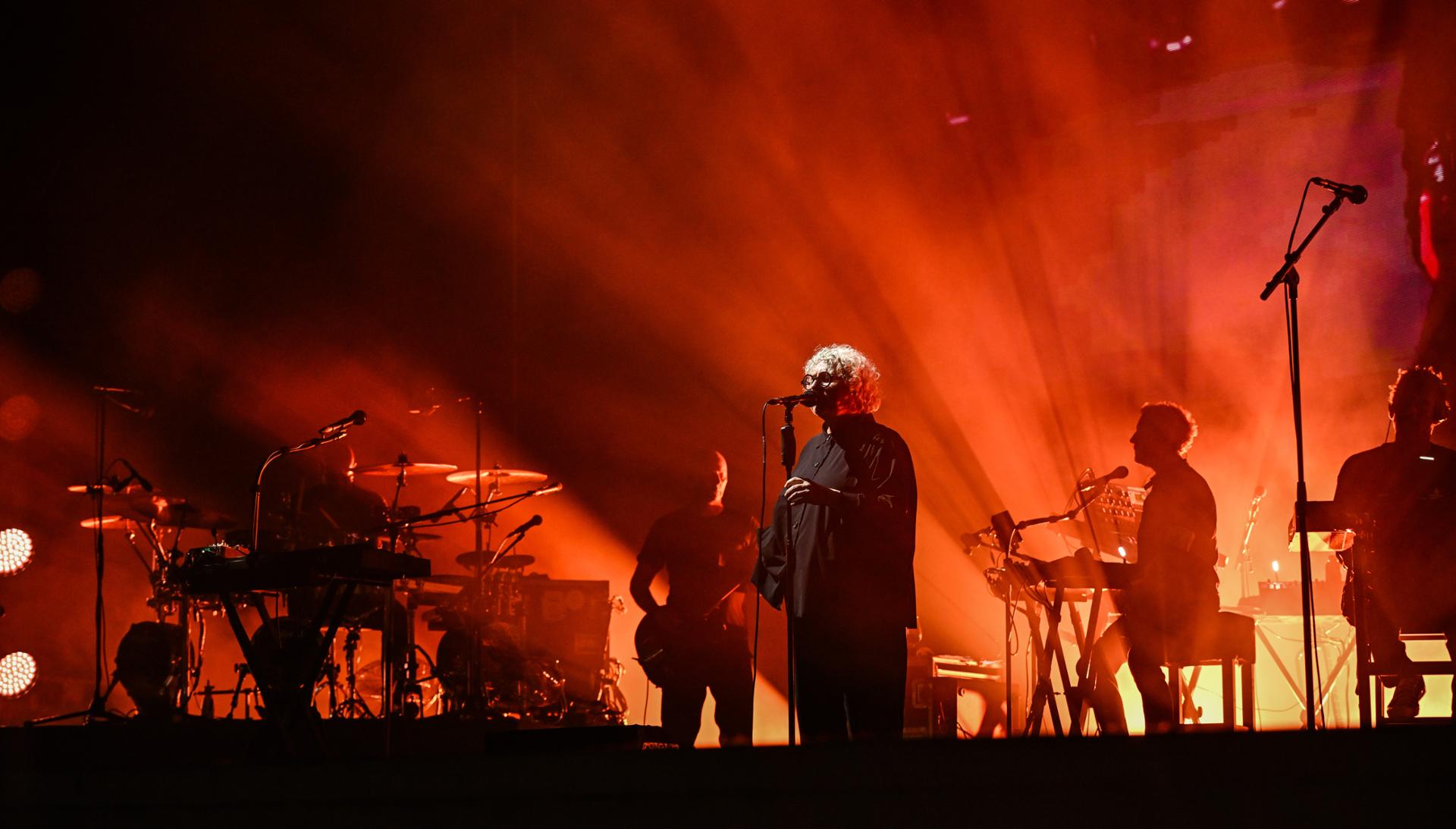
A performance by British band Massive Attack at the 2026 Pentaport Rock Festival in Incheon has triggered a political dispute after the group covered Seo Taiji & Boys' "Regret of the Times" and screened footage of the 1980 Gwangju pro-democracy movement during their set.
The band performed the cover on Aug. 1 at Songdo Moonlight Festival Park, with guest vocalist Elizabeth Fraser. The song, originally released by Seo Taiji & Boys in 1995, was itself once at the center of a censorship battle. The group had refused to comply with a government pre-screening requirement for the track, and the resulting standoff contributed to the eventual abolition of Korea's pre-release music censorship system, which was formally dismantled in 1996 — a turning point widely cited in accounts of the country's cultural liberalization after decades of military-backed rule.
Massive Attack's rendition was performed partly in Korean as homage and partly in English for a broader audience. The band framed it explicitly as an act of solidarity with that anti-censorship legacy.
"'Regret of the Times' took on an authoritarian government and won. In 2026, as corporate absorption and the censorship of artists for political expression looms large again, it resonates as a signal lesson," the Bristol-based band wrote in a social media post introducing the cover. "We see this cover as an act of continuity, revival and solidarity with Seo Taiji & Boys — K-pop progenitor — whose work defied state censorship while creating a global genre."
A video screened during the performance included footage of the 1980 Gwangju pro-democracy movement, alongside separate footage condemning Israel's actions in Gaza. The Gwangju footage was not prepared exclusively for the Korea show; it has been part of Massive Attack's live repertoire since May.
The May 18 Gwangju Democratic Uprising remains one of the most sensitive episodes in modern Korean history. In May 1980, citizens in the southwestern city of Gwangju rose up against the military junta led by Chun Doo-hwan, who had seized power in a coup months earlier. Troops fired on civilians, and the death toll — officially tallied at around 200 but long believed by many to be higher — became a defining wound in South Korea's path to democratization.
During the Incheon set, a caption displayed on screen read: "In 1980, the United States supported the civilian massacre carried out by the Korean government in Gwangju."
That footage is now at the center of a political dispute. Lee Beom-seok, a member of Incheon Metropolitan Council representing the opposition People Power Party, has vowed to raise the issue during an upcoming administrative audit of the Incheon Tourism Organization, which organizes the annual city-hosted festival.
Lee pointed to the caption claiming the U.S. "supported the civilian massacre carried out by the Korean government" — a claim historians say is not backed by direct evidence. The question of U.S. culpability in Gwangju has long been a point of contention in South Korea. Declassified documents show that U.S. officials were aware of troop movements under the Combined Forces Command structure, and the Carter administration released some forces from the combined command to Korean authorities prior to the crackdown. However, scholars generally agree there is no documentary proof that the U.S. directed or ordered the suppression.
"'The United States supported the civilian massacre during May 18.' There is only one group in the world that spreads this false narrative: North Korea," Lee said in a social media post.
He cited Korea's Special Act on the May 18 Democratization Movement, noting that Article 8 criminalizes the dissemination of false information about the uprising through media, online networks, or the screening of visual materials, with penalties of up to five years in prison or a fine of up to 50 million won ($35,000). The liberal ruling Democratic Party of Korea pushed the bill through the National Assembly in 2020.
"The Incheon Pentaport Rock Festival is a flagship event for the city, with around 2 billion won in municipal funds injected every year," Lee said. "When citizens' tax money is being spent, there can be no compromise."
The controversy in Incheon is not the band's first encounter with government pushback over political content this year. Singapore authorities banned two of the band's members from reentering the city-state after they closed a concert there with a Palestinian flag and slogans supporting Palestinians amid the war in Gaza. Singapore enforces strict laws prohibiting the public display of foreign flags or symbols at speeches or assemblies without prior authorization.
Massive Attack has a long-documented history of political activism at concerts, having used performances for decades to spotlight causes from Palestine to the Iraq War.
Jamie Finn, chief editor of Korean indie music publication Debaser Magazine, said the backlash appeared to be aimed at the wrong target.
"They did imply that, but not too much. It was mostly focused on the Korean government," Finn said, referring to the Gwangju footage. "They very much made the U.S. implicit in the Palestine stuff."
Finn, a foreign resident who traveled from Busan for the festival, described a powerful audience experience rather than a politically divisive one.
"I thought it was good and exciting to see Korean references in the show. It was interesting to see an international artist do some research about Korean social issues," he said. "It was difficult because I thought it was brilliant and beautiful but also really bleak. You could feel the collective sadness from the audience ... I think it was amazing though and the best performance of the weekend."
