Trump's Iran Threat and Houthi Tanker Strikes Erase Nearly $1 Trillion From Big Tech as Oil Crosses $100
Key Takeaways
- •The Magnificent Seven technology companies collectively shed approximately $938.7 billion in market capitalization on July 23, representing their second-largest one-day loss on record.
- •Brent crude surged 7% to $100.71, crossing the $100 threshold for the first time since late May, after Yemen's Houthi movement claimed attacks on two Saudi oil tankers near the Bab el-Mandeb Strait.
- •Alphabet reported its first-ever quarterly cash burn of $5.9 billion in negative free cash flow and raised its 2026 capital expenditure forecast to a range of $195 billion to $205 billion.
- •Tesla posted negative free cash flow of $1.1 billion in the second quarter, its first cash burn in over two years, as capital expenditure surged 142% year over year to $5.8 billion.
- •Bitcoin retreated toward $64,000 as rising Treasury yields and oil-driven inflation concerns prompted traders to reduce exposure to higher-risk assets including equities and cryptocurrencies.
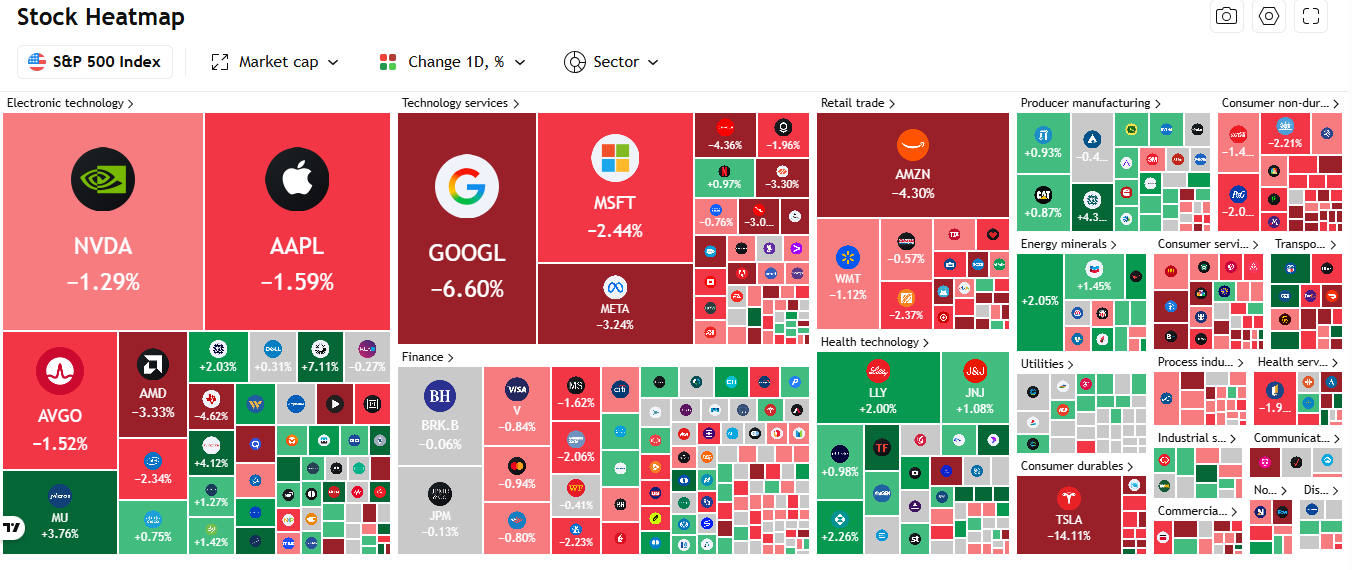
U.S. equities posted their worst single-day decline in a month on July 23, as geopolitical tensions, surging oil prices, and disappointing cash-flow results from mega-cap technology companies converged in a broad market sell-off.
The S&P 500 fell 1.2% to 7,408.30, according to Associated Press data. The Nasdaq Composite dropped 2.2%, and the Dow Jones Industrial Average declined 1%.
The Magnificent Seven — Alphabet, Amazon, Apple, Meta Platforms, Microsoft, Nvidia, and Tesla — collectively shed approximately $938.7 billion in market capitalization during the session. MarketWatch described it as the group's second-largest one-day loss on record, a figure approaching $1 trillion. These seven companies account for a disproportionate share of the S&P 500's total market value, meaning their simultaneous decline amplified the benchmark index's losses beyond what a comparable drop across other sectors would produce.
Trump Escalates Rhetoric Against Iran
President Donald Trump intensified market concerns by threatening further military strikes against Iranian infrastructure. Trump stated that the United States would destroy bridges or power plants in response to attacks on vessels. His remarks also raised the possibility of targeting infrastructure near Tehran.
Oil Crosses $100 Amid Red Sea Supply Disruption
Brent crude surged 7% to $100.71 during July 23 trading, breaching the $100 threshold for the first time since late May. West Texas Intermediate climbed 6% to $92.01. Both benchmark contracts extended gains for a fifth consecutive session.
The rally followed reported attacks on two Saudi oil tankers. Yemen's Iran-aligned Houthi movement claimed responsibility for the strikes and identified the vessels as Encelia and Layla. A maritime security source said a missile struck Encelia near Saudi Arabia's Jizan port.
The Houthis had previously announced a naval blockade on Saudi shipments. Their escalation heightened concerns about disruptions near the Bab el-Mandeb Strait, a chokepoint that gained prominence after earlier disruptions around the Strait of Hormuz prompted Saudi Arabia to reroute some crude shipments through the Red Sea. The Bab el-Mandeb route handled approximately 2.5 million barrels of Saudi oil per day. Ships avoiding the area face longer voyages around southern Africa, raising transport and insurance costs that could place additional upward pressure on energy prices.
Rising oil prices also reignited concerns about U.S. inflation. Energy costs feed directly into consumer prices through gasoline, diesel, and shipping expenses, and sustained crude levels above $100 have historically complicated the Federal Reserve's efforts to manage inflation. Treasury yields climbed as traders scaled back expectations for interest-rate cuts, adding pressure across technology stocks and crypto assets.
Alphabet Records First-Ever Quarterly Cash Burn
Alphabet reported negative free cash flow of $5.9 billion in the second quarter, marking the Google parent's first recorded cash burn. Cloud revenue still grew 82% year over year.
The company raised its 2026 capital expenditure forecast to a range of $195 billion to $205 billion, up from a prior projection of approximately $190 billion. Second-quarter capital expenditure reached roughly $45 billion, with much of the spending directed toward data centers and artificial intelligence infrastructure.
Strong revenue growth failed to offset investor unease about cash generation. Alphabet shares fell nearly 7% as traders questioned the timing of returns on AI investment.
Chief Financial Officer Anat Ashkenazi warned that 2027 spending would rise further, deepening concerns about pressure on future profit margins.
Tesla Posts First Cash Burn in Over Two Years
Tesla reported negative free cash flow of $1.1 billion in the second quarter — its first quarterly cash burn in more than two years. The electric vehicle maker accelerated spending across artificial intelligence, batteries, robotaxis, and manufacturing operations.
Capital expenditure surged 142% year over year to $5.8 billion. Tesla expected annual artificial intelligence investment to exceed $25 billion.
Chief Executive Officer Elon Musk defended the outlays during the company's earnings call, arguing that Tesla should rapidly expand its artificial intelligence investment. Investors, however, zeroed in on deteriorating cash flow and a miss on profit expectations. Tesla's roughly 14% decline weighed heavily on the broader technology sector.
AI Capital Expenditure Scrutiny Deepens
Beyond Alphabet and Tesla, other major technology stocks also declined. Consumer discretionary, communication services, and technology ranked among the weakest S&P 500 sectors.
The sell-off signaled growing investor impatience with rising capital expenditure, as companies face mounting pressure to demonstrate faster returns from artificial intelligence projects. The scrutiny marks a shift from recent quarters, when robust AI-driven revenue growth at several mega-cap firms largely overshadowed spending concerns.
Crypto Markets Decline Alongside Equities
Bitcoin retreated toward $64,000 as traders reduced exposure to higher-risk assets. Ether, Solana, and XRP recorded steeper percentage losses. Higher Treasury yields diminished demand for non-yielding assets, while oil-driven inflation concerns further eroded expectations for monetary easing.
Convergence of Pressures
The July 23 decline reflected a convergence of geopolitical, energy, and corporate pressures. Trump's threat against Iran raised fears of broader military escalation. Houthi tanker attacks created risks near a second critical oil transit route. Alphabet and Tesla then deepened the sell-off with weaker-than-expected cash-flow results, amplifying questions about the payoff timeline for massive artificial intelligence spending.
The Magnificent Seven's $938.7 billion combined loss — a verified figure — substantiates characterizing the session's damage as approaching $1 trillion.

