Kaspa’s Smart Contract Milestone Fails to Spark Major Price Move as Macro Pressures Weigh
Key Takeaways
- •Kaspa’s smart contract launch expands the network’s functionality beyond fast block times and GHOSTDAG consensus into programmable applications.
- •KAS price has remained muted despite the upgrade, with analysts pointing to tight liquidity and weak altcoin market conditions as key constraints.
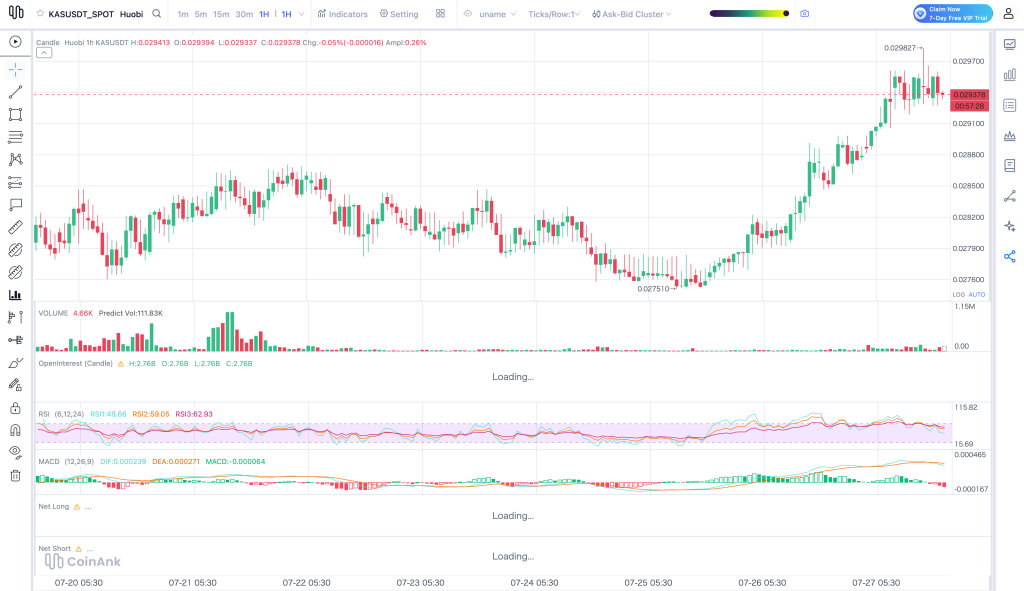
- •The 1-hour KAS/USDT chart shows a breakout structure, with important support around $0.0290 and resistance near $0.02980 to $0.02985.
- •Momentum indicators remain broadly constructive, although MACD histogram weakness suggests the pace of buying has slowed.
- •Future upside may depend on stronger on-chain adoption, improved macro conditions or renewed altcoin rotation.
Kaspa has activated smart contracts, marking what the source described as the largest milestone in the project’s history. The upgrade gives the network programmable functionality, but KAS price action has remained relatively muted despite expectations from some investors for a stronger move higher.
According to analyst Jesse, the explanation is less about a Kaspa-specific weakness and more about the broader macroeconomic environment. Jesse has been monitoring liquidity conditions and Federal Reserve policy as the main drivers of altcoin performance, and his view is that Kaspa is being held back by an unfavorable market backdrop.
Kaspa’s Smart Contract Launch
Kaspa’s smart contract activation represents a major technical development for the network. It introduces support for programmable applications, expanding the possible use cases for DeFi, NFTs, tokenized applications, and other on-chain activity.
For a project known for fast block times and its GHOSTDAG consensus mechanism, smart contracts had been viewed as an important missing component. The community welcomed the launch, and developers delivered on a long-standing roadmap commitment. Even so, KAS price barely reacted.
That muted response may not be unique to Kaspa. The broader crypto market has become increasingly sensitive to liquidity conditions, and even significant project upgrades can struggle to affect prices when the wider market is weak. Kaspa’s smart contract launch arrived during a period when investors were reducing exposure to altcoins across the board.
The launch also shifts the focus from delivery of the core upgrade to evidence of usage. For smart contract networks, markets often look beyond activation itself and track whether developers deploy applications, users interact with them, and on-chain activity grows over time. Those adoption signals can take longer to develop than the initial technical release.
KAS/USDT Technical Setup
On the 1-hour KAS/USDT chart, Kaspa has formed a stronger short-term technical structure after several days of consolidation between $0.0275 and $0.0283. Buyers pushed through resistance near $0.0282, producing an impulsive move to a local high near $0.02983.
Key support levels include:
- Immediate support: $0.02920–$0.02930
- Major support: $0.02890–$0.02900, the previous breakout area
- Strong support: $0.02820–$0.02840
Resistance levels ahead include:
- Immediate resistance: $0.02980–$0.02985
- Next resistance: $0.03020–$0.03050
- Bullish target: $0.03100–$0.03150
RSI readings show RSI 6 at 49.7, RSI 12 at 59.1, and RSI 24 at 62.9. Those levels suggest momentum remains bullish but has cooled from overbought conditions. The MACD still shows a bullish crossover, although shrinking histogram bars indicate that momentum has slowed.
Volume rose noticeably during the breakout above $0.0282, which supports the view that buyers participated in the move. Since the local highs, volume has eased while selling pressure has remained limited.
The pattern resembles a bullish breakout followed by flag-like consolidation. As long as Kaspa remains above $0.0290, buyers retain the technical advantage.
Macro Conditions Remain the Main Constraint
One trader’s explanation for Kaspa’s muted reaction is that macro conditions are outweighing project-specific fundamentals. The thesis is that crypto assets, especially mid-cap altcoins such as Kaspa, respond first to liquidity and only afterward to project quality.
When markets expect fewer rate cuts, a stronger U.S. dollar, and tighter financial conditions, speculative assets are more likely to be sold. Under those conditions, Kaspa can move lower with the rest of the sector even without negative token-specific news.
Kaspa has recently traded more like a high-beta altcoin than a fully decoupled asset. Broad crypto selloffs can overwhelm its own narrative. In practical terms, that means KAS may underperform when markets are risk-off and outperform only when altcoin rotation becomes strong enough to offset macro caution.
Federal Reserve policy is also central to this view. Quantitative easing appears to be off the table for now, while the Fed is relying on rate cuts as the main mechanism for adding liquidity to markets. That could leave financial conditions tight for an extended period until inflation reaches the 2% target.
This is important for altcoins because liquidity conditions affect how much capital investors are willing to allocate to higher-risk crypto assets. In tighter conditions, even positive network developments may be treated as longer-term fundamentals rather than immediate price catalysts.
One trader summarized the current setup as a “good asset, bad backdrop” scenario for Kaspa. If the Fed becomes more supportive and altcoins begin rotating, Kaspa could benefit quickly. Until then, macro conditions may continue to cap upside.
What Could Drive a Kaspa Breakout
For Kaspa to produce a more decisive breakout, the source outlined three possible scenarios.
The first scenario is that the Fed brings inflation down over time. That process could extend into 2027 or early 2028. It would be the slower path, but it could eventually restore the liquidity conditions that altcoins typically need.
The second scenario is that Kaspa developers create enough on-chain activity to generate liquidity and use cases for Kaspa, pushing price above key resistance levels without needing direct macro support.
The third scenario is that the Fed changes how it measures inflation through a new data task force. A surprise revision to inflation metrics could reprice Kaspa and the broader altcoin market to the upside, catching retail investors off guard.
In the near term, the technical setup remains constructive. If buyers defend the $0.0292–$0.0293 area and break above $0.02985, Kaspa could target $0.03020 and then $0.03050. Extended targets near $0.0310–$0.0315 are possible if buying volume increases.
A move below $0.0290 could lead to a retest of $0.0286–$0.0283. A loss of $0.0282 would invalidate the current breakout structure.
Kaspa is currently showing one of its strongest short-term technical setups in recent sessions, but its next directional move remains heavily dependent on whether macro conditions improve or continue to weigh on the broader altcoin sector. Alongside price levels, traders are likely to monitor whether the smart contract launch begins translating into measurable network activity, since that would provide a clearer test of the upgrade’s practical impact.
Frequently Asked Questions
A $1 KAS price is possible, but it would require broader adoption, stronger demand, and favorable market conditions. There is no guarantee that Kaspa will reach that level.
A $10 KAS price is possible, but it would require a major increase in adoption and market value. There is no guarantee that Kaspa will reach that level.
Whether Kaspa is suitable depends on individual investment goals and risk tolerance. Kaspa has drawn attention for its BlockDAG architecture and active development, but it remains volatile.

