Hyperliquid's HYPE Draws Whale Staking as Analysts Cite $150 Target and Robinhood Competition
Key Takeaways
- •A crypto whale staked 2.93 million HYPE tokens worth approximately $172 million across 19 wallets, having accumulated the tokens at an average price of $44 nine months earlier with an estimated $44.5 million in unrealized gains.
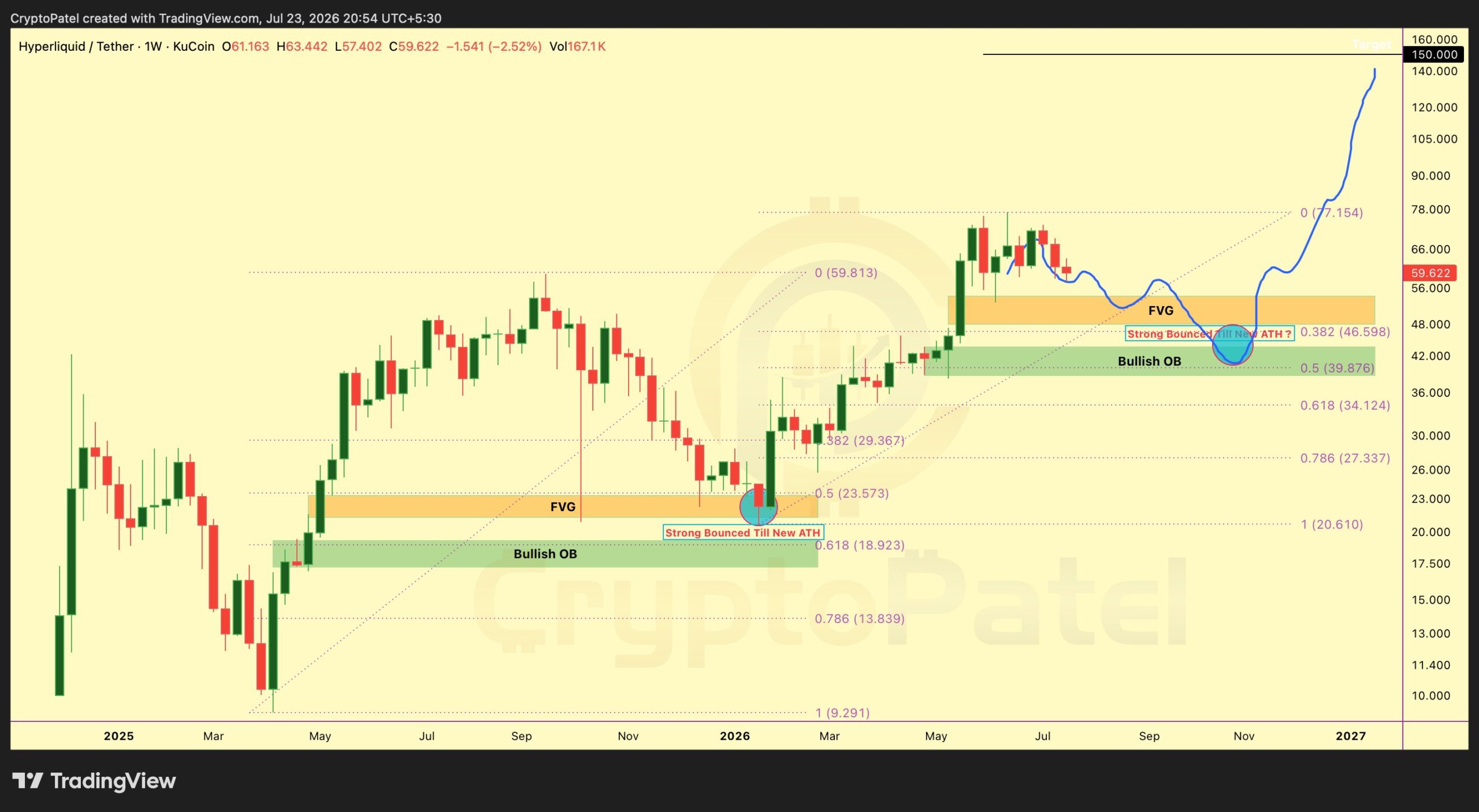
- •Analyst Crypto Patel identified a high-probability confluence zone for HYPE between $47 and $54 and suggested the token could rally toward $150 over a longer timeframe, while noting the bullish outlook would be invalidated by a weekly close below approximately $34.
- •A leveraged long position held for 287 days generated nearly $28 million in unrealized profit on an $80.71 million position using 5x leverage, with the trader recently adding 4.5 million USDC in margin.
- •Nearly 50% of Hyperliquid's trading volume comes from traditional finance assets, and the protocol generates approximately $800 million in annualized revenue, with 99% directed toward HYPE token buybacks.
- •Hyperliquid's expansion into tokenized securities places it in direct competition with Robinhood, which has recorded over $300 million in deposits and offers tokenized stocks across 120 countries.
Hyperliquid’s HYPE token is drawing renewed attention during what analysts describe as an accumulation phase, as long positions build, whale staking increases and the platform gains traction in tokenized securities trading.
Market participants cited by The Market Periodical said HYPE’s market structure remains constructive, while one large holder has staked 2.93 million HYPE tokens worth about $172 million. Hyperliquid, a Layer-1 blockchain built specifically for high-speed perpetual futures trading, is also becoming a venue for tokenized securities activity, with nearly 50% of its trading volume reportedly coming from traditional finance assets — a shift that underscores how decentralized exchanges are expanding beyond crypto-native instruments to compete directly with legacy brokerages.
The trend places Hyperliquid’s decentralized exchange in closer competition with platforms such as Robinhood, which is also pursuing tokenized stock trading.
Crypto Patel Says HYPE Structure Resembles Institutional Accumulation
Crypto analyst Crypto Patel said Hyperliquid is showing a market structure similar to the institutional accumulation phase that preceded its earlier all-time highs. Patel described the recent pullback in HYPE as more of a liquidity reset than a bearish reversal.
For HYPE, Patel identified what he called a high-probability confluence zone between $47 and $54. He pointed to a weekly fair value gap (FVG), a bullish order block between $38 and $43, and an overlap with the 0.382–0.5 Fibonacci retracement levels.
Patel also said HYPE continues to hold a higher-high and higher-low structure on the weekly timeframe. At the time cited in the source, Hyperliquid was trading at $59.
According to the analysis, HYPE could still retrace below $50 in the near term. Over a longer timeframe, Patel said the token could rally toward $150.
The analyst added that a successful defense of the $47 to $54 confluence zone could improve the chance of HYPE reclaiming its previous all-time high. He said the bullish outlook would be invalidated by a weekly close below the 0.618 Fibonacci retracement level, near $34.
Onchain Lens Reports $28 Million Unrealized Profit on Leveraged Long Position
Blockchain analytics platform Onchain Lens reported that a leveraged long position in Hyperliquid (HYPE) had generated nearly $28 million in unrealized profit after being held for 287 days.
The position was valued at $80.71 million, with unrealized profit and loss (PnL) of about $27.34 million. The trader entered the position at $38.67, while HYPE’s mark price was $58.49.
According to the data cited by the publication, the trader recently added 4.5 million USDC in margin. That included a 2 million USDC deposit on the previous day and 2.5 million USDC on July 17. The position uses 5x leverage and has a liquidation price of $52.368.
Separately, data from Arkham Intelligence showed that a crypto whale staked 2.93 million Hyperliquid tokens worth $172 million. The data indicated that 19 wallets, believed to be controlled by the same entity, deposited the 2.93 million HYPE into the Hyperliquid protocol.
The whale accumulated the tokens about nine months earlier at an average purchase price of $44 per HYPE. Based on the prices cited in the report, the position held an estimated $44.5 million in unrealized gains.
Hyperliquid Competes With Robinhood in Tokenized Securities
Traditional finance companies and crypto market platforms are increasingly operating in overlapping markets for tokenized securities trading. Finance analyst Parker said Alphabet (NASDAQ: GOOG) trading volumes on Hyperliquid had risen significantly.
Fidelity CIO Matt Hougan also discussed Hyperliquid’s traction and its competition with traditional finance platforms such as Robinhood. In a post on X, Hougan said previous crypto market cycles were driven by catalysts such as ICOs in 2017, DeFi, NFTs and memecoins in 2020-21, and spot Bitcoin ETFs in 2024-25.
Hougan said the next phase of growth could be driven by financial infrastructure moving on-chain, supported by stablecoins, tokenization, 24/7 markets, instant settlement and institutional decentralized finance (DeFi).
The Bitwise executive also said nearly 50% of Hyperliquid’s trading volume comes from traditional assets. The trading of tokenized traditional securities helps the protocol generate annualized revenue of $800 million, according to the report, with 99% of that directed toward buybacks of the HYPE token — a mechanism designed to reduce circulating supply and align token value with protocol usage.
Robinhood is also seeking a share of the tokenized securities market. The company has recorded more than $300 million in deposits over the past two weeks, processes 3.6 million daily transactions and offers tokenized stocks across 120 countries. The convergence between DeFi platforms like Hyperliquid and traditional brokers like Robinhood reflects a broader industry shift toward real-world asset tokenization, with both sides racing to capture demand for round-the-clock, self-custodied exposure to equities and other traditional instruments.

