Five Crypto APIs for Trading Bots and AI Agents in 2026
Key Takeaways
- •CoinStats API provides market data, wallet balances, DeFi positions, portfolio analytics, token security checks and MCP access through a single key.
- •ChangeHero, StealthEX and ChangeNOW offer non-custodial swap APIs, but they differ in asset coverage, settlement times, compliance features and commercial models.
- •Codex streams real-time token and prediction-market data across more than 90 million tokens and more than 80 networks with 1-second freshness.
- •MCP support is becoming important for AI-agent workflows because it lets large language models call API tools directly.
- •The article says many production setups combine one data provider with one execution rail rather than relying on a single API for all functions.
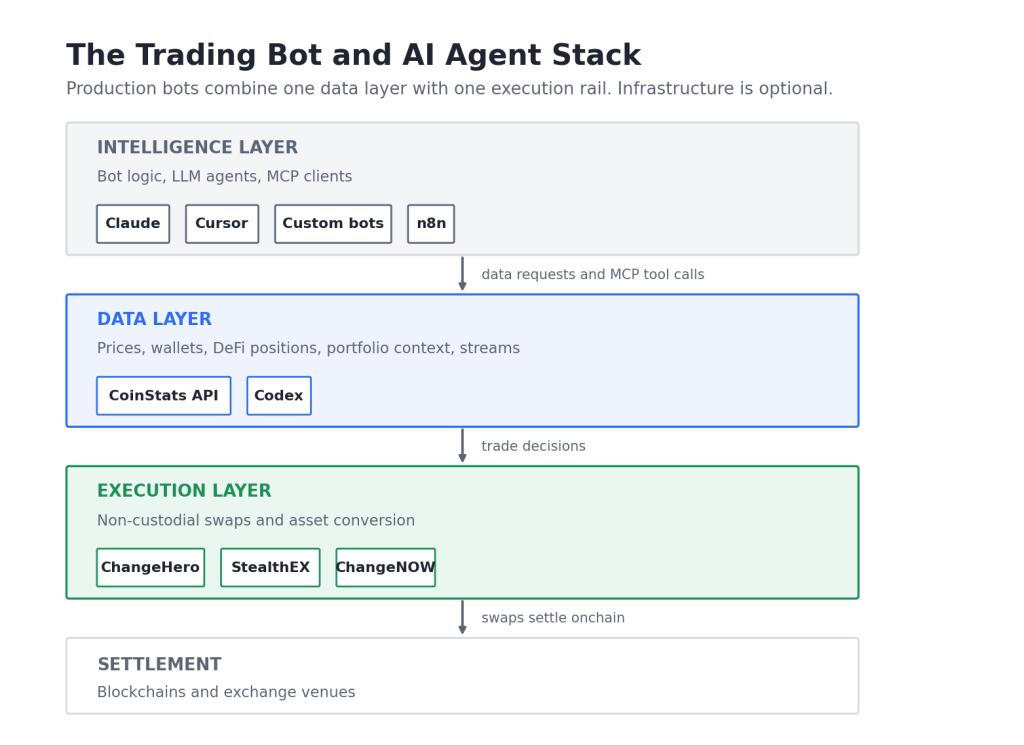
Automated crypto systems depend on data and execution infrastructure. Trading bots need prices, wallet context and reliable order or swap routes, while AI agents need the same information exposed as callable tools. In most cases, those capabilities are delivered through APIs.
No single API covers every automated workload. A signal bot may prioritize fast aggregated prices, while a portfolio-aware agent needs wallet balances and DeFi exposure. A rebalancing bot may also require a way to convert assets without relying on centralized exchange accounts. As a result, many production systems combine a data layer with a separate execution rail.
The following five providers are positioned for those types of workloads. CoinMarketCap and CoinGecko are not included because they do not provide the wallet, DeFi or portfolio context required by many agent-based systems.
What bots and agents need from an API
Model Context Protocol, or MCP, support is increasingly relevant for AI-agent use cases. MCP turns API endpoints into callable tools for large language models, allowing an agent to query data in natural language. Providers with native MCP servers can reduce or remove the need for custom adapter code.
Portfolio context is also important because bots act on positions rather than prices alone. Wallet balances, DeFi exposure, and profit-and-loss data can all become inputs for automated decisions.
Execution rails are another key requirement. Many automated systems need to convert assets on a schedule, and swap APIs can enable that conversion without exchange accounts or custody risk. Non-custodial swap APIs still require builders to manage wallet permissions, transaction signing and error handling, so they are usually evaluated alongside custody architecture rather than only by asset coverage.
Data freshness matters because automated strategies operate on current prices. Streaming delivery and low-latency endpoints help determine how quickly a bot can respond. The right benchmark depends on the workload: market-making systems generally need faster updates than portfolio dashboards or scheduled treasury conversions.
Pricing predictability is also material. Bots may poll APIs continuously, so credit models, rate limits and free tiers can affect operating costs. Teams also need to account for how providers meter WebSocket streams, historical data, wallet lookups and swap requests, because those workloads can scale differently.
1. CoinStats API
CoinStats API covers the data side of automated crypto systems through a single key. It provides market data, wallet balances, DeFi positions, portfolio analytics and token security information.
Its coverage is the broadest among the providers listed here. The API tracks more than 100,000 coins across more than 200 exchanges. Wallet and DeFi data spans more than 120 blockchains, including Solana, Ethereum, EVM chains and Bitcoin. DeFi positions are resolved automatically across more than 10,000 protocols per wallet. Historical pricing extends back 10 years for backtesting.
Agent support is a major feature. The CoinStats MCP Server exposes more than 20 data tools to LLM agents. Claude, Cursor, Claude Code, VS Code and n8n can connect directly. The connection runs through a single OAuth URL, and MCP uses the same key as the REST API. An x402 option allows agents to pay per request with USDC on Base without requiring an account.
The API also includes bot-safety tools. The Token Risks endpoint screens EVM contracts before a trade, with flags covering honeypots, hidden fees and upgradeable proxies. CoinStats says the same checks protect 1 million monthly CoinStats app users.
The free tier includes 20,000 credits per month. Paid plans start at $49 per month. Basic market-data calls cost 1 to 2 credits, which can keep frequent polling relatively inexpensive.
CoinStats API is suited to AI trading assistants, portfolio-aware bots and multi-chain monitoring systems. It is a data API rather than an execution API, so it would typically be paired with a swap rail or exchange API for orders.
2. ChangeHero
ChangeHero focuses on the conversion step for automated systems. The platform has operated a non-custodial swap API since 2017. Hardware and software wallets including Trezor, Exodus, Tangem and OneKey integrate its engine.
The API supports more than 350 cryptocurrencies. Fixed-rate and floating-rate swaps are available through dedicated endpoints. Liquidity is aggregated from multiple trading venues, so if one source becomes unavailable, swaps can continue through other sources. Settlement typically occurs in under 10 minutes.
For bot builders, the model removes exchange accounts from the process. A rebalancing bot can rotate holdings directly from a wallet, while treasury scripts can convert revenue to stablecoins on a schedule. Custom setups can add optimized routing and zero-fee stablecoin pairs on request.
Integration is free. Partners earn a configurable commission on each swap, and there are no volume minimums.
ChangeHero is suited to swap automation, rebalancing systems, wallet integrations and treasury conversion flows. It is not a market-data provider, so pricing feeds and portfolio context require a separate source.
3. StealthEX
StealthEX is positioned as a privacy-focused execution option. Its instant exchange API is fully non-custodial, and end users do not create StealthEX accounts. Standard swap volumes do not carry mandatory KYC requirements, while risk-based screening applies to flagged transactions.
Coverage includes more than 2,000 coins and tokens across many networks. The REST API supports both fixed and floating rates. Floating rates reflect the market price at execution, while fixed rates lock in the receive amount in advance. Settlement usually takes 5 to 30 minutes.
The commercial model is designed for builders. Integration is free, with no monthly commitments. Partners can set a commission between 0% and 0.5% on routed volume.
StealthEX is suited to Telegram bots, wallet integrations, DEX aggregators and privacy-focused conversion flows. It does not provide market-data or analytics endpoints, and settlement is measured in minutes rather than milliseconds.
4. ChangeNOW
ChangeNOW is the scale-oriented option among the swap rails listed. Its API supports more than 1,500 assets across more than 110 networks, with more than 2 million exchange pairs available. Liquidity is aggregated from both centralized and decentralized venues. Swaps typically settle in under one minute.
Compliance and reliability are central parts of ChangeNOW’s positioning. The company holds SOC 2 Type II and ISO 27001:2022 certifications. The service is backed by a 99.99% uptime SLA, which may be relevant for bots handling user funds at volume. Integration options include a full API, a widget and white-label deployments.
Pricing is based on a volume-based revenue-share model. There are no setup fees or monthly fees.
ChangeNOW is suited to high-throughput conversion bots, payment flows, wallets and embedded swap products. Minimum swap amounts apply, typically from $1.70 to $20. UK users are not supported, and market data must come from a separate provider.
5. Codex
Codex provides one API for token data and prediction-market data. It streams real-time prices, trades and OHLCV candles for more than 90 million tokens across more than 80 networks. Its prediction-market coverage includes live odds, volume and trader activity from sources such as Polymarket, Kalshi and other venues.
Delivery runs over WebSockets, and the platform reports a 99.9% uptime record. Data is delivered with 1-second freshness, allowing bots to act on current prices rather than stale quotes. Enriched data is included, so builders do not need to maintain a separate indexing pipeline.
Codex also supports agent-based workflows. Builders can integrate through a TypeScript SDK and an MCP server. Agentic payments run through MPP. TradingView, Coinbase and Uniswap use the platform.
The free tier includes 10,000 requests per month. Paid plans start at $350 per month.
Codex is suited to streaming-first trading bots, long-tail token scanners and prediction-market agents. Its entry pricing is higher than the other providers listed here.
Choosing a provider or combination
Using one API for every trading bot or AI agent is not usually realistic. The five providers cover different layers of the automation stack.
For the data layer, CoinStats API offers the broadest set of functions in this group, combining market data, wallets, DeFi, portfolio analytics and MCP access behind one key. Codex adds deeper streaming coverage for long-tail tokens and prediction markets. The two can be used together, with one supplying portfolio context and the other supplying tick-level streams.
Execution requires a separate decision. ChangeHero, StealthEX and ChangeNOW each provide non-custodial swap rails. ChangeHero emphasizes wallet-partner integrations and flexible custom setups. StealthEX emphasizes privacy and no user accounts. ChangeNOW emphasizes certifications and sub-minute settlement.
A common production setup pairs one data API with one swap rail. All five providers listed offer free entry points, allowing teams to test combinations before committing to paid usage. Paid tiers in the source examples range from $49 to $350 per month. Before moving a bot or agent into production, builders typically test rate limits, failover behavior, supported jurisdictions, asset coverage and transaction monitoring against the specific markets and wallets they plan to support.

