Brian Armstrong Says AI Agents Could Eventually Out-Transact Humans Using Crypto
Key Takeaways
- •Armstrong said AI agents using crypto could one day surpass humans in transaction volume, but not necessarily in transaction value.
- •Most on-chain transactions today are still initiated by people, and AI-driven payments remain an emerging use case.
- •Blockchain-based settlement may suit autonomous software because it operates continuously and supports programmable wallet payments.
- •Large-scale machine payments would require stronger infrastructure, including agent identity controls, spending limits, authorization, and revocation tools.
- •Exchanges, wallet providers, and stablecoins could play key roles if AI agents become significant participants in crypto payment activity.
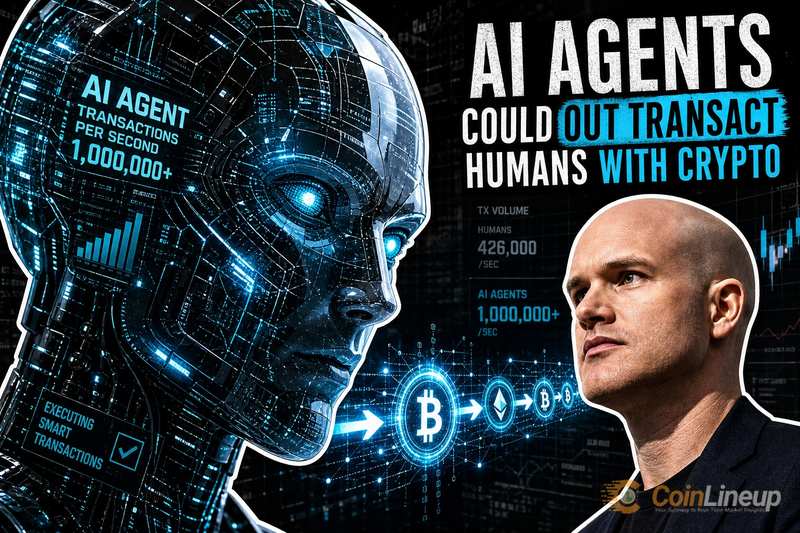
Coinbase CEO Brian Armstrong said AI agents could eventually generate more crypto transactions than humans, casting digital assets as a potential payment layer for autonomous software. His argument, made in a post on X, presents crypto rails rather than traditional banking systems as a medium through which machines may one day move value independently.
Armstrong outlined the thesis in an X post at https://x.com/brian_armstrong/status/2081504081902780564, where he suggested that AI agents using crypto could ultimately exceed humans in transaction volume. The statement was framed as a forward-looking view on the direction of autonomous economic activity, not as a description of current market conditions.
That distinction is important. At present, the overwhelming majority of on-chain activity is still initiated by people, while payments driven by AI agents remain an emerging use case rather than a measurable share of overall volume. Armstrong’s comment is therefore a directional claim about how the mix of crypto activity could change over time. It also concerns transaction count rather than necessarily transaction value, a distinction that matters because automated systems could create many small payments even if they do not dominate total settlement value.
Why Crypto May Fit Machine-to-Machine Payments
The reasoning behind Armstrong’s view centers on the differences between blockchain-based settlement and legacy financial infrastructure. Blockchains operate continuously, without banking hours, cutoff times, or weekend delays, a structure that can align with software systems designed to run at all times.
Programmable, wallet-based payments can also allow an agent to hold funds and execute transactions without requiring a human to approve every individual step. That level of autonomy is difficult to reproduce on traditional financial rails, which are generally built around identity checks, permissions, and account access designed for human users rather than software programs.
For small, frequent, or automated transactions, those frictions can become significant. Armstrong has previously advanced a related argument that AI will not replace crypto but will instead need it as a financial layer, including in remarks linked to the view that AI won’t replace crypto but will need it.
The broader use case still depends on infrastructure and adoption. Wallet standards, identity controls for agents, and dependable settlement systems would need to mature before machine-driven payments could move from concept to large-scale deployment. Developers and payment providers would also need practical safeguards for spending limits, authorization, and revocation so that autonomous agents can transact without creating unmanaged financial risk.
Implications for Exchanges, Wallets, and Stablecoins
If AI agents become active economic participants, the first impact would likely be felt by platforms that process crypto payments. Exchanges and wallet providers would need to support automated, high-frequency activity from non-human accounts while maintaining controls around security, compliance, and access.
Coinbase has already taken steps in this direction by pushing AI agents toward crypto payments while also pursuing a stablecoin deal with Cloudflare. That approach points to stablecoins as a possible settlement asset for agent-based economic activity because they are designed to maintain price stability relative to more volatile crypto tokens.
Significant questions remain around scale, trust, and regulation. A system in which software initiates payments raises unresolved issues involving accountability, fraud prevention, and how existing financial rules apply when the actor initiating a transaction is not a person. These questions are especially relevant for regulated intermediaries, which must reconcile automation with obligations around customer identification, sanctions screening, and transaction monitoring.
Armstrong’s view is notable because it comes from the chief executive of a major U.S. crypto exchange and from the same executive who has publicly said he remains bullish on Bitcoin. Whether AI-agent-driven transactions will actually overtake human transaction volume remains unproven, and the timeline described is a projection rather than a forecast tied to specific data.

