Circle Q2 2026 Earnings: USDC Growth Accelerates as Lower Rates Test the CRCL Revenue Model
Key Takeaways
- •Average USDC circulation increased 25% year over year in the quarter, but reserve income rose only 5% because the reserve return rate fell to 3.5%.
- •Total revenue and reserve income reached $701 million, while reserve income still accounted for about 95% of that total.
- •USDC held on Circle’s own platform climbed to $12.4 billion, and its share of total circulation rose to 19.5%.
- •Circle Payments Network reached $14.7 billion of annualized transaction volume, and enrolled financial institutions increased to 175.
- •Circle plans to launch Arc’s public mainnet on September 16, and its 2026 other-revenue guidance now includes recognized Arc token presale revenue.
Circle's Quarter Exposed the Next Test for CRCL
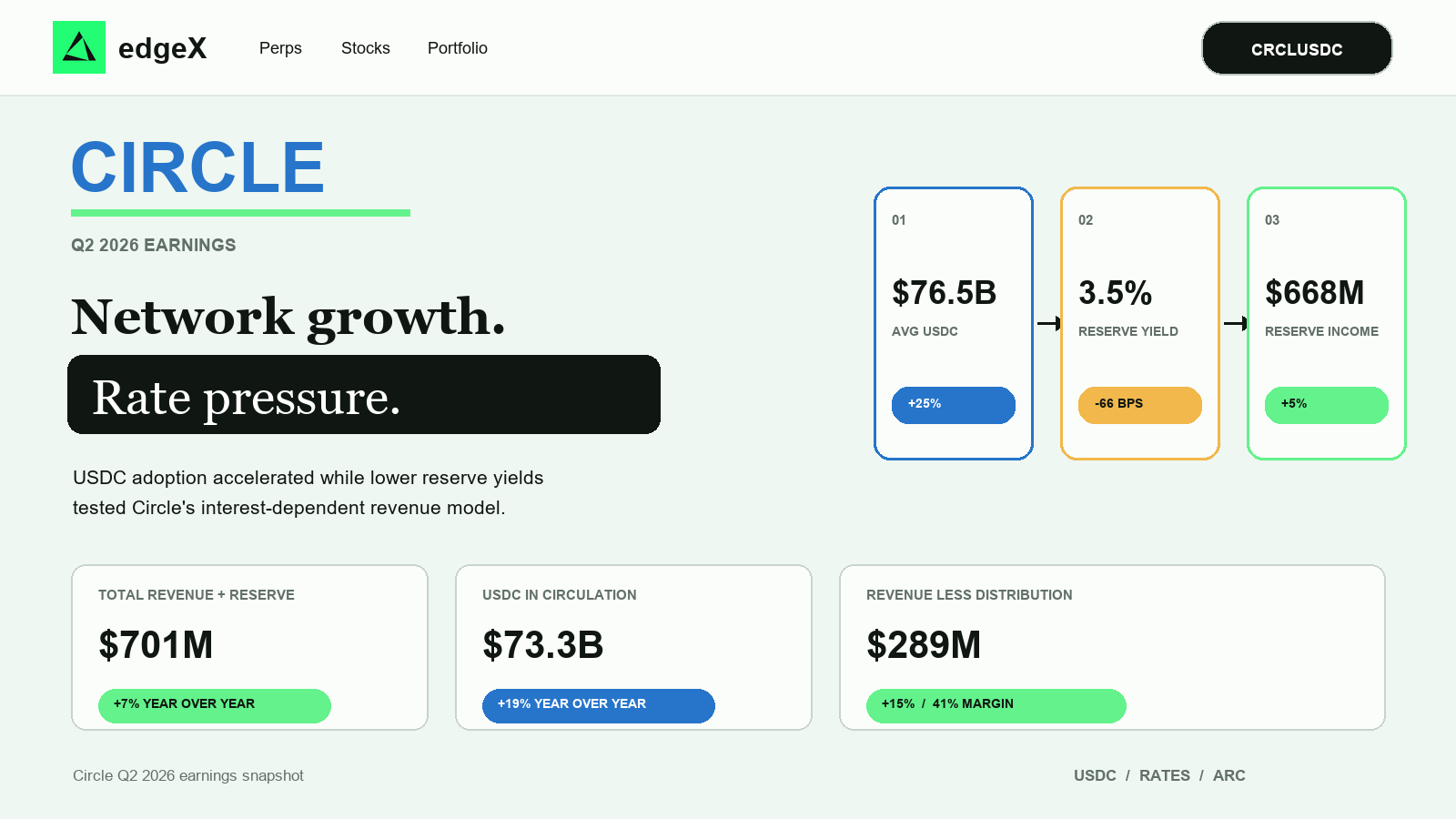
Circle's second-quarter report contained two stories moving in opposite directions. The USDC network expanded rapidly: average circulation increased 25%, onchain transaction volume jumped 151%, and the amount of USDC held on Circle's platform more than doubled. Yet total revenue and reserve income grew only 7% because falling reserve yields absorbed much of the benefit.
That divergence is the central CRCL investment question. Circle has built one of the largest regulated stablecoin networks, but its income statement still depends heavily on the interest earned from assets backing USDC. More tokens in circulation help. Lower short-term rates hurt. The company can reduce that sensitivity only if payments, infrastructure, custody and software become more meaningful contributors.
Q2 provides evidence that this transition has begun, not that it is complete. Other revenue grew 41%, Circle Payments Network expanded, Arc secured institutional participants, and two trust-bank approvals strengthened the regulated-infrastructure story. Reserve income still represented approximately 95% of total revenue and reserve income.
The Numbers Behind Circle Q2 2026 Earnings
Circle's quarter ended June 30. The financial statements show stronger operating economics than a year earlier, but comparisons are complicated by IPO-related expenses in Q2 2025.
| Metric | Q2 2026 Result | Investor Read |
|---|---|---|
| Total revenue and reserve income | $701 million | Up 7% year over year |
| Reserve income | $668 million | Up 5% despite 25% growth in average USDC circulation |
| Other revenue | $34 million | Up 41% from subscription and services growth |
| Revenue less distribution costs | $289 million | Up 15%, faster than headline revenue |
| RLDC margin | 41% | Expanded 302 basis points |
| GAAP operating income | $34 million | Improved from a $326 million operating loss |
| Net income from continuing operations | $48 million | Improved from a $482 million loss |
| Diluted earnings per share | $0.18 | Compared with a $4.48 loss per share |
| Adjusted EBITDA | $143 million | Up 8%; adjusted margin declined to 50% |
The dramatic GAAP improvement requires context. Q2 2025 included $435 million of stock-based compensation, largely associated with Circle's IPO. The comparable Q2 2026 charge was approximately $54 million. The return to profit is real in the reported accounts, but it does not represent a $530 million improvement in the recurring earning power of the business.
USDC Growth Ran Into Lower Reserve Yields
Reserve income increased to $668 million from $634 million. That 5% gain looks modest beside the 25% increase in average USDC circulation to $76.5 billion. The reason was a 66-basis-point decline in the reserve return rate to 3.5%.
More circulation does not guarantee faster revenue growth
Circle earns reserve income from the cash and short-duration assets backing USDC. Its economics therefore depend on both the size of the reserve base and the yield earned on it. A larger USDC float can be offset by lower interest rates, as Q2 demonstrated.
Quarter-end circulation was $73.3 billion, up 19% year over year but below the $76.5 billion quarterly average. That difference does not establish a lasting decline by itself, but it gives investors another reason to track daily circulation rather than relying only on annual growth rates.
Rate sensitivity remains the valuation constraint
If USDC circulation compounds at management's 40% through-cycle target, volume growth could offset some rate pressure. The calculation becomes harder if circulation growth slows while policy rates fall. CRCL's valuation therefore cannot be separated from the interest-rate path until non-reserve revenue represents a much larger share of the business.
This does not make lower rates uniformly negative. Easier financial conditions can support crypto activity, tokenized assets and cross-border payments. The question is whether those benefits create enough platform revenue to replace lost reserve yield.
Distribution Economics Improved Faster Than Revenue
Circle pays distribution and transaction costs to partners that help make USDC available. Those costs rose only 1% to $412 million, while total revenue and reserve income grew 7%. As a result, revenue less distribution costs increased 15% to $289 million and RLDC margin expanded to 41% from 38%.
USDC held on Circle's platform can improve retention
USDC on Circle's platform reached $12.4 billion at quarter end, up 106%. Its daily weighted average share of total circulation rose to 19.5%, an increase of 1,204 basis points. Holding a larger share within Circle's own platform can improve the portion of reserve economics the company retains rather than distributes to partners.
That metric may become as important as total circulation. Network growth is valuable, but the location and channel mix of USDC determine how much economics accrues to Circle. Investors should watch whether on-platform balances remain elevated without weakening the external partnerships that support distribution.
Network Usage Grew Far Faster Than Financial Revenue
USDC processed $14.8 trillion of onchain transaction volume during Q2, up 151%. Circle also reported approximately $163 billion of daily onchain volume and $1.9 billion of daily minting and redemptions. The figures demonstrate utility and network throughput even though transaction volume does not translate directly into an equivalent amount of Circle revenue.
Stablecoin market share and trading activity were mixed
Circle reported USDC market share of 27%, down 66 basis points. Secondary-market notional trading volume was $2.9 billion per day, down 45% in line with weaker crypto trading markets. At the same time, meaningful wallets holding more than $10 of USDC increased 24% to 7 million.
This is a broader adoption story with competitive pressure attached. USDC can gain users, transactions and institutional integrations while losing modest circulation share to rival stablecoins. CRCL investors should distinguish growth in the overall stablecoin market from Circle's ability to capture that growth.
Profitability Improved, but Investment Is Still Rising
Circle produced $34 million of GAAP operating income and $48 million of net income from continuing operations. Adjusted EBITDA increased 8% to $143 million, while its adjusted EBITDA margin declined 329 basis points to 50%.
The prior-year comparison flatters the GAAP swing
Operating expenses fell 56% to $254 million because the prior-year quarter included exceptional IPO-related stock compensation. On an adjusted basis, operating expenses increased 23% to $146 million as Circle invested in product development, infrastructure and AI capabilities.
That is the cleaner forward-looking signal. Circle has moved beyond the IPO accounting shock, but it is not entering a low-investment phase. Arc, payments infrastructure, trust operations and agent products require spending before their revenue contribution is fully visible.
Arc Is Becoming the Center of the Diversification Case
Circle plans to launch Arc's public mainnet on September 16. The company said the ecosystem has more than 100 institutional and ecosystem builders and named a founding validator group that includes BlackRock, DTCC, Mastercard, Visa, Standard Chartered, ICE and others.
Institutional names create credibility, not guaranteed economics
DTCC plans to enable tokenization of DTC-custodied assets on Arc, while BlackRock's BUIDL fund is expected to deploy on the network. These integrations could make Arc useful for tokenized securities, collateral movement, foreign exchange and settlement.
Participation does not establish the amount or timing of future revenue. Investors need information on fees, activity, developer adoption, asset volumes and Circle's share of the economics. Arc can strengthen USDC's utility even before it becomes a large standalone revenue source, but the valuation case eventually requires measurable monetization.
Token presale revenue complicates the guidance upgrade
Circle raised 2026 other-revenue guidance from $150 million-$170 million to $310 million-$330 million. The official guidance states that the revised range includes recognized Arc token presale revenue. That makes the upgrade material but less comparable with recurring subscription or payment income.
The distinction matters because investors are looking for durable diversification away from reserve yield. Token presale revenue can fund and validate the network, but it should not automatically receive the same valuation treatment as repeatable service revenue.
Payments and Agent Products Add Earlier-Stage Options
Circle Payments Network reached $14.7 billion of annualized transaction volume based on the trailing 30 days at quarter end, up 76% from Q1. Enrolled financial institutions increased 29% to 175. Partnerships with BNY, Standard Chartered, Nium, JCB and others expanded institutional access, settlement and payout use cases.
Agent Stack, launched in May, hosted more than 900 paid services, while 99.3% of x402 agent-payment volume settled in USDC. These businesses are small beside reserve income, but they show how Circle could monetize transaction coordination and programmable finance rather than only the assets backing USDC.
The investor test is conversion. Enrollment, integrations and annualized volume are adoption measures; recognized revenue and contribution margin determine whether they change CRCL's earnings profile.
Trust Charters Strengthen the Regulatory Moat
Circle received final OCC approval to establish Circle National Trust and NYDFS approval for Circle New York Trust. The federal charter authorizes regulated digital-asset custody and creates a route for future management of USDC reserves, while the New York entity adds a state-regulated trust structure.
These approvals can increase institutional confidence and lower uncertainty around custody and reserve infrastructure. They also bring compliance costs, supervisory obligations and execution risk. Regulation is not simply a protective moat; it is an operating capability Circle must fund and maintain.
Guidance Points to Better Retention and Higher Complexity
Circle kept its multi-year 40% through-cycle USDC circulation growth target and its $570 million-$585 million adjusted operating-expense outlook. It raised expected RLDC margin from 38%-40% to 41.7%-43.7%, alongside the higher other-revenue range.
The margin revision suggests stronger retention of network economics. The revenue revision broadens the growth story but includes Arc token revenue. Investors should therefore evaluate the outlook in two layers: recurring improvements in distribution economics and less recurring contributions tied to the Arc launch.
The Bull Case, Bear Case and Middle Path for CRCL
The bull case is that USDC circulation continues compounding, Circle retains more reserve economics, and regulated integrations make USDC a settlement layer for payments and tokenized assets. Arc, CPN and custody then create recurring fees that reduce rate sensitivity and justify an infrastructure valuation.
The bear case is that lower rates compress reserve income faster than new products monetize. Stablecoin competition limits market-share gains, partner payments remain substantial, and Arc activity produces less revenue than its institutional roster implies. CRCL would remain a high-expectation stock tied to interest rates and crypto liquidity.
The middle path is gradual diversification. USDC remains the profit engine, distribution economics improve, and new products add revenue unevenly. In that outcome, Circle becomes less rate-sensitive over time, but each Federal Reserve cycle still matters to near-term earnings.
What Circle Investors Should Watch Next
The next report should be read through a connected dashboard: average and quarter-end USDC circulation, the reserve return rate, reserve income, USDC held on Circle's platform, RLDC margin, recurring other revenue, adjusted operating expenses and Arc mainnet activity.
Investors should also separate transaction volume from monetization and token revenue from repeatable service revenue. The company is building credible infrastructure around a growing network. The next proof point is whether that infrastructure changes the income statement before lower rates change the reserve-income base.
Q2 strengthened the case that Circle has distribution, regulatory standing and institutional relationships that are difficult to reproduce. It also confirmed that CRCL remains financially anchored to reserve yield. The stock's longer-term story depends on closing that gap.
Trade Circle Perpetual Futures on edgeX
Circle earnings, stablecoin regulation and changes in interest-rate expectations can move CRCL outside regular U.S. market hours. edgeX provides eligible traders with access to crypto, commodity and stock-linked perpetual markets through a self-custodial platform.
Access the CRCLUSDC market
The CRCLUSDC perpetual market provides a Circle-linked contract for expressing long or short views. Before opening a position, traders should verify current leverage, funding, fees, liquidity, order availability and contract specifications on the product page.
Understand the instrument and its risks
Perpetual futures are derivatives, not Circle common stock. They do not provide ownership, voting rights, dividends or other shareholder rights. Leverage magnifies gains and losses and can result in liquidation. Availability varies by jurisdiction, and self-custody does not remove market, smart-contract, liquidity or execution risk.
Frequently Asked Questions
When did Circle release its Q2 2026 earnings?
Circle released its second-quarter results on August 5, 2026. The quarter ended June 30, 2026.
What was Circle's Q2 2026 revenue?
Circle reported $701 million of total revenue and reserve income, up 7% year over year. Reserve income contributed $668 million, while other revenue was $34 million.
Was Circle profitable in Q2 2026?
Yes. Circle reported $34 million of GAAP operating income and $48 million of net income from continuing operations. The prior-year loss included unusually high IPO-related stock compensation, so the year-over-year improvement should not be treated as entirely recurring.
How much USDC was in circulation?
Quarter-end USDC circulation was $73.3 billion, up 19% year over year. Average circulation during the quarter was $76.5 billion, up 25%.
Why did reserve income grow more slowly than USDC circulation?
The reserve return rate declined 66 basis points to 3.5%, offsetting part of the benefit from a larger average reserve base.
What did Circle change in its 2026 guidance?
Circle raised other-revenue guidance to $310 million-$330 million and RLDC-margin guidance to 41.7%-43.7%. The other-revenue range includes recognized Arc token presale revenue.
Is the CRCL share price in this article live?
No. Verify the latest CRCL quote through NYSE, a broker or a real-time market-data service before making a trading decision.

