Ceuta Migration Surge Exposes Deepening Fault Lines in European Politics and Demographics
Key Takeaways
- •Approximately 50,000 migrants entered Ceuta within 48 hours, vastly exceeding a 2021 influx of 8,000 that was linked to deliberate Moroccan border relaxation.
- •Italy suspended passport-free Schengen travel with Spain for one month, with Prime Minister Giorgia Meloni advocating an indefinite suspension, while France tightened its border and other EU states urged broader action.
- •The crisis marks an early stress test for the EU's New Pact on Migration and Asylum, finalized in April 2024 to create a unified migration framework through mandatory solidarity and faster processing.
- •Spain's Supreme Court recently prohibited the forced return of migrants arriving by sea at Ceuta and Melilla, a ruling cited as a trigger despite being insufficient to explain the scale of arrivals.
- •The EU's total fertility rate fell to 1.34 in 2025, while Spain's stands at 1.1, intensifying debates over whether Europe can sustain growth through migration, automation, or other structural reforms.
Ceuta Migration Surge Exposes Deepening Fault Lines in European Politics and Demographics
By Jacob Shapiro, Geopolitical Analyst, Mauldin Economics
Every explanation offered for what happened in Ceuta last week is technically accurate yet fundamentally insufficient. A court ruling, a politically weakened prime minister, an open-borders policy—none of these accounts for how roughly 50,000 people arrived at a small Spanish town within 48 hours. The question that follows is unavoidable: which actors stand to gain the most?
The Situation
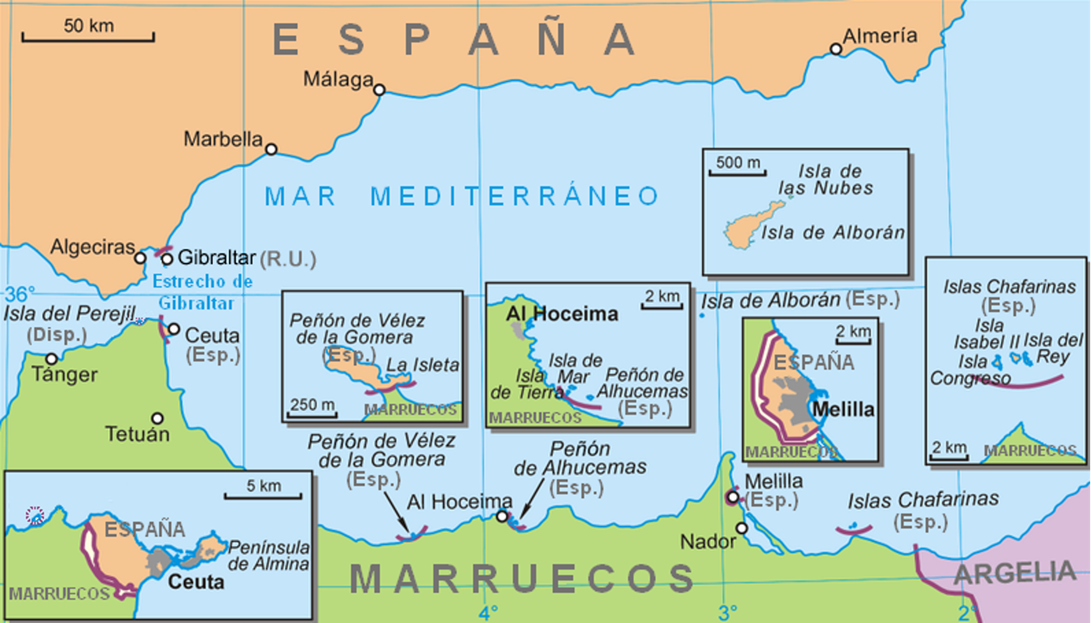
Over the course of two days last week, approximately 50,000 migrants entered the Spanish exclave of Ceuta, which has a population of roughly 84,000. Ceuta sits across the Strait of Gibraltar on the North African coast. Together with the exclave of Melilla and several small islets known collectively as the plazas de soberanía—or "strongholds of sovereignty"—these territories represent the remnants of Spanish colonial control along the African side of the Mediterranean. Ceuta and Melilla are also the EU's only land borders on the African continent, and although they are part of Spanish sovereign territory, they sit outside the Schengen area—making them a buffer zone where migration pressure concentrates.
Morocco has never recognized Spanish sovereignty over Ceuta or Melilla and has, on multiple occasions, leveraged its geographic proximity to exert political and diplomatic pressure on Madrid. In May 2021, Morocco deliberately relaxed border controls at both exclaves after Spain permitted Brahim Gali, the leader of the Polisario Front, to receive medical treatment on Spanish soil. That move triggered an influx of approximately 8,000 migrants and prompted the deployment of the Spanish military.
The Polisario Front carries its own complex history. Morocco annexed two-thirds of Western Sahara—a former Spanish colony—in 1975. The United States and Israel have since recognized Moroccan sovereignty over the territory (following Morocco's recognition of Israel), though most countries, including Spain, have not. The territory carries significant economic weight: Morocco holds roughly 70% of the world's known phosphate reserves, and Western Sahara contributes approximately 10% of Morocco's phosphate income.
Cui Bono?
The Western Sahara narrative, however, leads to a dead end for explaining last week's events. Spain abandoned its support for a referendum on Western Sahara's future in 2022, instead endorsing a Moroccan proposal under which the territory would retain autonomy under formal Moroccan sovereignty. That diplomatic realignment created a significant rift with Algeria, which—beyond being the Polisario Front's principal backer—supplied approximately 40% of Spain's natural gas imports in 2025.
Spain was willing to risk serious damage to its relationship with Algeria, a calculation that allowed it to weather the Russia-Ukraine war considerably better than its Eastern and Central European EU counterparts, in order to repair ties with Morocco.
Spain has not (yet) accused Morocco of complicity in last week's far larger influx. Prime Minister Pedro Sánchez visited Algeria in July, but there is no indication that Spain is reconsidering its position on Western Sahara—the two sides merely discussed "a mutually beneficial economic partnership." The stated trigger for the surge is a Spanish Supreme Court ruling issued weeks ago that prohibits the forced return of migrants arriving by sea at Ceuta and Melilla. Also cited is Sánchez's broader pro-migration agenda, which has drawn criticism from Denmark to Italy. Spain has one of the EU's lowest fertility rates at 1.1, and in January, Sánchez pushed through a controversial amnesty covering more than 500,000 undocumented migrants.
None of this, however, adequately explains how more than 50,000 people crossed into Ceuta in two days. Even with documented Moroccan complicity in 2021, the figure peaked at approximately 8,000. Local authorities had warned of the buildup for ten days, with arrivals numbering in the hundreds per day—a scale difficult to attribute solely to a court ruling and a prime minister pursuing unorthodox growth strategies. Sánchez has blamed human traffickers for spreading false information about the ruling.
The Third Rail of European Politics
The intra-European fallout was immediate, elevating the crisis beyond a local matter.
Italy suspended passport-free Schengen travel with Spain for one month, with Prime Minister Giorgia Meloni calling for the suspension to be made indefinite. France tightened its border with Spain as well. Non-neighboring states including Denmark and Czechia argued that the EU should consider suspending Spain from the Schengen area altogether. Only Slovakia's Robert Fico offered rare support, contending that policing Europe's borders is every member state's responsibility.
The response laid bare the limits of the EU's New Pact on Migration and Asylum, finalized in April 2024 after years of negotiation, which was intended to create a more unified European migration framework through mandatory solidarity mechanisms and faster processing procedures. The Ceuta crisis has become an early stress test of whether that pact can hold when a single member state's policies diverge sharply from the rest.
This dynamic reflects a recurring pattern in European geopolitics. Even as member states coalesce around shared priorities—defense self-sufficiency, support for Ukraine, maintaining a united trade stance toward China—migration, the third rail of European politics, resurfaces once again.
If the EU is to become stronger and more sovereign, migration policy cannot be left to bilateral bargains, nor can a single member state pursue policies so sharply at odds with the rest. That incoherence is precisely what enables outside actors to weaponize migration, as Morocco demonstrated to its own benefit in 2021.
Europe's Demographic Trilemma
The Ceuta episode raises even more difficult structural questions. European population growth is in steep decline: the EU's total fertility rate stood at 1.34 in 2025, a sharp drop since the pandemic. European states also face greater challenges integrating migrants of different faiths and ethnicities. Muslims constitute roughly 5% of Spain's population, and Islam is the country's fastest-growing religion, with Muslim women's fertility rates running at two to three times the native rate.
Official US national security policy now asserts that Europe faces the prospect of "civilizational erasure" and "will be unrecognizable in 20 years or less." The European right echoes the same concerns about the erosion of national distinctiveness. Yet there is reason for at least measured sympathy with Sánchez's predicament: like every aging society, Europe faces three fundamental options—encourage higher birth rates, accept more migrants, or invest heavily in automation and robotics.
The first is virtually impossible to achieve through policy alone. The second is politically explosive—Sánchez has led a minority government since 2023 and is unlikely to survive until the next election, due by summer. Migration policy contributed to the downfall of Angela Merkel and likely helped push Brexit over the line; the reaction to Ceuta illustrates why. That leaves automation, an area where the EU is not at the frontier—faster-aging societies such as China, Japan, and South Korea have grappled with these demographic challenges for decades and remain further ahead.
There may be a fourth path, though the EU may lack the political will to pursue it. Where 19th-century European imperialism extracted resources, a 21st-century equivalent might attract human capital—drawing the most skilled from neighboring countries—or open new consumer markets in demographically growing regions that will purchase European goods. Fewer people need not inevitably mean slower growth, but for a generation the European economy has depended on the German export machine as its beating heart. Without export growth, Germany and its supply chains—already strained by the loss of Russian energy and intermittent disruptions to the Strait of Hormuz—face a difficult road ahead.
A Case for Cautious Optimism on Europe
A bullish stance on Europe may seem surprising, but much of that optimism rests on the premise that Europe's challenges are severe enough to eventually compel the EU to replace high-minded pronouncements with genuine, rapid policy change.
There is already a concrete precedent visible in the same energy statistics referenced throughout this account. A few years ago, Spain drew a comfortable share of its natural gas from Russia; by 2025, the United States had quietly become Spain's second-largest supplier, accounting for nearly one-third of imports, while Spain reduced Russian LNG purchases by 41% in a single year.
Europe is frequently characterized as too sclerotic and over-regulated to move with urgency. The gas pivot demonstrates what happens when a genuine emergency—the weaponization of energy—removes the luxury of prolonged deliberation: Europe rewires critical supply chains within roughly two years, pragmatically and without fanfare, because it has exhausted all alternatives.
Europe possesses wealth, human capital, deep institutions, and favorable geography—but Ceuta serves as a reminder that without political cohesion and determined action, even these advantages can be diminished.
Map/Chart of the Week
Korean equities have once again reached attractive valuation levels.
Blind Spot: Populism and Energy
US President Donald Trump publicly attacked Chevron and Exxon earlier this week, demanding they lower retail gasoline prices and accusing them of excessive profits, while also complaining that Chevron's CEO had not shown sufficient gratitude for the administration's efforts on behalf of the domestic oil industry.
Had the same words been attributed to US Representative Alexandria Ocasio-Cortez, the media response would likely have focused on allegations of anti-capitalist overreach. Complaining that energy companies earn too much and demanding they set prices in line with White House preferences during a supply crunch is behavior more commonly associated with avowed socialists such as Brazil's Luiz Inácio Lula da Silva, who has pursued similar approaches and, in doing so, hindered his country's economic performance.
The irony is that this administration has placed the fight against communism at the center of its foreign and domestic policy. Secretary of State Marco Rubio stated on July 22: "We're certainly not going to allow communist efforts to undermine American society and drive wedges into our country." Yet a government that takes equity stakes in roughly 30 companies, sells preferential access to the president through a meme coin, charges fees for expedited access to his social media posts, dismisses apolitical career statisticians when data proves inconvenient, and pressures companies into compliance exhibits features that bear an uncomfortable resemblance to what it claims to oppose.
This is not principled communism, even if it shares certain superficial characteristics. It is traditional populism—and for the last two presidential cycles, populism has been the only option on the American ballot. There are no free-market fiscal conservatives wielding significant power in US politics today.
To the extent there is a bias in this assessment, it is not against one side but against the reality that there is effectively only one side. Figures like Mamdani and Trump, or J.D. Vance and AOC, represent two faces of the same phenomenon. The question is whether a historically justified fear of communism has become so consuming that those loudest in denouncing it escape scrutiny for resembling what they claim to stand against.
Originally published at Mauldin Economics. Source: GoldSeek.
