Hoskinson Says Bitcoin’s “Frozen” Governance Is Key Vulnerability as ADA Trades Near $0.16
Key Takeaways
- •Charles Hoskinson argued that Bitcoin's static governance model, rather than quantum computing, poses the greatest risk to the network, contrasting it with Cardano's on-chain voting system that could facilitate faster protocol upgrades.
- •An upcoming Cardano upgrade is planned to increase network speed by a factor of 60, potentially strengthening the project's long-term technical narrative.
- •Analyst More Crypto Online identified ADA's stabilization around $0.163 as constructive but emphasized that this does not constitute confirmation of a market bottom.
- •A sustained break above $0.20 is viewed as the first meaningful technical signal that ADA's correction may be ending, with subsequent resistance targets at $0.23 and $0.314.
- •If ADA loses its current support near $0.163, the next major downside level is identified at $0.092, representing approximately a 40% decline from current prices.
Cardano’s ADA has traded lower in recent days alongside many other altcoins. The token fell 2% on the day and was trading slightly above $0.16, while the broader crypto market was also weaker and Bitcoin moved near $64,000.
Against that backdrop, Cardano-related discussion centered on comments from Charles Hoskinson about Bitcoin governance, as well as technical analysis from More Crypto Online on ADA’s current price structure.
Hoskinson Points to Bitcoin Governance Risk
Charles Hoskinson argued that Bitcoin’s “frozen in time” governance, rather than quantum computing itself, represents the network’s greatest vulnerability. He contrasted Bitcoin’s governance model with Cardano’s on-chain voting system, which he said could coordinate a timely migration to quantum-resistant cryptography if needed.
The governance point matters because changes to major blockchain protocols are not only technical decisions. Bitcoin upgrades generally depend on broad social consensus across developers, miners, node operators, and users, while Cardano has emphasized formal on-chain governance as part of its network design. Hoskinson’s argument was that the ability to coordinate protocol changes could become important if cryptographic standards need to evolve.
Hoskinson also confirmed that an upcoming Cardano upgrade is intended to make the network 60 times faster.
The comments frame Cardano’s governance model as a potential structural advantage, but they do not in themselves indicate immediate adoption or a direct short-term effect on ADA’s price. The planned upgrade may support Cardano’s longer-term technical narrative, while current market pricing remains driven by broader conditions and near-term price action.
More Crypto Online Says ADA Is Stabilizing, Not Bottoming
Analyst More Crypto Online also commented on Cardano’s current price behavior, with the related X post available at https://x.com/moretradingonl/status/2080794455087386734?s=20.
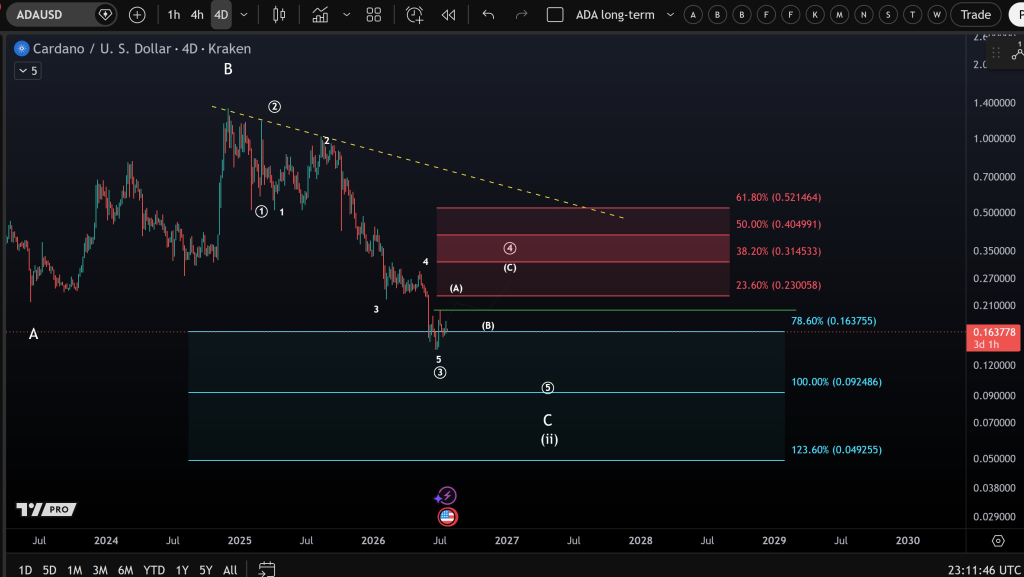
According to the analysis, Cardano is stabilizing around $0.163, identified as the first major downside target. However, the analyst distinguished stabilization from confirmation of a bottom. ADA is holding near that level, but the analysis said there is not yet confirmation of a reversal.
A move above $0.20 would make a wave 4 bounce toward $0.23 and $0.314 more credible, according to the same view. Such a move would be treated as the first meaningful signal that a low might be forming.
As long as ADA remains below $0.20, however, the analysis said the third wave could still be extending. The next major level identified below current prices is $0.092.
Fibonacci Levels and Wave Structure
The 4-day chart cited by More Crypto Online showed Cardano’s long-term wave structure and several key Fibonacci levels.
The 78.6% Fibonacci retracement level was placed at $0.163, with ADA trading directly around that level. The analysis described it as the first major downside target. Holding that area was characterized as constructive, but not sufficient to confirm a bottom.
The chart also showed a completed (A)-(B)-(C) correction, followed by a potential wave (ii) bounce. The labeling suggested ADA remains in a larger corrective phase, with the possibility of further downside before any sustained recovery.
On resistance, $0.20 was identified as the first major level to watch. A break above $0.20 would open the way toward $0.23 and $0.314, according to the chart analysis. The levels of $0.230 and $0.314 were listed as the next resistance areas.
On the downside, $0.092 was identified as the 100% Fibonacci extension level. If the third wave extends, that level was cited as the next major area below current prices.
The broader ADA chart was described as showing a multi-year downtrend from the 2021 peak above $3.00. In that context, current price action was framed as a correction inside the larger structure. A break above $0.20 was described as the first sign that the correction could be ending.
Possible ADA Price Scenarios
The short-term outlook described in the source remained cautious. ADA is holding support at $0.163, but the analysis emphasized that stabilization does not equal a confirmed bottom. The wave structure was presented as leaving room for additional downside before any sustainable recovery.
In the bullish scenario, ADA would break above $0.20, with the next targets at $0.23 and $0.314. The analysis said that would be the first real signal that the low might be in, and that such a move would require a broader crypto market recovery and positive news catalysts.
In the neutral scenario, ADA would continue trading between $0.16 and $0.18, with low volume and no clear direction. The source described this as the most likely outcome over the next few days.
In the bearish scenario, ADA would lose the $0.163 level, putting the next major level at $0.092. The source said that would represent a roughly 40% decline from current levels and would indicate that the third wave was still extending.
The original analysis concluded with a cautious view, stating that the chart remained bearish, the wave structure pointed lower, and positive fundamentals had not yet been reflected in price action. It said a break above $0.20 would be needed before considering that the technical picture had materially improved.

