Bitcoin Drops Below $69,500 as Oil Surges Above $100 After Tanker Attacks
Key Takeaways
- •Bitcoin fell below $69,500 as oil prices climbed above $100 per barrel following attacks on commercial tankers.
- •The sell-off reflected broader risk reduction across markets rather than a change in Bitcoin’s underlying fundamentals.
- •Elevated crude prices can increase inflation concerns and affect central bank policy expectations, pressuring risk assets.
- •Traders are focused on whether Bitcoin can reclaim the lost level and whether oil remains above $100.
- •Continued corporate engagement, including Strategy’s $15 million Bitcoin security consortium pledge, remains a factor in market sentiment.
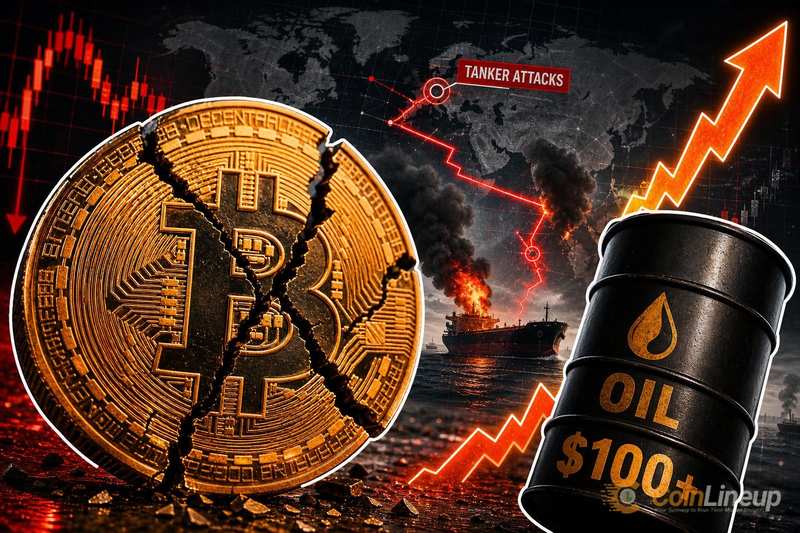
On March 12, 2026, Bitcoin slipped below a closely watched price threshold as oil prices jumped above $100 per barrel following attacks on commercial tankers, prompting a broad risk-off rotation across financial markets and pressuring cryptocurrency sentiment.
Bitcoin Under $69,500 as Energy Shock Spreads
Bitcoin fell under $69,500 as the sudden surge in energy prices rippled through global markets. Breaches of widely monitored price levels often signal a repositioning by traders rather than an isolated move within the crypto ecosystem. According to CoinDesk, the decline was part of a broader de-risking response to the day's geopolitical headlines, not a shift driven by Bitcoin's own fundamentals.
When macroeconomic shocks materialize, Bitcoin has frequently traded in tandem with equities and other risk-sensitive assets rather than functioning as a hedge. That pattern has been observed repeatedly during geopolitical flare-ups, including prior episodes of Middle East tensions and the early phases of the Russia–Ukraine conflict in 2022, when Bitcoin sold off alongside equities before eventually decoupling. The digital asset's correlation with traditional risk markets was again evident in the cross-market sell-off triggered by the tanker incidents.
Oil Above $100 and Rising Geopolitical Risk
The catalyst was a series of tanker attacks that pushed crude oil back above the $100-per-barrel mark. A sharp increase in oil prices typically signals market fears of supply disruptions and escalating geopolitical uncertainty. The $100 threshold itself carries psychological weight in energy markets, as it has historically coincided with periods of heightened inflationary pressure and consumer-facing economic stress.
Attacks on commercial shipping in strategic waterways — particularly chokepoints such as the Strait of Hormuz, through which roughly a fifth of global oil consumption transits — have repeatedly triggered sharp market reactions. Those concerns tend to cascade across asset classes: elevated energy costs combined with geopolitical instability push investors to reduce risk exposure broadly, and Bitcoin is often swept up in that rotation. Sustained high oil prices can also reinforce inflation expectations, which influence central bank policy decisions and, in turn, the liquidity environment that risk assets depend on. The result was cross-market volatility on the day that pressured cryptocurrencies alongside other risk trades.
The episode underscored how Bitcoin's price can be influenced by developments well beyond the digital-asset sector, even as long-term corporate holders such as Tesla continue maintaining Bitcoin on their balance sheets through periods of market turbulence.
What Traders Are Watching Next
The immediate focus is whether Bitcoin can reclaim and hold the level it lost, or whether the breakdown invites further selling. A swift recovery above the threshold would suggest the drop was a headline-driven reaction rather than a broader trend reversal.
Oil direction remains the primary macroeconomic variable. If crude oil stays above $100, the risk-off pressure is likely to persist; a pullback in energy prices would ease the macro headwinds that contributed to the sell-off.
Institutional activity may also factor into any recovery. Initiatives such as Strategy's newly launched Bitcoin security consortium, which pledged $15 million over three years, highlight continued corporate engagement with Bitcoin even during volatile stretches.
For now, the trajectory of broader risk sentiment will likely determine whether the market stabilizes near current levels or extends its decline.

