Bitcoin ETF Trading Volume Falls to Lowest Level Since October 2024 as Citi Cuts Price Targets
Key Takeaways
- •Spot Bitcoin ETF weekly trading volume fell to about $8.05 billion, its lowest full five-session level since October 2024.
- •Bitcoin ETFs recorded only $33.8 million in net inflows for the week after heavy withdrawals on Thursday and Friday nearly erased earlier gains.
- •Citigroup lowered its 12-month Bitcoin target to $82,000 from $112,000 and its Ethereum target to $2,240 from $3,175.
- •BlackRock’s iShares Bitcoin Trust posted $95.5 million in weekly net outflows, while Grayscale’s Bitcoin Mini Trust and ARK 21Shares Bitcoin ETF saw inflows that partially offset the weakness.
- •Ether ETFs attracted $103.9 million in net inflows last week, more than three times the Bitcoin ETF total despite having much smaller net assets.
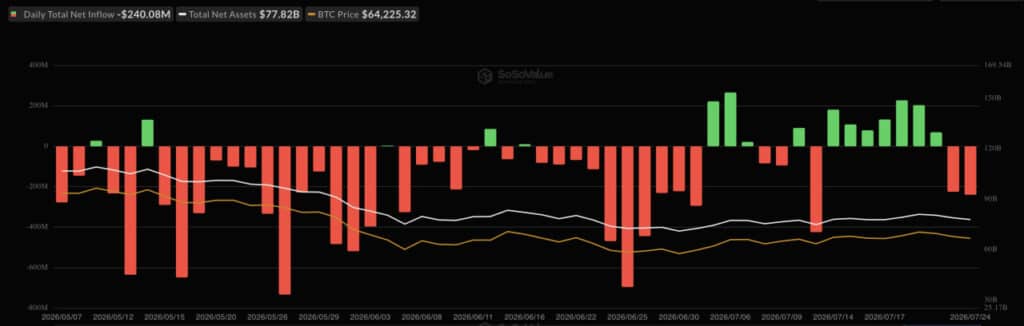
Bitcoin (BTC) is trading near $65,100 as Wall Street’s patience appears to be fading, and the latest Bitcoin ETF data is turning weaker. Spot Bitcoin exchange-traded fund (ETF) weekly trading volume fell to its lowest level for a full five-session week since October 2024, reaching about $8.05 billion, down 14% from $9.37 billion the previous week.
Citigroup was the first major bank to react, cutting its 12-month Bitcoin target to $82,000 from $112,000 and its Ethereum target to $2,240 from $3,175. The bank said the revision reflected negative ETF flows and stalled U.S. digital asset legislation, underscoring how closely institutional positioning has become tied to both product demand and the policy backdrop.
Bitcoin ETF Volume Slips to 2024 Lows
The volume data tells one story, while the flow data paints a more complicated picture. Bitcoin ETFs ended the latest week with just $33.8 million in net inflows, the weakest total across three consecutive positive weeks. That compared with $75.7 million the week before and $197.4 million in the week before that.
The slowdown was sharp. ETFs attracted roughly $499.1 million during the first three sessions of the week, but investors withdrew $225.2 million on Thursday and another $240.1 million on Friday, nearly wiping out the week’s gains within 48 hours.
BlackRock’s iShares Bitcoin Trust, ticker IBIT, the largest spot Bitcoin ETF by net assets, posted $95.5 million in net outflows for the week after losing a combined $414.7 million in the final two sessions alone.
Grayscale’s Bitcoin Mini Trust and the ARK 21Shares Bitcoin ETF helped offset some of the weakness, with about $85.8 million and $78.1 million in inflows, respectively, but those gains were not enough to close the gap.
Citi analysts wrote that the “absence of a catalyst for increased investor interest” led them to assume no net ETF inflows over the next 12 months. That is a notable assumption, because spot Bitcoin ETFs have become one of the main public-market routes for investors seeking exposure without holding BTC directly.
From a technical perspective, Bitcoin is holding a contested support zone in the mid-$50,000s, close to Citi’s bear-case target of $53,000. Under Citi’s revised base case, the $80,000 to $82,000 range now acts as medium-term resistance. The bull case would require renewed ETF inflows and meaningful progress on U.S. crypto legislation, while the bear case centers on a macro-driven recession that could push BTC toward $53,000.
Not all analysts share Citi’s caution. Bernstein described the ETF slowdown as a “short-term pause” and kept its end-2025 Bitcoin target at $150,000, arguing that the broader bull market remains intact.
Ethereum is facing a similar backdrop. ETH is trading near $1,570, with Citi’s bear-case floor at $1,094 and its base-case target at $2,240. Ether ETFs brought in $103.9 million in net inflows last week, more than three times the Bitcoin ETF total, despite having roughly one-eighth of the net assets. That relative strength stands out, even as both asset classes remain sensitive to ETF demand, regulatory clarity, and broader risk appetite.
Bitcoin Hyper Seeks Early-Stage Exposure to Bitcoin’s Ecosystem
With spot BTC around $58,400, ETF flows flat, and Wall Street targets reduced, Bitcoin still offers a clearly defined range. Citi’s base-case target of $82,000 implies roughly 40% upside from current levels. However, that return would be spread over 12 months and comes with macro risk in both directions, against a backdrop of an asset already worth hundreds of billions of dollars.
That is the case being made for Bitcoin Hyper ($HYPER), an early-stage infrastructure project built around Bitcoin’s ecosystem.
Bitcoin Hyper is positioning itself as the first Bitcoin Layer 2, a secondary network designed to process transactions off Bitcoin’s main chain in order to increase speed and lower fees. The project says it includes integrated Solana Virtual Machine (SVM) support, which would allow fast, programmable smart contracts within Bitcoin’s security model.
It also says its Layer 2 design enables sub-Solana latency and that it includes a Decentralized Canonical Bridge for native BTC transfers.
According to the project, the presale has raised $32,982,915.68 at a current price of $0.0136837. Staking is available at a high APY, although the specific rate has not been disclosed at this stage.
As with other presale-stage assets, the risks are significant. Liquidity is limited, the project has not been proven at scale, and Layer 2 execution risk remains substantial.
EXPLORE: Best Crypto Presales With Asymmetric Upside in the Current Market

