Best AI Receptionists and AI Answering Services for Small Businesses in 2026
Key Takeaways
- •AI receptionist services start at approximately $25 per month, compared to $250–$350 for human virtual receptionists, making always-on call coverage accessible to sole proprietors and small businesses for the first time.
- •The eight reviewed platforms employ different billing models—per-call, per-minute, or per-unique-caller—requiring businesses to match pricing structures to their specific call volume and duration patterns.
- •Only Smith.ai among the reviewed services provides built-in human backup agents across all subscription tiers, while the remaining platforms are purely AI-based or route edge cases to the business owner.
- •Vertical specialists such as Slang.ai for restaurants and Numa for car dealerships offer deeper industry-specific integrations than generalist platforms, though at premium price points starting near $400 per month.
- •Regulatory requirements for AI receptionists remain in flux, with EU GDPR mandating AI self-disclosure to callers, HIPAA compliance available on select tiers for healthcare data, and FCC robocall rules not applying to inbound-only AI agents.
Small businesses operate under constant time pressure. When a potential customer calls and the owner is out on a job, in a consultation, or driving between clients, that call often goes unanswered. The caller typically does not leave a message—they simply move on to the next business on their list. For service businesses where each new customer can represent hundreds or thousands of dollars in lifetime revenue, a missed call is a direct hit to the bottom line. Hiring a reliable human receptionist to cover a few dozen calls costs roughly $250–$350, and business owners must still research call centers or freelancers, navigate a median hourly rate of around $13, manage contracts, and assess regional fit. It is no surprise that many small businesses are turning to AI receptionists. These services now start at under $30 per month, answer instantly, and have zero downtime.
The underlying technology has matured rapidly. Advances in large language models and text-to-speech synthesis over the past several years have enabled far more natural conversational agents than the rigid phone-tree systems of previous generations, opening the door to AI receptionists that can handle open-ended caller questions rather than just routing through fixed menus. However, quality varies widely. Some services deliver genuine conversational capability, while others talk over callers and falter in complex discussions. Pricing models differ significantly across providers, making direct comparisons difficult. This guide breaks down the leading AI receptionist services available in 2026.
How to Choose an AI Answering Service
No single AI phone answering service is universal. The market offers a mix of standards and technical solutions tailored to different business types, and selecting the right one requires a transparent understanding of the available options.
The Pricing Decoder: Per-Call vs. Per-Minute vs. Per-Unique-Caller
Understanding pricing tiers is critical because costs can escalate with volume. Many top services offer multiple tiers, including free or low-cost entry plans. The most important distinction is per-call versus per-minute billing: prolonged calls can cause costs to snowball, particularly for businesses that require detailed customer assistance. Each service in this guide is categorized by billing method to support more predictable expense calculations.
Can It Actually Book Appointments?
A primary concern for small businesses is losing the next customer due to a dropped call. Most AI receptionist services go beyond simply answering—they book appointments using in-house tools or third-party integrations. Services can sync with Calendly, OpenTable, SevenRooms, Yelp Reservations, and Tripleseat, among others. Features may include real-time scheduling during the call, automated confirmation texts, reminders, and automated re-engagement messages for missed appointments.
Human Backup or Pure AI?
Reliability is a defining feature of the best services. Most AI call platforms reviewed here lack dedicated human agents, with the exception of Smith.ai. To compensate, many AI receptionists can route calls to a human assistant or the business owner as part of their workflow.
Where AI Still Falls Short
Newly launched AI receptionists rely on emerging tech stacks and attempt to optimize for specific niches. User reviews, however, consistently note that AI voices can still sound noticeably robotic. While accents and delivery are partly subjective, businesses also evaluate services based on failure rates. Talk-over—where the AI interrupts or speaks simultaneously with the caller—remains a persistent problem. Users prioritize natural conversation flows, low latency, smooth call transfers, and seamless calendar syncing. In some cases, AI receptionists must also handle multilingual conversations.
The Best AI Receptionists for Small Businesses
The following services span general-purpose answering and specialized verticals, including legal services, restaurants, and local trades.
1. Smith.ai — AI with Human Backup
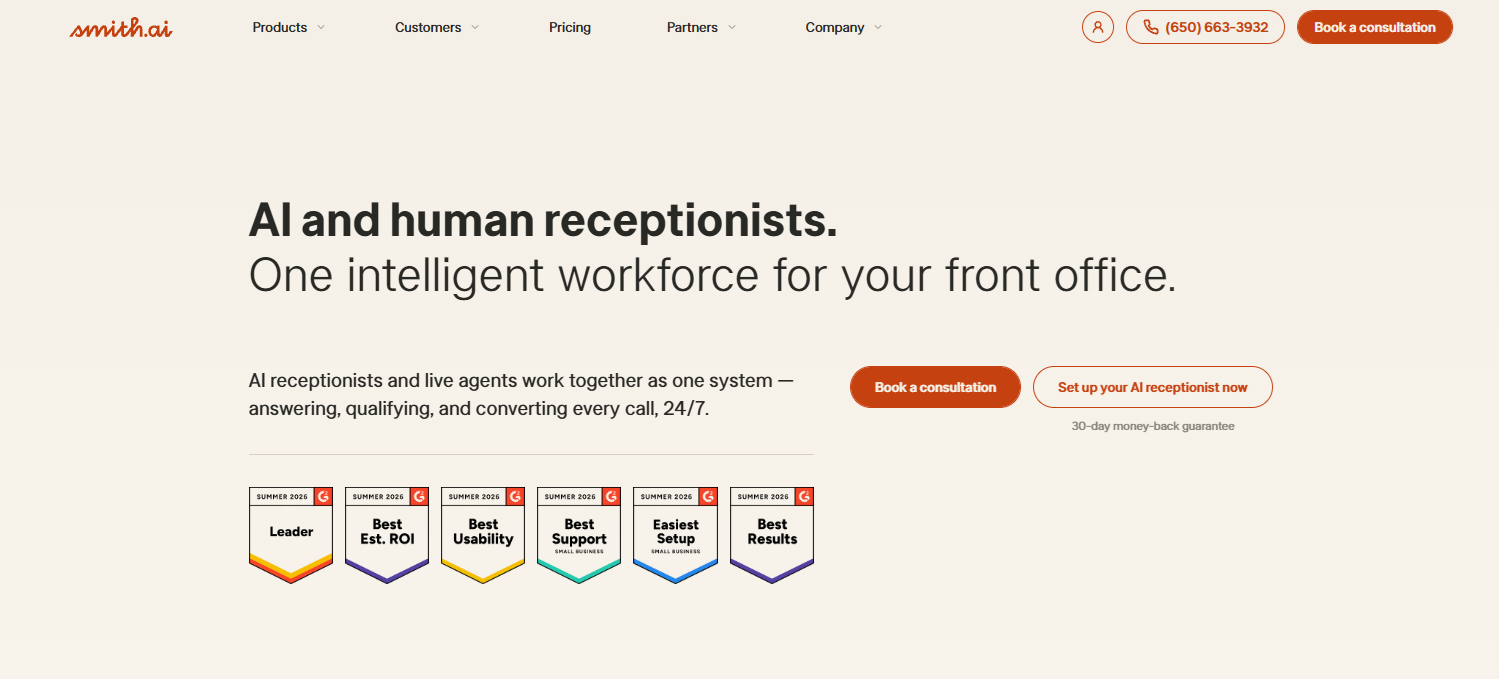
Smith.ai combines AI responses with human backup agents. Since its founding in 2015, the platform has handled over 10 million business calls, web chats, and text messages for 5,000 companies. Human backup is built into every tier, including the free subscription.
Smith.ai serves multiple verticals—legal, HVAC, real estate, and B2B calls—with particular depth in legal practices through integrations with Clio, MyCase, and PracticePanther. The platform is bilingual, using automated language recognition to provide service in English or Spanish.
Pricing is per call. The free tier includes 25 calls, with each additional call billed at $3. The $150/month tier covers approximately 2 calls per day, with additional calls at $2 each. The $500/month tier handles 10 calls daily, with additional calls at $1.67 each. All tiers support appointment logging and handoff to human agents.
The system goes beyond call interception, using connected AI agents for intake, qualification, data lookup, call routing, and automation, all linked to a live human agent network. On the downside, user reviews indicate that Smith.ai can bill up to 30% above the base subscription, frequently switching to more expensive human agents without explicit authorization. Cancellation is available only by email, with no automated contract termination.
2. Upfirst — Transparent Pricing, Credible Founders
Upfirst is a fully AI-based assistant built by the SimpleTexting team, including Gene Sigalov and Felix Dubinsky. Sigalov previously operated a small legal practice and reported paying $10 per minute for human receptionists.
Upfirst answers calls, collects caller data chosen by the business owner, and delivers summaries via email or text. It can book appointments and sync with preferred calendar tools, answer preset questions, or transfer calls to team members. The service is optimized for legal services, home repairs and trades, and wellness businesses.
Pricing starts at $24.95/month for 30 calls, with additional calls at $1.50 each. A Scale plan at $299/month includes 600 calls at $0.70 per additional call. Custom plans are available. A 14-day trial is included.
Upfirst integrates with Google Calendar, Outlook, Cal.com, Calendly, and others. CRM integrations include HubSpot, Salesforce, Pipedrive, and 195 apps via the Zapier ecosystem. Top-tier subscriptions offer full HIPAA support for medical and wellness businesses.
The biggest advantage is duration-independent billing—costs do not escalate with longer calls. The AI assistant is bilingual in English and Spanish out of the box, with options for up to 35 languages. Conversation summaries can be translated into a preferred target language.
The main limitation is the restrictive basic plan, averaging roughly one call per day. Active businesses may need to upgrade to the $159.95 or $299/month tiers. Upfirst lacks a human backup network and additional chat channels. Reviews indicate the AI can struggle with off-script, complex, or multi-part questions. The service also has a relatively thin review base.
3. Rosie — Minute-Based Value with Booking
Rosie is a customizable, pure AI answering service. The company reports over 2,000 connected businesses and more than 3.1 million AI conversations. The receptionist fields calls, answers pre-trained questions, books appointments, summarizes calls, and transfers to a human team member when its FAQ cannot resolve an issue.
Businesses receive a call summary with recording and transcription. Rosie trains on a business's Google profile and website in minutes, with no developer work required.
Rosie integrates with common calendars for bookings and connects to trade services including Housecall Pro, Jobber, Workis, and JobTread. For messaging and logging, it links to Slack, Gmail, and Google Sheets. CRM integrations include HubSpot, Follow Up Boss, Agency Zoom, and ActiveCampaign. Through Zapier, Rosie connects with over 1,000 ecosystem apps.
Pricing starts at $49/month for 250 minutes with limited features. The $149/month Scaling plan includes 1,000 minutes and unlocks logging, appointment booking, and summaries. The $299/month tier adds priority email support, guided onboarding, and custom agent training. Billing is per minute.
Strengths include natural voice quality with realistic AI voice options, even incorporating background noise for more natural interactions. Rosie filters spam and robocalls, sends mid-call SMS and links, and handles multiple simultaneous calls. However, advanced features are restricted from the base tier, and the AI's knowledge is limited to website content. There is no live human assistant for edge cases.
4. Dialzara — The Budget Pick
Dialzara provides an out-of-the-box AI receptionist requiring no additional hardware or integrations. The service claims natural, human-like responses and trains to match a business's voice and tone. It can book appointments, summarize calls, send emails, and screen for spam and robocalls.
Billing is per minute. The entry tier costs $29/month and includes 60 minutes, with additional minutes at $0.48. The $99/month plan includes extended minutes at $0.45 each for overages. Additional tiers are available at $199 and $349/month.
Dialzara integrates with the Zapier ecosystem and supports 10 languages across all packages: English, Spanish, French, German, Portuguese, Italian, Dutch, Mandarin Chinese, Japanese, and Korean.
The service offers a no-contract subscription cancelable at any time. Even at $29/month, it provides more integrations and language options than many competitors. The platform includes over 50 realistic AI voices, handles inbound calls, two-way SMS, and a chat widget, and can launch a trained agent in under 15 minutes using self-serve templates.
Drawbacks include the removal of most advanced features from the basic tier—they begin at the $99/month plan. There is no human backup network, only hot call transfers. Responses are largely template-based, limiting depth and specialization, making Dialzara less suitable for wellness or legal services. Minutes do not roll over, and the service is phone-only with no additional messaging tools. The review sample remains limited.
5. Goodcall — Unlimited Minutes, Google Pedigree
Goodcall was built by former Google AI developers and originated at a Google hackathon. The service reports over 42,000 businesses using its automation platform and has received investment from Neo, Merus, and Xoogler Ventures.
Goodcall deploys a specialized agent upon account setup, focusing on building the agent's knowledge base during onboarding. Businesses can connect knowledge sources, tools, and databases in minutes, with a dashboard for customizing behavior, logic, and workflows.
The platform supports seven languages targeting the European market: English (US, UK, AU), Spanish (US, Latin America), French, German, Italian, Portuguese, and Dutch. Real-time language switching is limited compared to some competitors.
Goodcall bills per agent. The entry tier is $79/month, including one logic flow limited to 100 customers per month. Additional tiers are priced at $129 and $249/month, with occasional promotions. This hybrid model of agentic workflows and per-caller billing suits businesses with a predictable, smaller customer base.
Integrations include Google Business Profile, Yelp, Cal.com, GoHighLevel, Google Calendar, and Outlook Calendar. Other app integrations run through Zapier or Google Sheets exports. Notably, there is no integration with ServiceTitan, Jobber, or HubSpot. The workflow supports mid-call SMS for booking and sends call summaries by email. The Scale tier retains unlimited user history for up to 500 unique monthly customers.
The primary benefit is predictable per-caller billing, meaning repeat customers do not incur additional charges. Drawbacks include limited trade app integrations, no number porting (only call forwarding), and user-reported latency and talk-over issues.
Vertical Specialists
Some AI receptionists differentiate by specializing in specific industries. These vertical specialists can offer more complex workflows and pricing structures better suited to particular business types than generalist platforms. As the market grows, vertical specialization has emerged as a key competitive strategy: providers that embed deeply in industry-specific software can offer workflows that generalist platforms cannot match.
6. Slang.ai — Restaurants
Slang.ai is a specialized voice reservation tool for restaurants, with connections to over 2,000 locations. The platform focuses on inbound calls, instant responses to common inquiries, and automated reservations.
For restaurants, where staffing shortages have been a persistent industry challenge, Slang.ai aims to free up staff time, saving some businesses up to 200 hours. The tool includes workflows to redirect clients to other locations within the same chain, custom call routing for VIP customers to reach concierges, and recognition of high-priority requests such as private dining, guest complaints, and lost items.
The service primarily operates in English, with Spanish available at higher tiers. Full bilingual workflows require upper-tier subscriptions.
Slang.ai integrates with OpenTable, SevenRooms, Yelp Reservations, and Tripleseat for real-time reservation booking. It does not take direct orders but pushes online ordering links connected to widely used apps. Call logs are sent via Zapier with summaries, guest tags, and caller data.
Pricing is hybrid, based on restaurant location and per-minute charges. Packages start at $399/month. Premium plans at $599/month or custom pricing offer narrower branding, cross-selling, custom integrations, and additional support.
The service is praised for a high-quality conversational workflow tailored to busy dining environments, handling questions about parking, dress codes, and dietary restrictions. Drawbacks include a high price point, especially for chains and branded restaurants, and the redirect to online ordering forms, which may frustrate callers who prefer to order by phone. An alternative service, Loman.AI, exists but has limited reviews and pricing data.
7. Numa — Car Dealerships
Numa positions itself as an AI operating system for franchise dealerships and busy auto repair shops. The company observed that on a day with approximately 60 calls, a dealership could lose up to 24 customers simply by not answering.
Numa's approach accounts for the operational realities of auto repair shops, where even a human receptionist may be insufficient. For chains or franchises with 30 locations, response times can reach 23 hours. An AI receptionist can handle call overflow and reduce response time to under 2 minutes, potentially recovering revenue from the over 71% of calls that go unanswered.
Pricing is custom and location-based. Baseline plans range from $149 to $249/month, but scaling and enterprise tiers require individual negotiation. Numa has not published a public pricing list.
Numa integrates deeply with dealership management systems including CDK Global, Reynolds & Reynolds, Tekion, and Dealertrack, as well as service schedulers like Xtime and myKaarma. The platform allows highly customized onboarding and detailed answers for specialized queries.
Drawbacks include pricing well above generalist AI receptionists and a requirement for a sales demo and guided onboarding for each business. Response accuracy depends on the Dealership Management System (DMS) and the quality of data it contains. Numa offers no human backup network—only internal advisors can take over the workflow. Booking is handled via scheduling links rather than direct completion by the AI agent.
The Phone-System Hybrid
Some businesses prefer to retain human receptionists, whether on-site or virtual. Hybrid AI systems combine automated voice responses with seamless human assistant integration, capturing the speed and cost-efficiency of AI alongside the adaptability of human agents.
8. Allo — AI Receptionist Inside a Business Phone System
Allo handles customer overflow with an AI-powered business phone that can transition seamlessly to a live assistant. The platform targets international markets and complies with Europe's GDPR requirements. Allo is a mobile-first phone system designed to replace legacy business lines.
The service intercepts every call with a summary and screens for potential leads. As a generalist AI receptionist, it can be added alongside existing human assistants.
Allo offers over 50 languages, including English, Spanish, French, German, Italian, Portuguese, Mandarin, Japanese, Korean, and Hindi. Language recognition is automatic, with no menu prompts.
Billing is per receptionist seat, with rising limits for minutes and callers. The lowest tier is $216 billed annually. The business tier costs $32 per user monthly, each with its own calling number. Higher tiers add LLM integration, analytics, and custom dashboards (Ultra subscription). Plans are flexible, accommodating everyone from freelancers to large organizations with multiple live assistants and phone numbers.
Allo's strengths include the widest multilingual coverage among reviewed services and a complete VoIP phone system supporting manual team calls, SMS texting, and power dialing. The platform processes visual images during or after calls for summary notes. CRM integrations include HubSpot, Salesforce, Attio, and Pipedrive.
Cons include potential cost escalation, as each seat has minute and caller allocations that can diverge from claims of limitless usage under heavy call volume. Allo does not provide its own human team, unlike Smith.ai. Larger organizations may require guided initial configuration.
What an AI Receptionist Costs in 2026
AI receptionists now compete directly with live virtual receptionist services. Ruby charges $250/month for 50 minutes of live human assistance, with higher tiers scaling to 500 monthly minutes. AnswerConnect charges $350 for 20 minutes of receptionist service, up to $575 for 400 monthly minutes, with a $49.99 setup fee on some tiers.
By comparison, AI assistants start as low as $24.95/month—the entry tier of Upfirst. This order-of-magnitude price gap means that businesses that previously had no answering solution at all—sole proprietors, independent contractors, and early-stage startups—can now afford always-on call coverage.
The Rules: Recording, Consent, and AI Disclosure
AI receptionists face regulatory scrutiny because the technology involves call recording and the storage of user identities and data. In the United States, healthcare-related data falls under HIPAA regulations; top-tier Upfirst subscriptions offer HIPAA-compliant workflows.
In the European Union, GDPR restrictions apply. EU regulations require AI receptionists to disclose that the caller is speaking with an artificial agent. Services like Goodcall have integrated AI self-identification into their workflows.
On the US market, AI calls fall under Federal Communications Commission (FCC) regulations and are treated similarly to robocalls. However, AI receptionists handling only inbound calls do not fall under FCC robocall regulations. The regulatory landscape for AI voice agents remains in flux, and businesses deploying these tools should monitor for evolving disclosure and consent requirements at both the federal and state levels.
Final Verdict: Match the Pricing Model to Your Call Pattern
Selecting the best AI receptionist depends on a business's call patterns and workload. The most important step is to evaluate each service's billing model transparently and understand the real costs before committing. The business type will indicate whether per-minute, per-caller, or hybrid billing is most appropriate, while common customer query types will help determine which features and integrations matter most. Available languages and language recognition capabilities are additional decision factors.
AI virtual receptionists offer both basic packages and specialized extras. Some extras target specific industries—legal, wellness, healthcare, or home repairs—while others integrate with industry-specific software such as restaurant reservation platforms. Businesses can test entry-level solutions for compatibility and then apply customization as needed. As the category matures, expect further convergence between AI receptionist platforms and the broader business phone and CRM ecosystems, with larger telecommunications and software providers potentially moving into the space through acquisitions or native features.

