Shiba Inu Triggers Seven Bullish On-Chain Signals Despite Persistent Price Pressure
Key Takeaways
- •Shiba Inu displays seven bullish on-chain signals while its price remains under downward pressure.
- •Approximately 250.2 billion SHIB left exchanges compared to 185.4 billion entering, yielding a negative netflow of about 64.8 billion tokens.
- •Active addresses grew by more than one percent over the past 24 hours despite weak price performance.
- •SHIB continues to trade below its 50-day, 100-day, and 200-day moving averages, keeping key resistance levels intact.
- •The Relative Strength Index has climbed out of oversold territory, suggesting bearish momentum is weakening even though a full technical recovery remains unconfirmed.
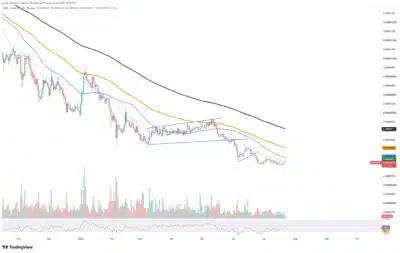
Shiba Inu (SHIB) has triggered seven bullish on-chain signals even as its price continues to face downward pressure, according to CryptoQuant data. The latest blockchain metrics indicate growing accumulation, with investors moving tokens off exchanges and network activity improving, while SHIB remains below key technical resistance levels.
Shiba Inu, launched in 2020 as an Ethereum-based token styled after the same Shiba Inu dog meme that inspired Dogecoin, has grown into one of the most widely held meme coins by market capitalization. Like other meme-themed cryptocurrencies, SHIB's price has historically been sensitive to retail sentiment and social media momentum, making on-chain data particularly relevant for assessing whether holders are positioning for the long term or preparing to sell.
Exchange Data Signals Growing Holder Confidence
Declining exchange reserves stand as one of SHIB's most prominent bullish signals. When tokens held on exchanges decrease, fewer coins are readily available for immediate sale, which can reduce potential market supply over time.
Exchange Netflow remains negative at approximately 64.8 billion SHIB, confirming that more tokens are leaving exchanges than entering them — a pattern typically associated with investor accumulation rather than distribution.
Network activity has also strengthened. Active Addresses rose by more than 1% over the past 24 hours, reflecting continued user participation despite the token's weak price performance.
Exchange withdrawals have outpaced deposits by a significant margin. Approximately 250.2 billion SHIB left exchanges, while roughly 185.4 billion SHIB entered trading platforms. This imbalance suggests that investors are increasingly opting for self-custody over keeping their holdings positioned for potential sale.
Exchange Inflow Mean and Exchange Outflow Mean further support the broader accumulation trend. Although both averages increased, larger average outflow transactions indicate that bigger holders are continuing to remove substantial amounts of SHIB from exchanges. Together, these indicators account for six of the seven bullish signals currently identified.
Technical Resistance Caps Price Recovery
Despite the improving on-chain picture, SHIB's technical outlook remains cautious. The token continues to trade below its 50-day, 100-day, and 200-day moving averages, keeping important resistance levels intact.
However, the Relative Strength Index (RSI) has climbed out of oversold territory and continues to recover. This improvement represents the seventh bullish signal, suggesting that bearish momentum has begun to weaken, even though buyers have not yet regained full market control.
According to TradingView, exchange reserve value measured in U.S. dollars has declined in tandem with SHIB's market price, while exchange inflows remain relatively elevated. As a result, SHIB has not yet confirmed a broader technical recovery.
On-Chain Metrics Outpace Price Action
The divergence between SHIB's strengthening on-chain profile and its lagging price mirrors a pattern seen across crypto markets, where accumulation signals can precede — but do not guarantee — price recoveries. The current data shows seven bullish signals pointing to ongoing accumulation despite persistent market weakness. While technical resistance continues to limit upside momentum, improving network activity and declining exchange balances suggest that investor confidence remains stronger than recent price performance would indicate.

