S&P Dow Jones Indices and Pantera Capital Launch Revenue-Based Crypto Index Excluding Bitcoin
Key Takeaways
- •S&P Dow Jones Indices and Pantera Capital launched the S&P Pantera Digital Asset Index on July 21 as a revenue-based benchmark for digital assets.
- •Bitcoin is deliberately excluded from the index to shift focus toward other digital assets tied to on-chain revenue activity rather than store-of-value properties.
- •The index weighs assets by revenue-generating activity instead of using a traditional market-capitalization ranking, mirroring a fundamentals-driven approach similar to revenue multiples in equity analysis.
- •This launch follows a prior collaboration between S&P and Pantera that introduced an 18-token crypto index, indicating an ongoing partnership in crypto benchmarking.
- •No confirmed component list, full methodology document, performance figures, or adoption data were released alongside the launch, leaving institutional allocators awaiting further S&P disclosures.
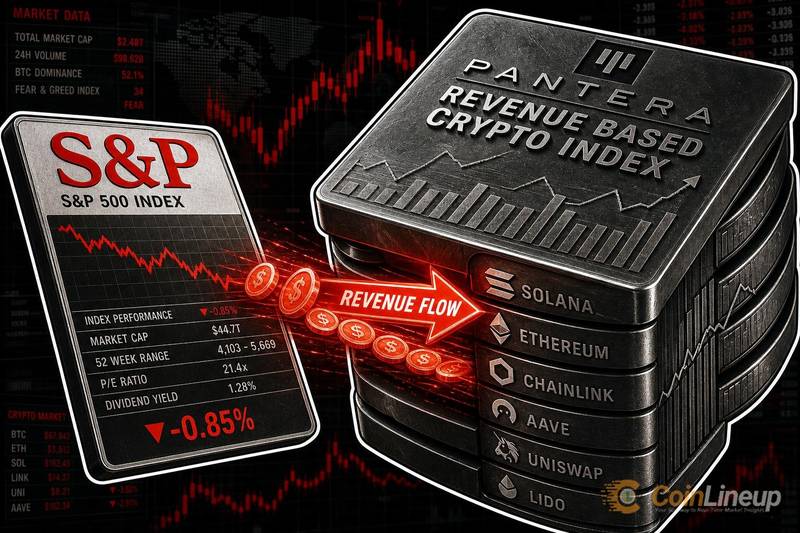
S&P Dow Jones Indices and Pantera Capital have launched a revenue-based digital asset index that excludes Bitcoin, introducing a new benchmark designed to measure a distinct segment of the cryptocurrency market beyond its largest coin. The move reflects a broader trend among major index providers — including S&P Dow Jones, FTSE Russell, and Morningstar — to build out structured crypto benchmarking infrastructure as institutional interest in digital assets matures beyond single-coin exposure. According to a July 21 press release, the product — formally named the S&P Pantera Digital Asset Index — is positioned as a structured benchmark rather than an informal market listing, as detailed in the official S&P brochure.
The most notable feature of the index is Bitcoin's exclusion. Investopedia's coverage highlights the same point, describing a benchmark built to measure something more targeted than a standard broad-market crypto basket. Since Bitcoin typically dominates how general audiences perceive crypto indexes — often accounting for over half of total market capitalization — removing it shifts the narrative toward other digital assets and their underlying fundamentals, particularly protocols and networks whose value proposition is tied to on-chain activity rather than store-of-value properties.
Revenue-Based Methodology
The "revenue-based" designation is central to the index's positioning, even though a full methodology document was not included in the launch materials. Based on the press release, the Investopedia report, and the S&P brochure, the benchmark is presented as a departure from a simple market-capitalization ranking — one that weighs digital assets by revenue-generating activity rather than size alone. This approach mirrors a broader analytical shift in crypto markets, where fee-generating protocols in sectors such as decentralized exchanges, lending platforms, and layer-1 networks have drawn increasing attention from institutional researchers seeking fundamentals-driven evaluation frameworks analogous to revenue multiples in traditional equity analysis.
What Is Known So Far
The confirmed details are limited but meaningful: S&P and Pantera are defining a segment of the digital asset market that is not centered on Bitcoin. This launch follows a related S&P and Pantera initiative previously covered by CoinLineup, in which the two firms introduced an 18-token crypto index. Pantera's broader market visibility has also been noted in CoinLineup's reporting on KB Financial Group's blockchain strategy partnership with Pantera Capital.
No verified performance figures, confirmed component list, or adoption data accompanied the launch materials. The absence of a published component list or full methodology means asset managers and institutional allocators will likely await further S&P disclosures before integrating the benchmark into investable products. Additional detail is expected in later S&P disclosures or updates to the index brochure.
This article is for informational purposes only and does not constitute financial or investment advice. Cryptocurrency and digital asset markets carry significant risk. Always conduct your own research before making decisions.

