U.S. Justice Department Seeks to Forfeit Over $25M in Cryptocurrency Tied to Romance and Investment Scams
Key Takeaways
- •The DOJ filed five civil forfeiture complaints seeking more than $25 million in cryptocurrency linked to romance and investment fraud schemes that affected victims in both Canada and the United States.
- •The largest complaint targets roughly $12.1 million connected to romance-based fraud involving over 200 victims, while a second complaint addresses $10.4 million tied to more than 270 individuals.
- •Authorities identified the alleged laundering infrastructure as primarily based in Southeast Asia, with associated IP addresses traced to China, Malaysia, and Cambodia.
- •Some fraud operations included secondary recovery scams in which initial victims were approached again with offers to retrieve lost funds in exchange for additional fees or deposits.
- •The DOJ action follows Interpol-coordinated Operation First Light 2026, which spanned 97 countries and territories and resulted in 5,811 arrests along with the interception of $283 million in illicit assets.
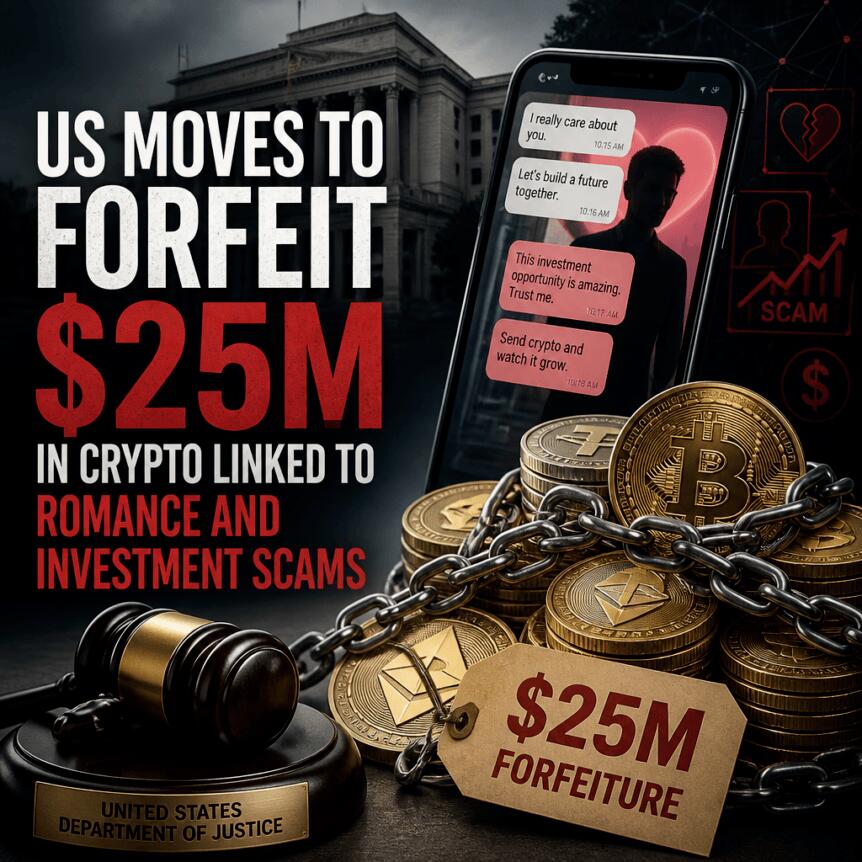
The U.S. Department of Justice has filed five civil forfeiture complaints seeking more than $25 million in cryptocurrency allegedly linked to international romance and investment fraud operations that targeted victims across Canada and the United States.
According to the U.S. Attorney's Office for the District of Columbia and the U.S. Secret Service, the complaints result from separate investigations conducted by the Cyber Fraud Task Force. Prosecutors say victims were led to believe they were making legitimate digital asset investments, only for their funds to be routed through laundering networks designed to obscure the origin and movement of stolen cryptocurrency. The DOJ describes tactics that frequently combine social engineering, fraudulent trading platforms, and layered wallet transfers to hinder recovery efforts.
Civil forfeiture actions target property alleged to be connected to unlawful activity, rather than charging a defendant in a criminal case. In crypto fraud matters, that can allow authorities to seek control of assets held in identified wallets while tracing and victim-identification work continues.
Breakdown of the Forfeiture Complaints
The largest complaint seeks approximately $12.1 million connected to romance-based fraud schemes that reportedly defrauded more than 200 victims. Prosecutors say proceeds were routed through intermediary addresses and commingled with funds from other victims—an approach that complicates both attribution and recovery.
A second complaint targets $10.4 million tied to suspected victim transactions involving more than 270 individuals. The DOJ also filed three additional, smaller complaints involving fake investment accounts and a separate "recovery" scheme. In this latter pattern, initial victims are later targeted again with offers to help recover their lost funds in exchange for a new fee or deposit—a tactic observed across many fraud ecosystems.
Alleged Laundering Infrastructure
The DOJ said the alleged laundering infrastructure was predominantly based in Southeast Asia, with related IP addresses associated with China, Malaysia, and Cambodia. The enforcement theory is that criminals deliberately sought to sever the on-chain connection between victim payments and the addresses that ultimately received the funds.
Prosecutors characterize these operations as extending beyond straightforward investment fraud. Crypto-enabled romance scams typically rely on social engineering to build trust, after which victims are steered toward fraudulent trading or investment platforms. Once funds are deposited, the money is moved through multiple wallet layers and networks designed to conceal the trail of stolen assets.
Broader International Enforcement Context
The DOJ filing follows wider international enforcement activity targeting social engineering scams and their associated laundering networks. According to earlier reporting by Cointelegraph, Interpol-coordinated Operation First Light 2026 involved 97 countries and territories.
Interpol reported that the operation resulted in 5,811 arrests and the interception of $283 million in illicit assets. The operation also identified more than 142,000 victims and blocked over 31,000 bank accounts.
Within the operation, Thai authorities reportedly uncovered a network that allegedly converted romance-scam proceeds into cryptocurrency. Investigators described the use of cross-chain token swaps to further obscure fund movements. Cointelegraph reported that a wallet associated with a suspected money launderer processed more than $122.5 million in crypto over a 10-month period.
While that figure originates from Interpol-linked reporting rather than the DOJ civil forfeiture filings, the operational pattern is consistent: trust-building scams, conversion of funds into cryptocurrency, followed by multi-step transfers and trading-like activity designed to frustrate tracing.
Prior U.S. Enforcement Actions
The DOJ's latest action also aligns with a broader pattern of U.S. enforcement against cryptocurrency used in romance and investment fraud. As Cointelegraph previously reported, federal agents seized over $61 million in USDT stablecoin in February from addresses allegedly associated with laundering proceeds tied to fraudulent investment platforms.
In that earlier case, investigators described a workflow similar to the one reflected in the current forfeiture complaints: scammers build trust through romantic relationships, direct victims to fake trading platforms, and then move funds across multiple wallets. The DOJ complaint language further details how schemes can evolve into secondary "recovery" scams and how funds are commingled among victims—factors that affect both law enforcement disruption strategies and victims' ability to trace assets.
Implications for Tracing and Recovery
These cases demonstrate that fraud operations often shift from social manipulation to complex financial plumbing. Even when victims send funds into what appears to be a legitimate digital asset transaction, the traceable elements can be deliberately fragmented through intermediaries, layered transfers, and cross-network activity.
The filings also underscore why blockchain visibility does not automatically translate into easy recovery. Public ledgers can preserve transaction histories, but investigators still need to connect wallet activity to victims, laundering infrastructure, exchanges, and potential claimants before seized or restrained assets can be addressed through court processes.
As the forfeiture cases proceed, attention will focus on whether courts allow the government to establish ownership and tracing theories at the complaint stage, and whether additional actions follow targeting other wallets or infrastructure connected to the same alleged laundering clusters.

