XRP Exchange Supply Ratio on Binance Falls to Five-Month Low
Key Takeaways
- •XRP's Exchange Supply Ratio on Binance has fallen to approximately 0.02605, its lowest reading in roughly five months.
- •The ratio has been trending downward since March, with the most significant decline occurring in late June despite XRP trading within a relatively stable price range.
- •The sustained decrease suggests users have been transferring XRP off Binance to private wallets or institutional custody rather than keeping tokens positioned for immediate sale.
- •Binance's XRP holdings declined throughout the period regardless of notable price swings, with the token having traded near $1.50 earlier before recovering to about $1.14.
- •While lower exchange balances may reduce potential selling pressure, the analyst cautioned that the metric should not be treated as a standalone bullish signal for XRP's price direction.
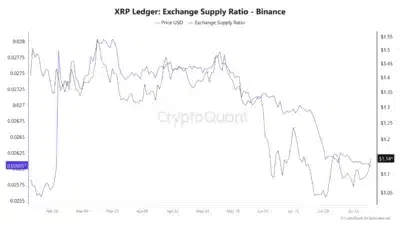
XRP’s Exchange Supply Ratio on Binance has declined to its lowest level in about five months, showing a sustained reduction in the exchange’s XRP holdings relative to the token’s circulating supply.
According to CryptoQuant analyst Arab Chain, the XRP Exchange Supply Ratio on Binance has fallen to approximately 0.02605 while XRP trades near $1.14. The reading indicates that Binance now holds a smaller share of XRP’s circulating supply than it did earlier in the year.
The Exchange Supply Ratio measures the amount of XRP held on Binance compared with the asset’s total circulating supply. Traders and analysts monitor the metric because it can show how much XRP is readily available for trading on the exchange. While the indicator does not determine price direction on its own, sustained changes in exchange balances can offer insight into possible shifts in selling pressure.
CryptoQuant data shows that the ratio remained above 0.028 during March before entering a gradual decline over the following months. The downtrend accelerated in June and ultimately pushed the metric to its lowest level since February.
Binance XRP Balances Decline as Available Exchange Supply Narrows
Arab Chain said the falling Exchange Supply Ratio suggests XRP has continued moving away from Binance rather than remaining on the exchange for immediate trading. The tokens may have been transferred to private wallets, institutional custody providers, or other storage destinations outside Binance.
Binance is the world's largest cryptocurrency exchange by spot trading volume, so shifts in its token balances carry weight as a market indicator. The decline in Binance's XRP holdings aligns with a broader pattern observed across major exchanges, where sustained outflows can signal accumulation behavior as users move assets to self-custody rather than keeping them positioned for sale.
The data also shows that Binance’s XRP holdings fell despite notable price fluctuations during the period. XRP traded near $1.50 earlier in the timeframe before declining and later recovering to about $1.14. Throughout those price movements, the Exchange Supply Ratio continued to trend lower.
Source: CryptoQuant
That pattern differs from periods when investors send assets to exchanges ahead of potential sales. Instead, Binance has accounted for a progressively smaller portion of XRP’s circulating supply, reducing the amount of the token immediately available for spot transactions on the platform.
The sharpest decline occurred in late June, when the ratio fell quickly even as XRP traded within a relatively stable range. The movement indicates that withdrawals continued regardless of short-term price changes.
What the Metric May Mean for XRP Price
Arab Chain explained that a lower Exchange Supply Ratio means fewer XRP tokens remain on Binance relative to circulating supply. If the trend continues, reduced exchange inventory could ease selling pressure because fewer coins are immediately available for liquidation.
However, the analyst cautioned that the metric should not be treated as a standalone bullish signal. XRP’s price remains affected by investor demand, trading volume, liquidity conditions, broader cryptocurrency market sentiment, and the movement of funds between exchanges and private wallets.
If Binance balances continue to decline while buying demand strengthens, tighter exchange supply could add support for price stability. Conversely, an increase in XRP deposits back to Binance would raise the amount available for sale and could indicate renewed selling activity.
The latest decline in Binance’s XRP Exchange Supply Ratio marks a notable change in the exchange’s share of the token’s circulating supply. Although lower exchange balances can reduce potential selling pressure, XRP’s price performance will still depend on wider market demand, liquidity, and whether the current withdrawal trend continues.

