Best Bitcoin Hardware Wallets in 2026: In-Depth Review of Five Leading Self-Custody Devices
Key Takeaways
- •The review assessed public-facing documentation, store listings, setup flows, and community discussions for all five wallets on July 14, 2026, without conducting physical device testing.
- •Coldcard is positioned as the strongest option for advanced users due to its dedicated secure element, air-gapped PSBT signing via microSD, and a workflow that never requires USB connection to an online computer.
- •Blockstream Jade delivers QR-based air-gapped signing, open-source firmware, and Bitcoin plus Liquid network support at the lowest price point among the shortlisted devices, though its blind oracle PIN model introduces a server-side dependency.
- •BitBox02 Bitcoin-only is recommended as the best entry-level device because its guided desktop companion app reduces setup friction, and its Bitcoin-only firmware variant meaningfully reduces attack surface compared to the multi-edition version.
- •SeedSigner scored highest on the review's quantitative scorecard but was not named the top overall recommendation because it requires users to source components, assemble the device, and manage a stateless signing workflow that is not plug-and-play.
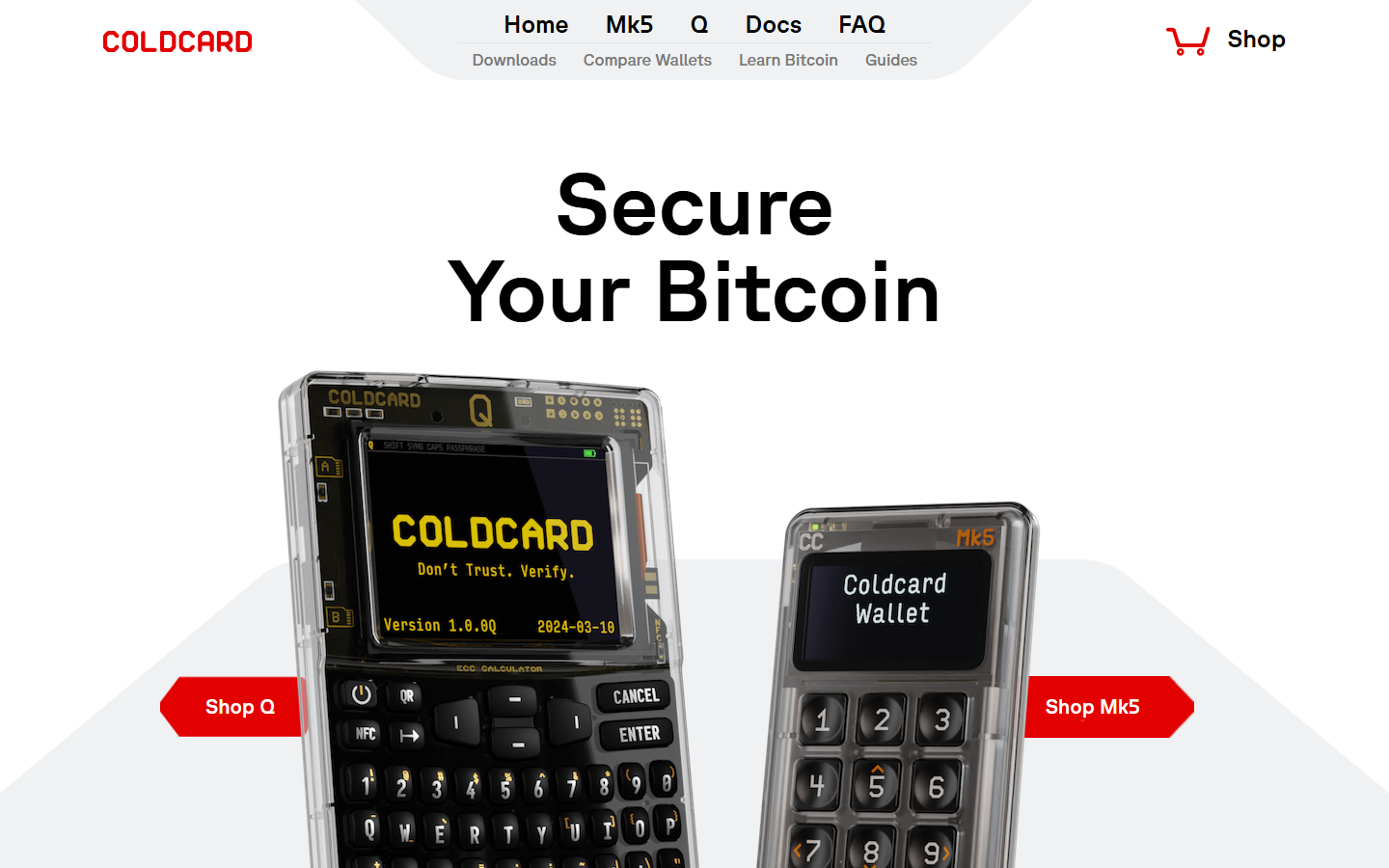
Coldcard remains the strongest pick for advanced single-sig and multisig users who prioritize secure signing and Bitcoin-first design. Blockstream Jade is the best value option for users who want strong Bitcoin-native features without paying premium-device pricing. BitBox02 Bitcoin-only is one of the best balanced choices for users who want a smooth experience without leaving the Bitcoin-only lane. Passport by Foundation Devices is the best premium wallet for users who want a cleaner interface without giving up serious security. SeedSigner remains the best DIY path for users who value open components and stateless signing over convenience.
5 Best Bitcoin Hardware Wallets Reviewed (2026 List)
The collapse of major exchanges such as FTX in 2022 and the long-running Mt. Gox rehabilitation proceedings have made the cost of leaving coins on a custodial platform concrete rather than theoretical, accelerating demand for hardware wallets that let users hold their own keys.
If you are still exploring the broader Bitcoin self-custody landscape, you can compare these picks against multisig wallet setups, or start with a Bitcoin DCA app if you are still in the accumulation phase before moving to cold storage.
Below is a detailed analysis of the five best Bitcoin hardware wallets, examining their security model, signing posture, setup experience, and real community feedback to help you identify the right self-custody device for your threat model and experience level.
Coldcard
Coldcard is the strongest pick for advanced users who want the deepest Bitcoin-native security model available in a commercial device. The device is built around a dedicated secure element, air-gapped signing via PSBT and microSD, and a signing model that never requires USB connection to a hot computer.
Navigating the Coinkite store directly confirms the Coldcard Q listed alongside the Mk4, with current pricing and availability. Both models are positioned at serious Bitcoin self-custody users, not casual buyers. The quick-start documentation's first step is key generation on the device itself — the computer never sees the seed. This posture, confirmed step-by-step in the public documentation, makes Coldcard the default recommendation for security-conscious users who are comfortable with a steeper learning curve.
The signing workflow confirmed in public documentation: generate seed on device, export PSBT via microSD, sign offline, broadcast from a watch-only wallet such as Sparrow. That is a more involved process than most competing devices, but every step is auditable.
Best for: Advanced self-custody users, multisig setups, air-gapped signing workflows.
Main tradeoff: Higher learning curve than most competing devices — the setup documentation assumes familiarity with PSBT and watch-only wallets.
One user on r/Bitcoin described exactly this pairing in practice: "Some of my favorites is sparrow and blue wallet" — a response to a post about Coldcard's open-standards model that drew nods from others running similar setups. A different user in the same thread described stripping the wireless card from an old netbook, installing Linux and Sparrow, and pairing it with Coldcard for what they called the same level of security at nearly zero cost. That pairing pattern — Coldcard as the signing layer, Sparrow as the coordination surface — comes up consistently when r/Bitcoin users describe their actual production setups.
Blockstream Jade
Blockstream Jade is the best value option in this shortlist. The setup documentation confirms the onboarding path: Jade connects to the Blockstream Green app or Sparrow for initial setup, and QR-code air-gapped signing is available as an alternative to USB. The firmware is open-source and the companion app setup walkthrough is well-documented.
The blind oracle PIN model — where the device uses a server to verify the PIN rather than storing it locally — is explained clearly in the documentation and is worth reading before setup. It is not a meaningful blocker, but it introduces a server dependency that users should understand. Blockstream has published technical details of the blind oracle mechanism, which uses a shared secret combined with a virtual secure element to protect the seed in the event the device is physically captured, but the model still requires trusting that the server side behaves as documented.
The price-to-feature ratio is the clearest signal: Jade delivers QR-based air-gapped signing, open-source firmware, and Bitcoin+Liquid support at a price point below most competing devices. Pricing and availability were confirmed directly on the Blockstream store. The store listing is straightforward — one device model with clear pricing, no upsell noise, which is consistent with the product's value-focused positioning.
Best for: Value-focused Bitcoin users who want strong security without premium pricing.
Main tradeoff: Blind oracle PIN introduces a server dependency — read the documentation before relying on it for meaningful balances.
In a r/Bitcoin thread where someone was ditching Ledger for a Bitcoin-only device, one experienced commenter ran through six open-source options and placed Jade Plus in the same tier as Coldcard Q and BitBox02. The original poster replied: "I'm leaning more with Blockstream Jade tbh" — a response that reflects what actually moves buyers at that price point. One dissenting voice in the same thread said they tried Jade Plus and found the blind oracle setup "cumbersome" and the buttons "a pain." Both reactions are worth knowing before recommending it.
BitBox02 Bitcoin-only
BitBox02 Bitcoin-only is one of the best choices for users who want a smooth, low-friction self-custody experience without leaving the Bitcoin-only lane. The Bitcoin-only firmware variant is the one worth choosing — it reduces the attack surface meaningfully compared to the multi-edition version, and the product page makes this choice explicit. This principle is well-understood in the hardware wallet space: every additional blockchain implementation adds code paths that can introduce vulnerabilities, which is why several Bitcoin-focused manufacturers now offer dedicated Bitcoin-only firmware branches.
Navigating the BitBox setup guide at bitbox.swiss/start confirms the onboarding path: the BitBoxApp desktop companion walks users through device pairing, backup creation to microSD, and initial receive address generation in a clean step-by-step interface. The process is notably more guided than Coldcard and requires no prior familiarity with PSBTs. The device is small enough to fit in a pocket and the setup guide is one of the clearest in this shortlist. That accessibility is genuine, not a compromise on security.
Best for: Beginners who still want a quality device, users who want the least friction in self-custody setup.
Main tradeoff: Less raw feature depth than Coldcard for advanced workflows — not the right tool for complex multisig or scripting use cases.
One user on r/Bitcoin posted that they had moved to cold storage after three years and chose BitBox02 specifically because Coldcard was out of reach on budget. "I know coldcard is the GOAT but as per my requirement and budget, Bitbox was the best fit." The replies pushed back on one thing: they had bought the multi-edition instead of Bitcoin-only. "You got the shitcoin version = more lines of code, more attack vectors," wrote one commenter. A second told them to ditch the companion app entirely and pair with Sparrow or Electrum instead. Both are honest corrections that affect how the device should be set up.
Passport by Foundation Devices
Passport is the premium pick for users who want a well-designed, air-gapped, open-source hardware wallet with a more intuitive interface than Coldcard without giving up serious security. The device hardware is open-source (schematics published) and the supply chain attestation approach is explained in the docs — a meaningful step for users who want hardware-level verification. Supply chain attestation has gained attention in the hardware wallet industry after documented cases of tampered or counterfeit devices reaching buyers through unofficial reseller channels.
Navigating the Foundation Devices documentation at docs.foundationdevices.com confirms the setup path: the Envoy companion app guides the initial setup, and QR-based air-gapped signing is available throughout the workflow. The documentation is detailed and covers multisig, PSBT signing, and Envoy pairing clearly. The interface is genuinely better than most competing devices in this shortlist. The screen is larger, the navigation is cleaner, and the Envoy app reduces the gap between technical rigor and usable daily workflow.
Best for: Users who want premium build quality, open-source hardware, and a more intuitive air-gapped experience than Coldcard.
Main tradeoff: Higher price point than Jade or BitBox02.
Community discussion specifically on Passport is sparse relative to Coldcard, Jade, and BitBox02 — no qualifying r/Bitcoin thread from the past year focused on actual user experience with Foundation Devices' product. The documentation at docs.foundationdevices.com is where the honest pre-purchase research lives.
SeedSigner
SeedSigner is the best choice for users who want full open-source verification, component-level transparency, and stateless signing. Reviewing the build guide on GitHub at github.com/SeedSigner/seedsigner confirms the component list: a Raspberry Pi Zero 1.3 or 2W, a 240×240 LCD, and a camera module. All parts are available off-the-shelf from consumer suppliers, which is the point — there is no specialized supply chain to trust.
The stateless signing model is confirmed in the build guide: the device holds no persistent wallet state between sessions. The seed is entered fresh each time via QR scan or manual dice-roll entry, and the device signs the transaction statelessly. After signing, it is powered off and the key material is gone. The assembly instructions are clear for users with basic electronics comfort. The software build process is well-documented and the project is actively maintained by the community.
Best for: DIY and multisig tinkerers, users who want component-level transparency and stateless signing.
Main tradeoff: Not a plug-and-play product — requires component sourcing, assembly, and comfort with DIY hardware and software builds.
A user on r/Bitcoin posted a detailed account of how they generated a seed phrase using SeedSigner alongside physical BIP39 word cards — 2048 words printed and cut out, 23 chosen by hand from a box, the 24th checksum calculated by SeedSigner offline. "I also verified seedsigner os before running it on the seedsigner hardware," they wrote. "This should be the best trustless way to generate a seed phrase." The thread pushed back on a few entropy details but validated the core approach. No commercial device supports this kind of end-to-end physical verification.
What Makes a Hardware Wallet Truly Bitcoin-Maximalist
The first filter is simple: does the device treat Bitcoin as the product, or does it treat Bitcoin as one asset inside a casino-style multi-coin interface. Bitcoin-first devices tend to make fewer design compromises around address handling, PSBT workflows, backups, and multisig support.
The next filter is trust. A serious Bitcoin hardware wallet should make it easy to verify what is being signed, avoid unnecessary hot-device dependency, and support strong recovery paths. Open-source firmware, reproducible builds, or at least verifiable community scrutiny all matter here. The 2023 Ledger Recover episode — where Ledger introduced an optional seed-recovery service that split and shard-stored seed material with third parties — illustrated how quickly trust can erode when firmware-level decisions are not fully transparent, and it drove a measurable number of users toward fully open-source alternatives. So does PSBT support, because wallet interoperability is part of long-term sovereignty and connects directly to stronger Bitcoin security setups.
The final filter is survivability. A wallet should still make sense if the vendor disappears, if the user needs to migrate to a different stack, or if the setup eventually moves into multisig. Many beginner wallets are easy on day one and fragile on year five. That matters even more for users who also plan to stack through Bitcoin DCA apps and periodically sweep funds into cold storage.
Wallet Positioning at a Glance
What stood out immediately was not the number of features but the posture of each wallet. Coldcard and SeedSigner are clearly built for users who want verification and control first. BitBox02 Bitcoin-only is built to reduce early friction. Jade sits in the middle as a practical sovereignty-first wallet that stays more accessible on price.
That difference is not cosmetic. It signals what kind of user each product expects. In practice, the better choice depends on whether the reader is optimizing for clean onboarding, lower price, deeper control, or a migration path into more advanced self-custody workflows.
Coldcard vs Jade vs BitBox02 vs Passport vs SeedSigner
Coldcard is still the benchmark when the job is secure signing rather than marketing polish. It is strongest in setups where the user already understands UTXOs, PSBT flow, and the difference between convenience and safety. It also pairs naturally with more advanced multisig planning.
Jade wins when price discipline matters. It gives users access to a serious Bitcoin-only stack without forcing them into generic altcoin wallet design. That makes it one of the most useful recommendation targets for first-time self-custody users.
BitBox02 Bitcoin-only remains one of the most defensible recommendations for mainstream users because it does not force them to become experts before they can become safer. Passport sits slightly above that tier for users who want a more premium device and better on-device clarity. SeedSigner is different: it is less of a consumer gadget and more of a sovereignty tool for readers who are already comfortable with deeper wallet and self-custody workflows.
Ranking Scorecard
Scored out of 10 per category. Total out of 70.
Scoring notes: Security model weighs secure element quality, signing posture, and attack surface. Setup ease reflects time-to-first-receive for a new user with no prior hardware wallet experience. Value for money accounts for feature set relative to street price. Open source covers both firmware and hardware schematics where applicable. Air-gap scores reflect how completely the device can sign without any live network or USB dependency. Multisig and interop reflects how cleanly the device pairs with Sparrow, Electrum, and coordinator software.
SeedSigner scores highest on the scorecard but is not the top recommendation for most readers — that gap reflects the tradeoff between sovereignty ceiling and practical accessibility. Passport scores highest among commercial devices. Coldcard and Jade sit close together, and the right call between them depends almost entirely on budget and how much setup friction the reader is willing to accept.
Which Wallet Is Best for Beginners, Power Users, and Multisig Setups
For beginners, BitBox02 Bitcoin-only is the easiest clean recommendation. It is focused enough to avoid the worst altcoin-wallet clutter and simple enough that a new user can move coins off an exchange quickly after using a Bitcoin DCA platform.
For power users, Coldcard remains the strongest answer. Its workflow makes more sense the more a user understands Bitcoin, especially if coin control, PSBT export, and multisig planning already matter.
For users planning a long-term vault, SeedSigner, Coldcard, and Passport all fit better than generic retail wallets. If the user expects to migrate into a multisig setup later, choosing a wallet with a strong Bitcoin interoperability story now saves time and risk later. That decision also matters if the user eventually wants a separate spending stack for Lightning payments while preserving cold-storage discipline.
For cost-sensitive users, Jade is hard to beat. It covers enough of the serious Bitcoin feature set that many users will never need to upgrade.
Key Risks, Weaknesses, and Troubleshooting Before Choosing a Wallet
The first mistake is buying a wallet based on influencer familiarity instead of threat model. Most users do not need the flashiest device. They need a device whose backup flow they will actually test and understand.
The second mistake is ignoring software interoperability. A wallet is not a religion. If the device cannot move cleanly across Bitcoin-native software like Sparrow or multisig coordinators later, it may create lock-in at the exact moment flexibility matters.
The third mistake is confusing hardware with security. A hardware wallet with a sloppy backup, weak passphrase practice, or no recovery rehearsal is not a secure setup. The device is only one layer. Users should verify their backup by performing a small test recovery before trusting it with significant balances.
Methodology: What Was Verified
To build this ranking, the public-facing product positioning of the shortlisted wallets was reviewed and compared — covering how each one presents its custody model, setup flow, signing posture, and Bitcoin-specific feature set. This approach ensured the article would not depend only on generic wallet roundups or brand familiarity.
That direct review does not replace a real device test. But it does make one thing clear very quickly: some wallets are built around sovereignty and verification, while others are built around ease of onboarding. For this type of reader, that tradeoff matters more than cosmetic design.
The public-facing product surfaces of all five wallets were captured on 2026-07-14. This review verified documentation, setup flows, store listings, and community discussions directly. Physical device testing was not conducted.
Frequently Asked Questions About Bitcoin Hardware Wallets
Is a hardware wallet better than leaving bitcoin on an exchange?
Yes. A hardware wallet removes exchange counterparty risk and gives the user direct control over keys, which is the core point of owning bitcoin in the first place. The failure of FTX, the years-long Mt. Gox recovery process, and several smaller exchange insolvencies have demonstrated this risk in practice.
Is a Bitcoin-only wallet better than a multi-coin wallet?
Usually yes, especially for users who want a lower-noise and lower-attack-surface setup. Bitcoin-only products tend to make fewer compromises.
Should beginners start with multisig?
Usually no. A clean single-sig setup that is properly backed up is safer than a complex multisig setup the user does not fully understand.
Which wallet is best overall?
Coldcard is the best overall choice for advanced users. BitBox02 Bitcoin-only is the best overall choice for beginners who want quality without excessive complexity.
Disclaimer: This article is for informational purposes only and does not constitute financial or investment advice. Cryptocurrency and digital asset markets carry significant risk. Always do your own research before making decisions.

