Agibot Unveils Four Embodied AI Products at WAIC 2026
Key Takeaways
- •Agibot unveiled the A3 Ultra humanoid, X2 EDU platform, G2 Max industrial robot and OmniHand 3 Ultra-M dexterous hand in Shanghai.
- •The company used more than 30 robots at the conference for visitor assistance, information services and live demonstrations.
- •The A3 Ultra is powered by Nvidia’s Jetson Thor platform and is designed for commercial, service and public-facing environments.
- •The G2 Max targets heavy-payload industrial tasks such as material handling and palletizing.
- •Omdia analyst Lian Jye-Su said limited high-quality data remains a key obstacle to training robots for accurate real-world task performance.
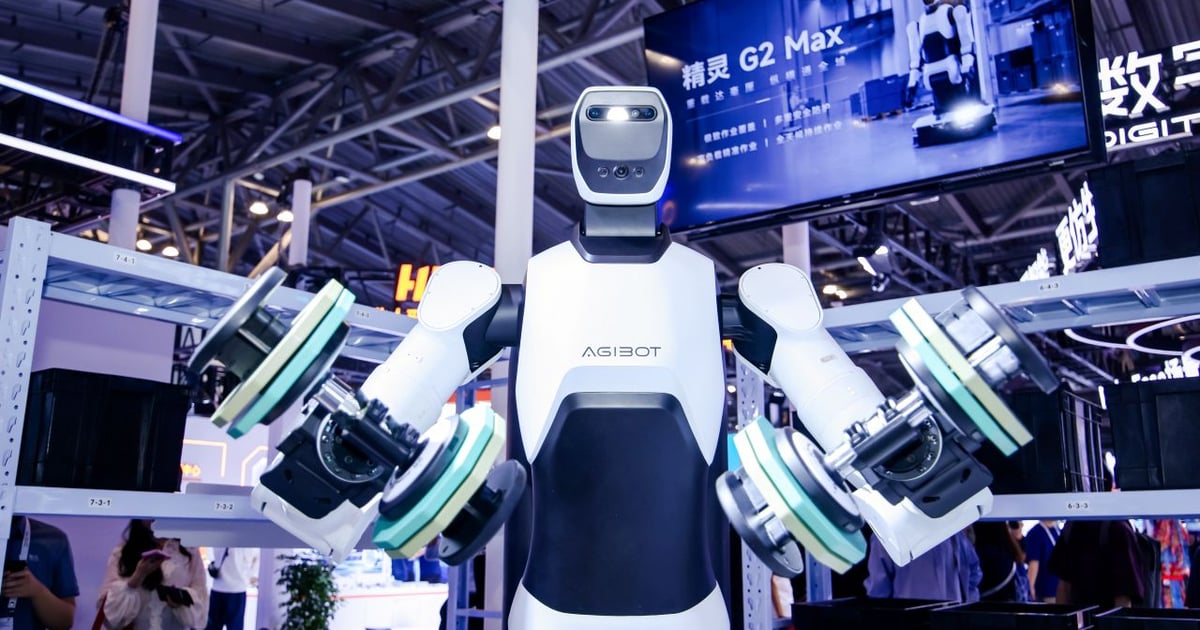
Agibot unveiled four embodied AI products at the World Artificial Intelligence Conference 2026 in Shanghai, broadening its lineup beyond humanoid robots into industrial automation, research platforms and dexterous manipulation.
The Chinese robotics company introduced the full-size Agibot A3 Ultra humanoid, the modular X2 EDU development platform, the G2 Max industrial task robot and the OmniHand 3 Ultra-M dexterous robotic hand. The launches come as the robotics industry seeks to move embodied AI — AI systems designed to perceive, reason and act in the physical world — from one-off demonstrations toward dependable, full-scale use in commercial and industrial settings.
Agibot, one of China’s largest robot makers, deployed more than 30 robots at the conference last week. The robots provided visitor guidance and information services and were used in live demonstrations. The company also presented industrial application cases and its manipulation foundation models.
Together, the products signal Agibot’s effort to build a broader embodied AI portfolio rather than depending on a single general-purpose humanoid platform.
“What Agibot is doing shows that the embodied AI market still requires innovations across the technology stack,” said Lian Jye-Su, an analyst at Omdia, a division of Informa TechTarget. “Agibot is taking an interesting approach by establishing [product lines] to address these innovations individually, which is a unique move among humanoid robotics vendors.”
A broader embodied AI portfolio
The A3 Ultra is a full-size humanoid built for commercial, service and other public-facing environments. It is powered by Nvidia’s Jetson Thor platform. According to Agibot, the robot can carry up to 5kg per arm and provides up to eight hours of combined operating time.
Agibot has not disclosed pricing or commercial availability for the A3 Ultra.
The G2 Max is a more specialized physical AI system. The force-controlled robot is designed for heavy-payload industrial work, including material handling and palletizing.
The OmniHand 3 Ultra-M is aimed at the manipulation challenges faced by increasingly capable robots. The direct-drive dexterous hand has 20 active degrees of freedom and vision-based tactile sensing, allowing it to combine visual information with physical feedback during interactions with objects.
The X2 EDU is an open, modular humanoid development platform intended to give researchers and developers a way to build, test and evaluate embodied AI capabilities. Open development platforms can also help robotics teams compare approaches across perception, motion control and task execution before those capabilities are deployed in commercial machines.
Su said the transition from robot demonstrations to real operating environments is progressing only in specific applications.
“The biggest barrier is high-quality data,” he said. “The industry still lacks good data to train and fine-tune the robot to perform tasks accurately.”
That issue could become more important as Agibot and competitors attempt to move beyond individual deployments and scale robots across more environments. Unlike purely digital AI systems, embodied AI must account for varied physical spaces, objects, safety requirements and human interactions, which can make repeatable training and evaluation harder.
“It will take years for the industry to build up the repertoire of high-quality data across different industries,” Su added. “To achieve this, Agibot will need to partner with as many companies across the industry as possible to ensure they can serve all the different use cases.”
Agibot’s latest launch points to a broader question for the embodied AI sector: whether increasingly capable hardware can be matched with the data, software and real-world operating experience needed to make robots reliable at scale.
“The industry should no longer judge embodied AI by whether a robot can complete an impressive demonstration once, but by whether it can be manufactured, delivered and integrated reliably into real operating environments,” Peng Zhihui, co-founder, president and CTO of Agibot, said in a release.
