Zoomex Contract Grid: A Strategy for Profiting From Sideways Crypto Markets
Key Takeaways
- •Zoomex's Contract Grid is an automated trading strategy that profits from price oscillations within a defined range, operating without requiring a specific directional market forecast.
- •The system offers three directional modes (Long, Short, and Neutral) and three grid spacing configurations (Arithmetic, Geometric, and Large-Range) to accommodate varying market conditions and volatility levels.
- •Once configured, the platform autonomously opens and closes positions, replenishes orders after completed trades, and continues operating as long as prices remain within the predefined range.
- •Zoomex provides a Futures Grid marketplace where traders can browse community-run strategies across multiple trading pairs with displayed metrics including backtest ROI, leverage, and minimum investment requirements.
- •As a derivatives strategy, Contract Grid outcomes are influenced by parameter settings, leverage and margin choices, trading fees, funding costs, and the risk of prices breaking beyond the established range.
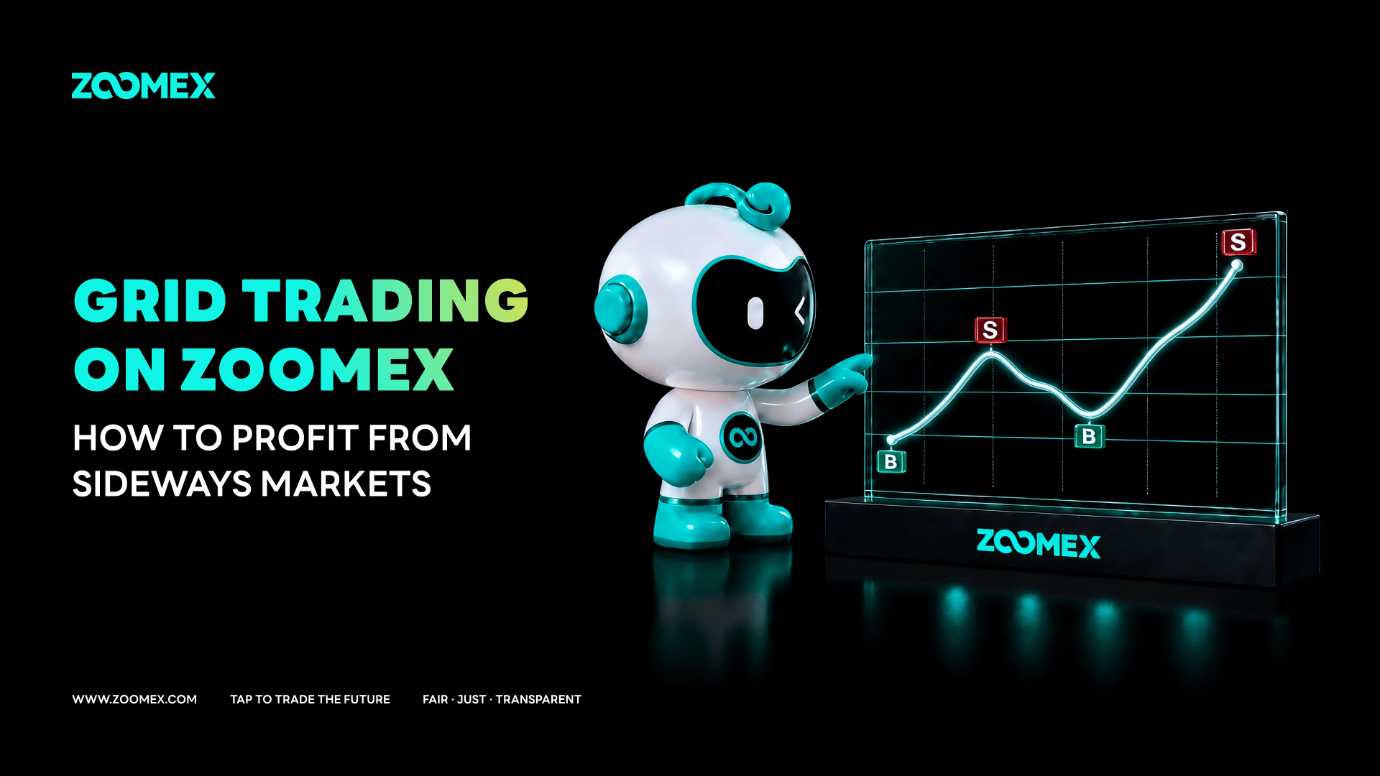
Victoria, Seychelles, July 22, 2026 — Most cryptocurrency traders devote significant effort to predicting the next major market direction. Yet markets do not always trend decisively. Prices frequently move sideways for days or even weeks, oscillating within a defined range without committing to a sustained upward or downward trajectory. Such conditions can be challenging to navigate through manual trading.
Zoomex's Contract Grid is designed specifically for this type of environment. Rather than depending on directional forecasts, the strategy is engineered to generate returns from price movement itself, irrespective of whether the broader market trends higher or lower. As with any derivatives-based strategy, however, outcomes depend on how parameters are set, how the market behaves after launch, and how costs such as trading fees and funding affect net results.
How Contract Grid Trading Works
A grid trading strategy divides a chosen price range into multiple incremental price levels. As the market moves through these levels, the system automatically executes buy and sell orders based on parameters established by the trader.
Once the price range and trading parameters are configured, Zoomex's Contract Grid manages the entire process autonomously. It opens and closes positions as the price crosses each grid level, replenishes orders following every completed trade, and continues operating for as long as the market remains within the defined range.
The underlying principle is straightforward: the strategy does not require the market to move in any particular direction. Instead, it is designed to capture value from continuous price fluctuations within the selected range. The defined range is therefore central to the strategy: if the market breaks beyond those boundaries, traders may need to reassess the configuration, margin usage, or whether the strategy remains appropriate for current conditions.
This approach is especially effective during range-bound markets, where manual trading typically demands constant vigilance to identify and act on relatively modest opportunities. Contract Grid automates this workflow, enabling traders to systematically capture market volatility that might otherwise prove difficult to trade with consistency.
Aligning the Grid with Market Conditions
Zoomex's Contract Grid provides three directional modes, giving traders the flexibility to match the strategy to prevailing market dynamics rather than applying a uniform approach across all scenarios.
Long Grid is tailored for an oscillating but broadly bullish market, buying during pullbacks and selling during rallies as prices trend upward over time.
Short Grid is designed for a bearish, range-bound market, selling into strength and buying back during periods of price weakness.
Neutral Grid maintains simultaneous long and short positions, allowing traders to capture opportunities from price movement in either direction without requiring a directional market view.
Contract Grid also offers multiple grid spacing configurations.
The Arithmetic Grid places grid levels at equal price intervals, making it well-suited for assets that trade within relatively stable and predictable ranges.
The Geometric Grid positions levels at equal percentage intervals instead. This structure is better adapted to more volatile trading pairs, where fixed price intervals may trigger orders either too frequently or too infrequently.
For traders with longer time horizons, the Large-Range Grid expands both the price boundaries and the spacing between grid levels. This configuration reduces trading frequency while allowing the strategy to accommodate larger market swings without exceeding its predefined range.
Setting Up and Monitoring a Contract Grid
Launching a Contract Grid on Zoomex requires traders to define several key parameters:
- Trading pair
- Maximum and minimum price boundaries
- Number of grid levels
- Trading direction
- Leverage and margin
Before activation, the platform validates these parameters to confirm that the selected configuration can function as intended. Because Contract Grid operates in futures markets, leverage and margin settings are especially important: higher leverage can increase capital efficiency but also magnifies losses and liquidation risk if price action moves against the position or outside the planned range.
Once a strategy is live, Zoomex delivers comprehensive performance tracking, including data on active strategies, historical records, cumulative profit, ROI, the number of arbitrage trades executed, and detailed order and pairing records. This level of transparency allows traders to evaluate strategy performance and make informed adjustments over time.
For traders who are new to grid trading, the Futures Grid marketplace offers a practical entry point. It hosts live, community-run strategies across trading pairs including XRPUSDT, WLDUSDT, HYPEUSDT, AVAXUSDT, BTCUSDT, and BNBUSDT. Each listed strategy displays its trading direction, leverage, 30-day backtest ROI, minimum investment requirement, and suggested duration. Rather than constructing a strategy entirely from scratch, traders can review existing approaches and use them as reference points. Backtest figures can help compare strategy settings, but they reflect historical data and do not guarantee future performance.
About Zoomex
Founded in 2021, Zoomex is a global cryptocurrency trading platform specializing in derivatives. The platform serves more than 3 million users across over 35 countries and regions, providing access to more than 590 trading pairs. Built on the principles of ease of use, transparency, fairness, and speed, Zoomex aims to deliver a clear and efficient trading experience.
Through its high-performance matching engine, transparent asset and order displays, and clearly defined fee and rule mechanisms, Zoomex enables users to better understand their account status, order execution, trading costs, and overall results.
Zoomex maintains registrations, licenses, and regulatory standings across multiple jurisdictions, including the U.S. MSB, Canada MSB, U.S. NFA, and Australia AUSTRAC. The platform has also completed security audits conducted by blockchain security firm Hacken. Zoomex continues to reinforce its trust framework through initiatives covering Proof of Reserves, Security & Transparency, Compliance Information, and Fees/Rules Transparency.
Beyond its trading operations, Zoomex has established partnerships in professional sports, including the TGR Haas F1 Team, FIFA World Cup-winning goalkeeper Emiliano Martínez, and world-class tennis events such as Wimbledon. The values of speed, precision, discipline, fair play, and rule-based execution closely align with Zoomex's approach to derivatives trading.
Media Contact: Catherine, Zoomex — 306 Victoria House, Victoria, Mahé, Seychelles — Website: www.zoomex.com — Email: catherine.shi@zoomex.com
Publication Partner: ZM Newswire — Powered By Zeest Media (zeestmedia.com/zm-newswire)
This article is provided for general informational purposes only and should not be considered financial, investment, or trading advice. Cryptocurrency-related activities carry risks, including the potential loss of capital.

