Zoomex Launches Contract Grid Trading to Capitalize on Sideways Crypto Markets
Key Takeaways
- •Zoomex's Contract Grid applies grid trading methodology to leveraged cryptocurrency derivatives, aiming to generate returns from price oscillation within defined ranges rather than from directional market movements.
- •The strategy offers three directional modes (Long, Short, and Neutral) and three grid spacing options (Arithmetic, Geometric, and Large-Range) to accommodate different market conditions and volatility profiles.
- •A well-known limitation of grid strategies is that decisive price breakouts beyond configured boundaries can cause the strategy to stop functioning effectively and incur losses, especially when leverage is involved.
- •Zoomex's Futures Grid marketplace provides live, community-run strategies across major pairs like BTCUSDT and ETHUSDT, displaying trading direction, leverage, 30-day backtest ROI, minimum investment, and suggested duration.
- •Founded in 2021, Zoomex serves over 3 million users across more than 35 countries with access to 590+ trading pairs and holds regulatory registrations including U.S. MSB, Canada MSB, U.S. NFA, and Australia AUSTRAC.
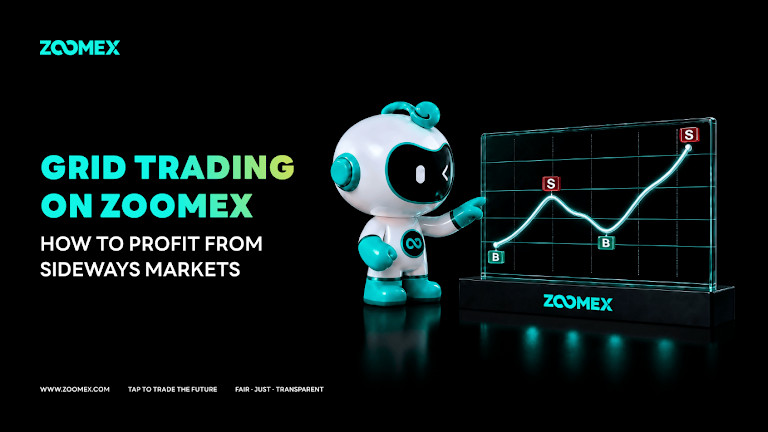
Victoria, Seychelles — July 22, 2026. Most cryptocurrency traders devote significant effort to predicting the next major market move. In reality, however, markets frequently trade sideways for extended periods — fluctuating within a defined range without committing to a sustained upward or downward trajectory. These range-bound conditions are notoriously difficult to trade manually.
Zoomex's Contract Grid is purpose-built for this type of environment. Rather than relying on directional forecasts, the automated strategy is designed to generate returns from price movement itself, irrespective of whether the broader trend is bullish or bearish. Grid trading is a well-established quantitative technique that originated in traditional financial markets, and several major cryptocurrency exchanges already offer some form of automated grid functionality. Zoomex's Contract Grid extends the concept to leveraged derivatives trading, which amplifies both the potential returns and the risk profile compared to spot-based grid strategies.
How Contract Grid Trading Works
A grid trading strategy divides a selected price range into multiple discrete price levels. As the market moves through those levels, the system automatically executes buy and sell orders according to parameters defined in advance by the trader.
Once the price range and trading parameters are configured, Zoomex's Contract Grid manages the entire process autonomously. It opens and closes positions as price crosses each grid level, replenishes orders after every completed trade, and continues operating for as long as the market stays within the defined range.
The underlying principle is simple: the strategy does not require the market to move in any particular direction. Instead, it is engineered to benefit from continuous price oscillation within a selected range. This makes the approach especially valuable during range-bound markets, where manual trading typically demands constant monitoring to capture relatively small opportunities. By automating the process, Contract Grid allows traders to systematically exploit market volatility that might otherwise prove inconsistent to trade by hand.
A well-known limitation of grid strategies, however, is that if price moves decisively beyond the configured range — either breaking out above the maximum boundary or breaking down below the minimum — the strategy may cease executing effectively and can incur losses, particularly when leverage is involved. Traders should be aware of this risk when setting grid parameters.
Adapting the Grid to Market Conditions
Zoomex's Contract Grid offers three directional modes, enabling traders to align the strategy with prevailing market conditions rather than applying a single approach to every scenario:
- Long Grid — Designed for an oscillating but generally bullish market. The system buys during pullbacks and sells during rallies as prices trend upward over time.
- Short Grid — Intended for a bearish, range-bound market. The system sells into strength and buys back during periods of weakness.
- Neutral Grid — Simultaneously maintains long and short positions to capture opportunities from price movement in either direction, without requiring a directional market view.
In addition to directional modes, Contract Grid provides multiple grid spacing options:
- Arithmetic Grid — Places grid levels at equal price intervals. This makes it suitable for assets trading within relatively stable and predictable ranges.
- Geometric Grid — Places levels at equal percentage intervals. This structure is better suited to more volatile trading pairs, where fixed price intervals may trigger either too frequently or too infrequently.
- Large-Range Grid — Expands both the price boundaries and the spacing between grid levels. This reduces trading frequency while allowing the strategy to accommodate larger market swings without exceeding its predefined range, making it appropriate for traders with longer horizons.
Setting Up and Monitoring a Contract Grid
Launching a Contract Grid on Zoomex requires traders to define several key parameters:
- Trading pair
- Maximum and minimum price boundaries
- Number of grid levels
- Trading direction
- Leverage and margin
Before activation, the platform validates these parameters to ensure the selected configuration can operate correctly.
Once a strategy is live, Zoomex provides comprehensive performance tracking, including active strategies, historical records, cumulative profit, ROI, the number of arbitrage trades executed, and detailed order and pairing records. This level of visibility enables traders to monitor strategy performance and make informed adjustments over time.
For traders new to grid trading, the Futures Grid marketplace offers a practical starting point. It features live, community-run strategies across trading pairs including XRPUSDT, WLDUSDT, HYPEUSDT, AVAXUSDT, BTCUSDT, and BNBUSDT. Each listed strategy displays its trading direction, leverage, 30-day backtest ROI, minimum investment, and suggested duration. Rather than building a strategy from scratch, traders can review existing approaches and use them as a reference. As automated trading tools become a standard competitive feature across crypto derivatives exchanges, the availability of transparent performance data and community-shared configurations may serve as a differentiator for platforms seeking to attract quantitative-minded traders.
About Zoomex
Founded in 2021, Zoomex is a global cryptocurrency trading platform focused on derivatives trading. The platform serves more than 3 million users across more than 35 countries and regions and offers access to more than 590 trading pairs.
Zoomex's infrastructure is built around a high-performance matching engine, transparent asset and order displays, and clearly defined fee and rule mechanisms, enabling users to monitor their account status, order execution, trading costs, and results.
Zoomex maintains registrations, licenses, and regulatory statuses across multiple jurisdictions, including the U.S. MSB, Canada MSB, U.S. NFA, and Australia AUSTRAC. The platform has also completed security audits conducted by blockchain security firm Hacken. Zoomex further strengthens its trust framework through its Proof of Reserves, Security & Transparency, Compliance Information, and Fees / Rules Transparency initiatives.
Beyond trading, Zoomex has established partnerships in professional sports, including the TGR Haas F1 Team, FIFA World Cup-winning goalkeeper Emiliano Martínez, and world-class tennis events such as Wimbledon.
Media Contact: Catherine, Zoomex — 306 Victoria House, Victoria, Mahé, Seychelles — www.zoomex.com — catherine.shi@zoomex.com

