Tesla Shares Fall to Multi-Month Low After Q2 Earnings Miss and Negative Free Cash Flow
Key Takeaways
- •Tesla's adjusted earnings per share of 33 cents in the second quarter fell significantly short of the median analyst estimate of 51 cents.
- •The company reported a free cash flow outflow exceeding $1 billion during the quarter, driven by capital expenditures that surged to over $5.7 billion.
- •Terafab, a joint Tesla-SpaceX semiconductor project in Texas leveraging Intel's manufacturing expertise, has a projected first-phase cost exceeding $50 billion and could ultimately surpass $110 billion in total spending.
- •Tesla is simultaneously ramping production across multiple product lines including the Cybercab, Tesla Semi, Megafactory Texas, and Optimus humanoid robots, representing an unusually broad investment cycle.
- •Technical analysis shows TSLA trading below both its 50-day and 200-day exponential moving averages, with the next key support level at $300 if the current decline continues.
Tesla Stock Hits Lowest Level Since April Amid Earnings Miss
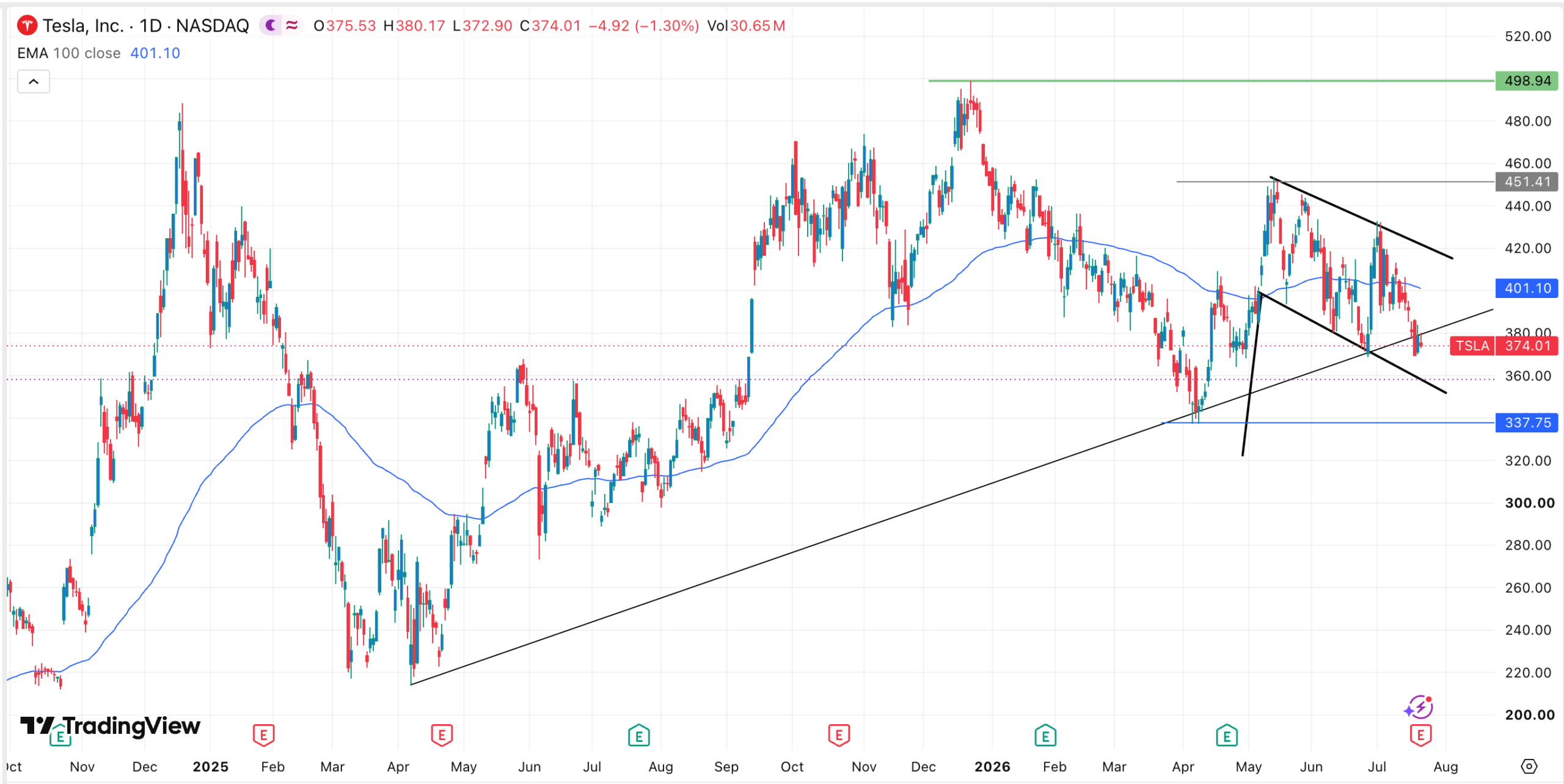
Tesla (TSLA) shares slipped more than 4% in extended trading on July 23, 2026, falling to $360 — their lowest level since April 14. The decline extended a downtrend that began on May 13, when the stock peaked at $451.
The sell-off followed the release of Tesla's second-quarter results, which revealed an earnings-per-share miss, contracting gross margins, and a significant cash outflow tied to the company's escalating capital expenditure program.
Strong Revenue Overshadowed by Negative Free Cash Flow
On several metrics, Tesla delivered a solid quarterly performance. Vehicle deliveries increased, and the energy business resumed growth. The company's trailing twelve-month (TTM) revenue climbed to a record $100 billion.
However, these positives were outweighed by a free cash flow outflow exceeding $1 billion during the quarter, driven by a surge in capital spending to over $5.7 billion. The cash burn was consistent with guidance issued by management in the prior quarter, when the company cited the Terafab project as the reason free cash flow would turn negative for the year.
Terafab is a large-scale joint undertaking by Tesla and SpaceX in Texas. The initiative aims to draw on Intel's semiconductor manufacturing expertise to produce chips for both companies, with the eventual goal of supplying other firms as well. The project's first phase alone is projected to cost over $50 billion, with total expenditures potentially surpassing $110 billion over time — a figure that could rise further given escalating costs for memory, servers, and semiconductors. For perspective, spending at that scale would rank among the largest private-sector manufacturing investments in history and reflects a broader pattern of major technology companies pursuing in-house semiconductor capabilities to reduce dependence on third-party foundries.
Earnings-per-Share Falls Short of Estimates
Tesla's adjusted EPS came in at 33 cents, well below the median analyst estimate of 51 cents. Gross margin also contracted during the quarter as average vehicle selling prices eased. The decline was compounded by lower regulatory credit revenue. The pricing pressure mirrors a wider trend across the EV industry, where multiple manufacturers have repeatedly cut prices to defend market share amid intensifying competition and moderating demand growth.
Musk Outlines Growth Investments Across Multiple Product Lines
In his earnings remarks, Elon Musk outlined steps the company is taking to sustain revenue momentum. Tesla has begun manufacturing the Cybercab model at its Texas plant and expects to commence production of the Tesla Semi at its Nevada factory. Separately, the Megafactory Texas facility is approaching completion. The simultaneous ramp across robotaxis, commercial trucks, energy storage, and humanoid robotics represents an unusually broad investment cycle for a single automaker and helps explain the magnitude of the company's current capital expenditure.
The company is also developing its Optimus humanoid robots at the Fremont factory, the site of former Model S and Model X production lines. Tesla aims to begin Optimus production later this year, though questions remain about whether customer demand will materialize at scale — a setback would represent a costly setback for the company.
In Europe, recent reporting indicates rising demand for Tesla vehicles, prompting management to expand capacity at the company's German plant, which serves more than 30 markets. Nevertheless, competitive pressure continues to intensify as Chinese manufacturers gain share. Beyond BYD, companies including SAIC, Nio, and Li Auto have expanded their presence in Europe and other regions. Collectively, Chinese EV makers sold over 1 million vehicles in June. The European Union has applied countervailing duties on Chinese-built electric vehicles since 2024, a measure intended to counter state subsidies to Chinese manufacturers.
Technical Outlook Points to Further Downside Risk
On the daily chart, TSLA has retreated from its May high of $451 to $360, breaking below the ascending trendline connecting lows since April. The stock has also remained beneath both the 50-day and 200-day Exponential Moving Averages (EMA). Technical indicators suggest the previously forming bullish flag pattern — composed of a vertical advance followed by a descending channel — is being invalidated. Should the decline continue, the next key support level to monitor is $300.
