Se espera que el PBOC fije la tasa de referencia USD/CNY en 6.7248, según estimación de Reuters
Puntos clave
- •Se espera que el PBOC fije la tasa de referencia diaria USD/CNY en 6.7248, según una estimación de Reuters.
- •El yuan de China puede cotizar dentro de un rango de más o menos 2% del punto medio oficial en el mercado onshore.
- •El renminbi offshore, CNH, no está sujeto a la fijación diaria, y la brecha entre las tasas onshore y offshore se vigila como indicador de presión sobre la moneda.
- •El PBOC usa cotizaciones de mercado, el cierre previo, las condiciones del mercado cambiario y factores económicos internos para determinar el punto medio.
- •Una fijación más fuerte o más débil de lo esperado suele interpretarse como una señal de política sobre la postura del banco central respecto a la fortaleza o debilidad del yuan.
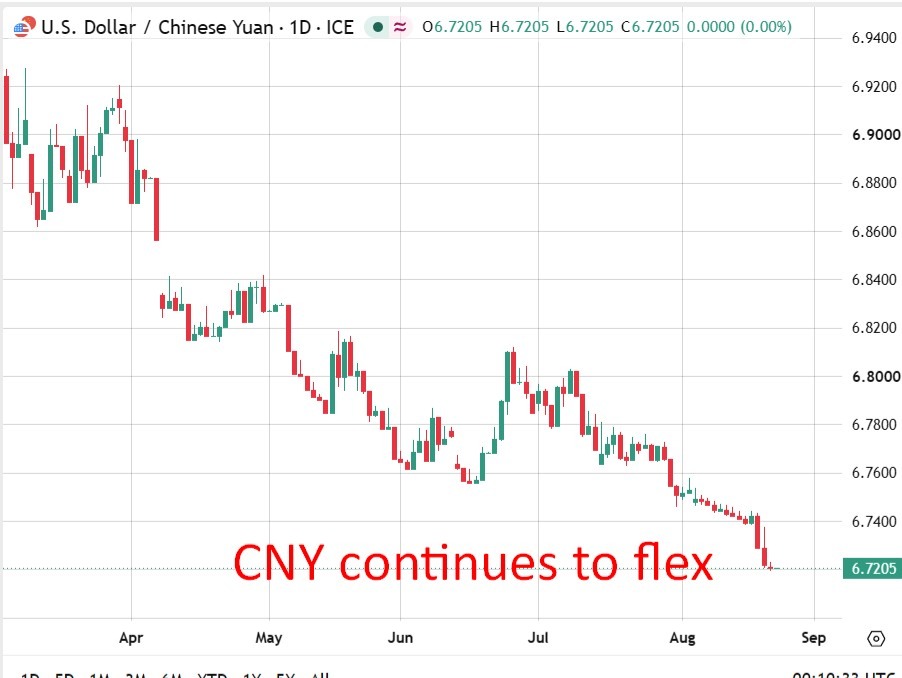
The People's Bank of China (PBOC) is expected to set its daily USD/CNY reference rate at 6.7248, according to a Reuters estimate. The fixing is due at around 0115 GMT (2115 US Eastern time) and remains one of the most closely watched signals in Asian foreign exchange markets.
China operates a managed floating exchange rate system under which the renminbi (yuan) is allowed to trade within a prescribed band around a central reference rate, or midpoint, set each trading day by the PBOC. The current trading band permits the currency to move plus or minus 2% from the official midpoint during onshore trading hours. That band binds only the onshore market: the offshore renminbi, CNH, which trades mainly in Hong Kong, is not constrained by the daily fixing, and the gap between onshore and offshore rates is itself tracked as a gauge of currency pressure. The managed float dates to July 2005, when China ended a long-standing peg to the US dollar, and the band has been widened in stages since — from an initial 0.3% to 0.5% in 2007, 1% in 2012, and 2% in March 2014.
Each morning, the PBOC determines the midpoint using a range of inputs, drawing on quotes submitted by market-making banks on the China Foreign Exchange Trade System (CFETS). These include the previous day's closing price, movements in major currencies — particularly the US dollar — broader international FX conditions, and domestic economic considerations such as capital flows, growth momentum, and financial stability objectives. A reform announced on August 11, 2015 instructed market makers to base quotes more closely on the prior day's closing rate, increasing the weight of market forces in the daily fixing. The midpoint is not a purely mechanical calculation, giving policymakers discretion to guide market expectations.
Once the midpoint is announced, onshore USD/CNY is free to trade within the allowable band. If market pressures push the yuan toward either edge of that range, the central bank may step in to smooth volatility. Intervention can take the form of direct buying or selling of yuan, adjustments to liquidity conditions, or guidance through state-owned banks.
As a result, the daily fixing is often interpreted as a policy signal rather than just a technical reference point. A stronger-than-expected CNY midpoint is typically read as a sign that the PBOC is leaning against depreciation pressure, while a weaker fixing for the CNY can indicate tolerance for a softer currency, often in response to dollar strength or domestic economic headwinds.
The fixing takes on added significance during periods of heightened global volatility, such as shifts in US rate expectations, trade tensions, or capital flow pressures. For investors, it provides insight into Beijing's currency priorities as policymakers balance competitiveness, capital stability, and financial market confidence. Beyond the headline midpoint, the CFETS trade-weighted yuan index, which measures the currency against a basket of 24 trading partners, is watched as a complementary benchmark of the renminbi's value beyond its dollar rate.
Earlier: Goldman flags China stimulus risk as growth slips further below target

