LiquidChain (LIQUID) Targets Cross-Chain Interoperability Across Bitcoin, Ethereum, and Solana with Layer 3 Architecture
Key Takeaways
- •LiquidChain's presale has raised $915,000, with LIQUID tokens priced at $0.0148 each and a staking rate of 1,232% APY.
- •The platform employs a cross-chain virtual machine and unified proof engine designed to execute transactions referencing Bitcoin, Ethereum, and Solana simultaneously with atomic settlement.
- •LiquidChain proposes a build-once development model using Solana-based SDKs, enabling applications to reach users and liquidity across all three blockchain ecosystems.
- •The LIQUID smart contract has been reviewed by SpyWolf and listed by CertiK, with no high-severity vulnerabilities identified.
- •The project's planned use cases include shared order books, cross-chain swaps, lending, borrowing, and staking, with a roadmap advancing from testnet infrastructure to mainnet deployment.
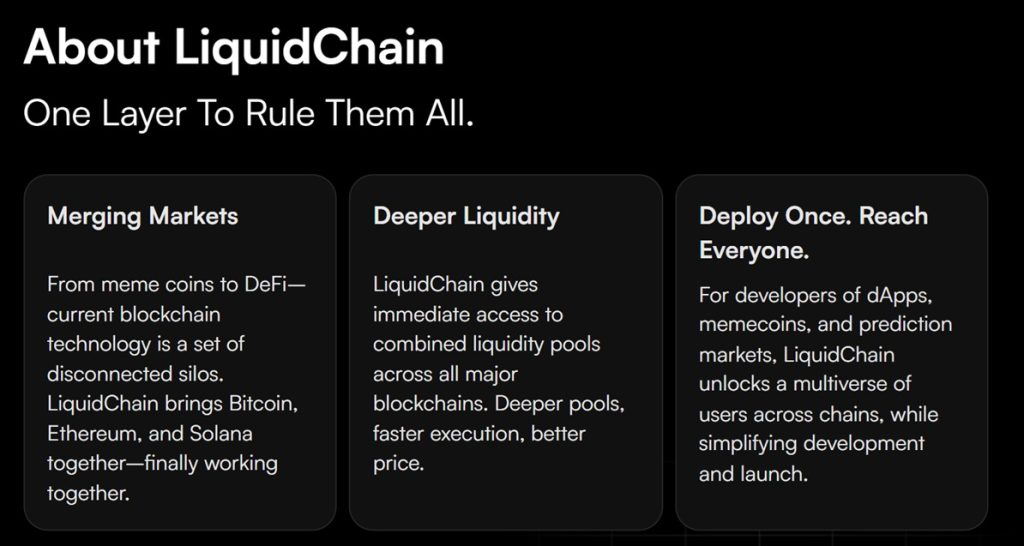
The cryptocurrency industry has spent years developing faster blockchains, cheaper execution layers, and increasingly sophisticated financial tools, yet interoperability between these networks remains largely unsolved. Bitcoin holds the deepest pool of crypto capital, Ethereum serves as the primary hub for decentralized finance, and Solana delivers speed for consumer-scale trading — but users still must choose between them.
Existing cross-chain infrastructure — ranging from token bridges to messaging protocols like LayerZero, Chainlink CCIP, and Cosmos IBC — has made incremental progress, but cross-chain bridges have also been among the most exploited sectors in decentralized finance, with billions lost to high-profile hacks. The fragmentation problem persists even as total value locked across chains has grown into the tens of billions of dollars.
LiquidChain (LIQUID) is aiming to change that paradigm through Layer 3 technology. If Layer 1 blockchains created independent economies and Layer 2 networks made some of those economies faster and cheaper, Layer 3 takes a more ambitious approach: building an execution layer capable of drawing liquidity and users from multiple chains simultaneously. The Layer 3 concept remains early in its broader adoption cycle, with a limited number of projects pursuing multi-chain execution environments rather than single-chain scaling.
LiquidChain is pursuing this model across Bitcoin, Ethereum, and Solana. At the time of writing, the project's presale has raised $915,000, with LIQUID priced at $0.0148 per token and a staking rate of 1,232% APY.
How LiquidChain's Layer 3 Model Works
LiquidChain is designed as a common execution and settlement environment rather than another isolated base chain. According to its whitepaper, the platform envisions unified liquidity pools in which assets from Bitcoin, Ethereum, and Solana can be represented and used within the same cross-chain market.
The ecosystem's core component is a cross-chain virtual machine paired with a unified proof engine, capable of executing transactions that reference multiple underlying blockchains simultaneously — verifying changes to Bitcoin, Ethereum, and Solana in real time. The objective is atomic settlement, meaning every component of a multi-chain transaction either completes in full or does not execute at all.
Current bridge solutions typically require users to move assets manually, wait for confirmations, and accept additional smart contract risk. The recurring security incidents involving bridges — which have become frequent targets for attackers due to the large value they custody — underscore the difficulty of connecting chains safely. Developers face a related challenge: a product targeting users across three chains currently requires separate deployments, separate liquidity incentives, and ongoing maintenance for each network.
LiquidChain proposes a build-once development model in which developers use its Solana-based software development kits to create applications that reach users and liquidity across all three ecosystems. Planned use cases include shared order books, cross-chain swaps, lending, borrowing, and staking. The project's roadmap progresses from testnet infrastructure and developer APIs to unified liquidity pools, mainnet deployment, derivatives, and multi-chain lending.
The LIQUID smart contract has been reviewed by SpyWolf and is listed by CertiK, with no high-severity vulnerabilities identified.
Market Context and Challenges
LiquidChain's thesis is that blockchain growth has produced abundance without unity. The crypto ecosystem has more block space, liquidity, and developer talent than ever before, yet much of that value remains siloed across incompatible networks.
A Layer 3 architecture could reshape how new applications are built. Rather than deciding whether a lending market belongs on Ethereum or Solana, a developer could design it around capital from both networks, with the potential to incorporate Bitcoin liquidity as well.
However, execution remains the critical challenge. Cross-chain systems must maintain speed without compromising verification integrity, and unified liquidity requires more than infrastructure — it demands active participation from developers, market makers, and applications generating real transaction volume. LiquidChain's early fundraising indicates investor interest in this approach, with the 1,232% staking APY serving as an additional incentive during the presale period.
Looking Ahead
Bitcoin, Ethereum, and Solana have demonstrated that separate blockchain economies can attract billions of dollars in value and millions of users. LiquidChain is positioning itself at the intersection of these networks, building an execution layer designed to make them function together rather than competing with any individual chain.
Source: ICO Bench
