Google's AI ATLAS Report: AI Used Across 68% of Occupations Without Mass Job Displacement
Key Takeaways
- •Google's ATLAS report found that AI usage spans over 68% of occupations representing approximately 88% of total US employment, yet the median occupation with any AI adoption uses it for only 21% of tasks.
- •Fewer than 10% of AI conversations related to non-routine cognitive work involve attempts at end-to-end task automation, with the vast majority of usage being collaborative and assistive in nature.
- •AI usage is concentrated among higher-earning occupations, with a 1% increase in an occupation's median earnings associated with a more than 2.5% rise in AI usage intensity.
- •The study captured data only from Google's own AI services and did not include competing platforms like ChatGPT, Claude, or Microsoft Copilot, meaning the full workplace AI footprint is likely larger.
- •Researchers are monitoring whether AI-driven automation of entry-level tasks could narrow career on-ramps in fields such as law, consulting, and software development for recent college graduates.
AI is now present in 68% of occupations representing 88% of US employment, spanning roles from software developers to farmers, industrial engineers, and foresters. Rather than automating those jobs out of existence, AI is predominantly helping workers perform their tasks more effectively, according to a new analysis released by Google. The findings reflect usage of Google's own AI services and do not capture activity on competing platforms such as OpenAI's ChatGPT, Anthropic's Claude, or Microsoft Copilot, meaning the actual workplace footprint of AI tools may be larger still.
For a time, several AI company founders, insiders, and promoters fueled narratives of an impending "total-job-destruction Armageddon," suggesting that AI would soon replace nearly all office jobs. In recent months, however, many of those voices have retreated from such dire predictions. US employment data reinforces a more measured picture: actual layoffs have remained relatively small.
Many workers who were laid off secured new positions while still receiving severance pay—in some cases collecting two salaries during the remainder of their severance period—and therefore never qualified for unemployment insurance. Several layoff announcements from global companies included cuts in other countries rather than the US market. Some announced "layoffs" were actually the elimination of vacant, unfilled positions. Other announcements came from companies that continued hiring in different departments, giving laid-off workers the opportunity to apply internally.
Still, AI has undeniably driven shifts in the labor market. One notable concern involves recent college graduates entering a workforce where AI enables experienced professionals to automate routine or entry-level tasks—the very "grunt work" that traditionally served as a pathway for younger workers to gain a foothold. Workforce researchers are tracking whether this dynamic could narrow the on-ramp into professions such as law, consulting, and software development, where early-career employees have historically built expertise through structured analytical assignments. These changes remain new and are not yet comprehensively tracked.
Google published its analysis (100-page PDF) examining how its AI services are actually being used—covering human interaction with AI both on the job and at home. The report encompasses Google AI mode in browsers, Google's Gemini app, and Google's Gemini API, which enables companies to integrate Google's AI models into their own websites and services for content generation, conversational agents, long-document summarization, and custom AI agents.
The core finding: AI is being widely adopted across a vast range of jobs—from coding to automotive repair—but is primarily used by workers to complete their tasks and improve quality, not to replace those jobs entirely.
Google monetizes its Gemini app and Gemini API through multiple channels: bundling Gemini with existing software and increasing subscription fees (for example, integrating Gemini into Workspace and raising the monthly subscription by 16.7%); pay-as-you-go input and output tokens, caching, storage, and add-ons; Cloud tools; and other mechanisms. Google's commercial interest in broad AI adoption provides relevant context for interpreting the report's framing, though the underlying usage data offers a substantial empirical window regardless.
The report marks the first installment in a series of papers called the AI & Economy ATLAS (Activity, Task, Landscape, and Adoption Study), analyzing Google AI usage data. The analysis covers AI use at work, outside of work, and internationally.
The following six summaries are directly quoted from Google's analysis:
1. AI has diffused very broadly in both work and life. Adoption in the workplace spans all major sectors (e.g., from Professional and Business Services, to Construction, Leisure and Hospitality, and more). It also spans over 68% of all occupations that collectively represent just above 88% of total US employment, including both much-discussed occupations such as software developers and market researchers, and those less-discussed such as farmers, industrial engineers, and foresters.
2. Though broadly used at work, the overall depth of AI's use is shallow. AI is used for only 21% of total tasks in the median occupation with any AI use. Only 3% of occupations showed AI usage for over 75% of their tasks; these occupations include software quality assurance analysts and testers, human resources specialists, and document management specialists.
3. While there is some task automation, the vast majority of use so far is collaborative and assistive to tasks and work. Non-routine cognitive tasks (e.g. hypothesis testing and creative design) make up only about 35% of the professional tasks in the economy as a whole, yet they make up almost 65% of work-related AI interactions in our data. In our initial attempt to taxonomize intent, only a small amount of this usage appears to be focused on automation based on our classification. Instead, usage of AI for non-routine cognitive work is centered on Partial Drafting and Generation, Review and Refinement, Ideation and Strategy, and Information Retrieval and Learning. Attempts to automate tasks end-to-end represent less than 10% of AI conversations in non-routine cognitive work appearing in our data.
4. AI use is not only a white-collar phenomenon; it is also assisting in physical and manual work. While nearly a third of heavily physical occupations show no observed AI usage, workers in many manual and technical trades are using AI on the job. In these roles, AI frequently acts as a hands-on collaborator for diagnostics, troubleshooting, and real-time learning. We also observe disproportionate multimodal use of AI (i.e., uses that involve images and video) in these contexts: for example, automotive technicians and industrial mechanics using AI to interpret complex test results, debug electrical wiring, and inspect machinery for wear, where the usage rate of multimodal AI is more than 2 times higher than the overall work baseline.
5. Work-related AI usage correlates strongly with higher wages and education. In the US workforce, a 1% increase in an occupation's median earnings is associated with a more than 2.5% increase in AI usage intensity. Weighted by Gemini conversations, the median salary across observed occupations is around $83,000, roughly $20,000 higher than the true employment-weighted national median. This relationship persists even after controlling for the occupation's educational attainment (which itself is positively correlated with AI usage). This correlation means current AI usage is concentrated among higher-earning occupations, a pattern labor researchers are monitoring for potential divergence in productivity and earnings across the workforce.
6. While wages and expertise are typically correlated in the economy, ATLAS points to a complex relationship between AI usage and expertise. When classified according to expertise levels, tasks requiring lower-to-middle levels of expertise tend to see relatively higher AI usage than the highest expertise level tasks, despite ATLAS data also suggesting high-earning workers—and therefore those with more scarce skills and expertise—adopt AI at the highest rates.
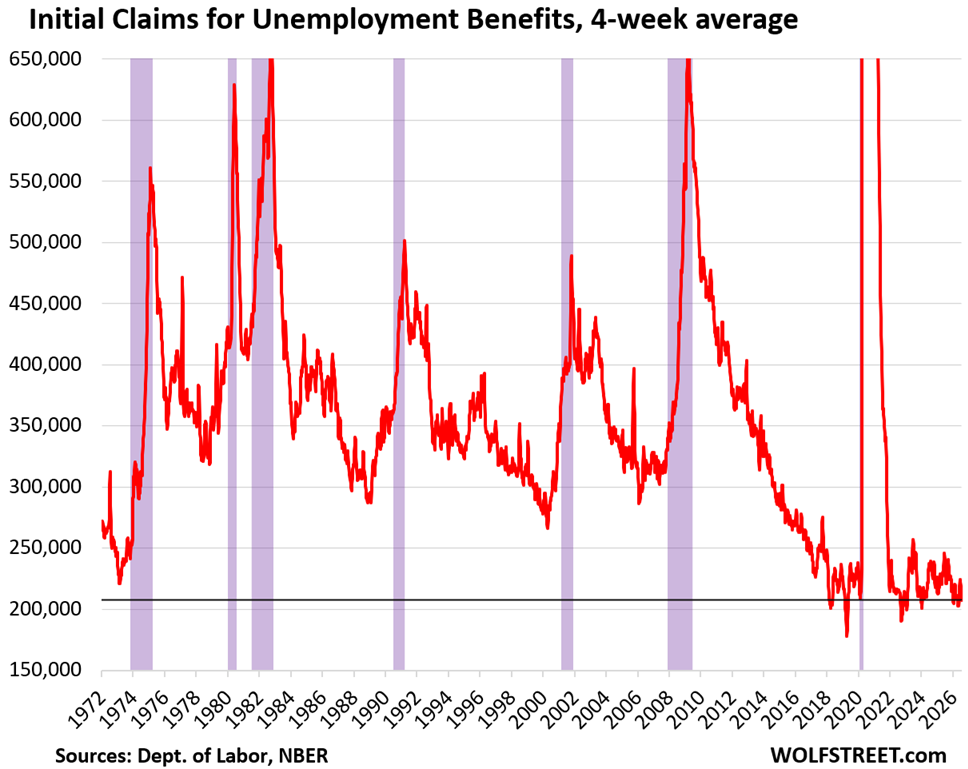
Labor market data broadly supports the view that AI is not causing widespread job destruction, though it may be contributing to shifts. Initial unemployment insurance claims—which track individuals who have recently been laid off and filed for unemployment compensation—have remained at historic lows and declined further in recent weeks, including the most recent reporting period released by the US Labor Department, despite the labor force being substantially larger than in previous years and decades.
Source: Wolf Street
