Galaxy Pledges Up to $5 Million for Bitcoin Post-Quantum Security Development
Key Takeaways
- •Galaxy Digital has committed up to $5 million in grants to fund quantum-resistant upgrade proposals, post-quantum cryptography research, wallet and custodian migration tooling, and formal security audits for Bitcoin-related systems.
- •The company established a quantum advisory council including researchers Barry Sanders of the University of Calgary, Damien Bérubé of MIT, and Eran Tromer of Boston University to help prioritize research directions and assess proposals.
- •Glassnode estimates that approximately 30% of Bitcoin's supply could be at risk from cryptographically relevant quantum computers, divided between structurally unsafe coins (10%) and operationally unsafe coins (20%).
- •Experts remain divided on the urgency of quantum threats, with Blockstream CEO Adam Back citing a 20-40 year horizon while Bernstein argues Bitcoin has only three to five years to prepare.
- •NIST released its first finalized post-quantum encryption standards in August 2024, and Blockstream Research published a paper in December 2025 proposing a hash-based signature scheme as a potential replacement for Bitcoin's ECDSA and Schnorr signatures.
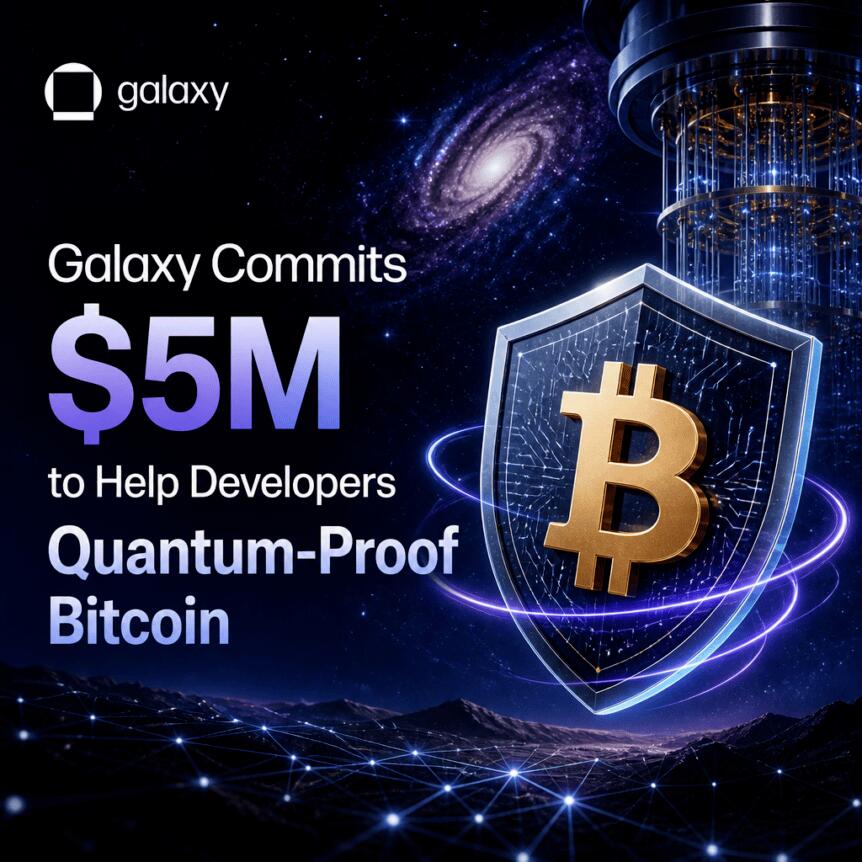
Galaxy Digital has launched a new initiative to accelerate post-quantum security work for Bitcoin, committing up to $5 million in grants for open-source developers. The funding is intended to support research and engineering tied to quantum-resistant upgrades, including cryptography research, migration tooling, and formal security reviews.
The company also announced a quantum advisory council as part of its Bitcoin Quantum Readiness Initiative. Galaxy said Tuesday that the council will bring together researchers with backgrounds in cryptography, applied security, and academic computing, with the goal of turning broad discussions about “quantum risk” into concrete development roadmaps.
What Galaxy Digital plans to fund
Galaxy’s grant program is aimed at practical components of a possible post-quantum transition for Bitcoin-related systems. According to the company’s statement, the funding will support “quantum-resistant upgrade proposals” and post-quantum cryptography research, with a specific focus on Bitcoin signature schemes.
The program also targets an implementation layer that can be overlooked in theoretical cryptography discussions: wallet and custodian migration tooling. Even when a cryptographic replacement is technically feasible, moving users, keys, and custody infrastructure to new standards generally requires careful engineering, operational planning, and risk-managed deployment.
Galaxy said the grants will also support formal security audits. That area can be important for institutional adoption, particularly when new cryptographic constructions are unfamiliar to auditors or have not yet been widely deployed in production systems.
The company is therefore funding more than algorithm research. Its stated scope includes Bitcoin signature schemes, wallet and custodian migration tools, and security audits, all of which could be relevant if Bitcoin developers eventually pursue quantum-resistant changes. Because Bitcoin changes are not directed by any single company, grant-funded work would still need to move through open-source review and, for protocol-level changes, broader community coordination before it could become part of widely used software.
Quantum advisory council includes academic and security researchers
Galaxy Digital’s Quantum Readiness Initiative adds an advisory component through a council that includes Barry Sanders, professor and scientific director of Quantum City at the University of Calgary; Damien Bérubé, an MIT Sea Grant Knauss fellow; and Eran Tromer, professor of computer science at Boston University.
Advisory councils do not directly change Bitcoin protocol code, but they can influence which research directions are prioritized, how proposals are assessed, and what readiness criteria developers may seek to meet. For builders, that may reduce uncertainty by clarifying which cryptographic schemes and migration methods are most likely to withstand technical review.
Galaxy’s earlier announcement of the Bitcoin Quantum Readiness Initiative provides the broader context for the grants and council. The company has positioned both as ways to convert readiness planning into open-source deliverables that contributors can use.
Estimates of Bitcoin exposure vary by risk category
Concerns about quantum risk center on how future quantum computers could affect the cryptographic systems currently used to secure Bitcoin. Analytics provider Glassnode has argued that a significant share of Bitcoin’s supply could be exposed if “cryptographically relevant” quantum computers emerge.
As reported by Glassnode through a Cointelegraph-linked analysis, about 30% of Bitcoin’s supply could be at risk. Glassnode’s breakdown separates coins it describes as “structurally unsafe,” representing about 10% of supply because of output type, from those it describes as “operationally unsafe,” representing about 20% of supply tied to key or address management practices.
That distinction points to two categories of concern for developers and investors. Structural issues relate to cryptographic assumptions embedded at the protocol or script level. Operational issues involve practices that exchanges, custodians, and wallet operators may be able to adjust more quickly than protocol-level fundamentals can be rewritten.
The categories also help explain why migration tooling is part of Galaxy’s grant scope. If some exposure comes from how keys and addresses are used, then readiness is partly a software and operations problem for wallets, exchanges, and custodians, not only a question of selecting a new signature algorithm.
Debate continues over quantum timelines
Timing remains one of the largest unresolved questions behind post-quantum planning. Researchers and executives continue to disagree over when quantum capabilities could become dangerous to today’s signature schemes and related cryptographic assumptions.
Blockstream CEO Adam Back argued in November 2025 that Bitcoin faces no “meaningful quantum threat” for at least the next 20 to 40 years. He described that period as enough time for adoption of post-quantum cryptography standards approved by the US National Institute of Standards and Technology (NIST).
Other research has emphasized a shorter preparation period. NIST released its first finalized post-quantum encryption standards for key establishment and digital signatures in August 2024, including algorithms that could support future migrations across industries and potentially inform Bitcoin-related upgrades.
NIST’s standardization process is relevant because it reduces uncertainty over which algorithms may be considered credible at the cryptographic policy level. That standards work could influence future decisions by institutions, infrastructure providers, and open-source developers evaluating post-quantum migration paths.
Beyond general standards, practical proposals are already being discussed. In December 2025, Blockstream Research published a paper proposing a hash-based signature scheme as a “promising path for securing Bitcoin in a post-quantum world.” As described in coverage, the proposal targets replacing Bitcoin’s ECDSA and Schnorr signatures with a scheme whose security relies solely on cryptographic hash functions.
While Back’s timeline suggests a long period for preparation, Bernstein has argued for a shorter window. In an April report referenced in coverage, Bernstein said Bitcoin “has about three to five years to prepare” for a post-quantum security upgrade.
Migration remains a central challenge
Even if major quantum breakthroughs are decades away, as some industry leaders expect, the most difficult part of post-quantum readiness may not be cryptography alone. Migration would require coordination across wallets, custodians, infrastructure providers, developer ecosystems, and the security processes institutions use to deploy and maintain cryptographic systems.
Galaxy’s grant structure reflects that operational challenge. By funding quantum-resistant proposals as well as wallet and custodian migration tooling and formal audits, the program treats readiness as an engineering and implementation issue, not only a theoretical cryptography problem.
For Bitcoin holders, the immediate issue is not necessarily whether protocol changes are imminent. The more relevant question is whether the community can converge on migration paths that can be implemented safely and iteratively, without requiring rushed transitions if assumptions about quantum timelines change.
The next measure of Galaxy’s initiative will be how the grants translate into specific open-source deliverables. Particular attention is likely to fall on proposals that connect signature-layer changes with realistic wallet and custody migration plans, as well as on research that narrows the divide between long-range quantum timelines and arguments for earlier preparation.

