Bitcoin Volatility Drops to 2016 Lows as Price Hovers Near $66,100
Key Takeaways
- •Bitcoin’s 30-day realized volatility has dropped to 28.3 from 41.6 on June 25, placing it in the bottom 8% of its range since 2016.
- •Bitcoin has gained more than 2% over the past week and has traded between $64,700 and $66,700.
- •The 200-day moving average near $72,700 remains the main resistance level, while the 20-day and 50-day moving averages are providing near-term support.
- •Muted open interest suggests leverage is relatively light, lowering the immediate risk of major liquidation cascades.
- •Bitcoin Hyper is positioning itself as a Bitcoin Layer 2 network with Solana Virtual Machine integration and has raised close to $33 million in presale funding.
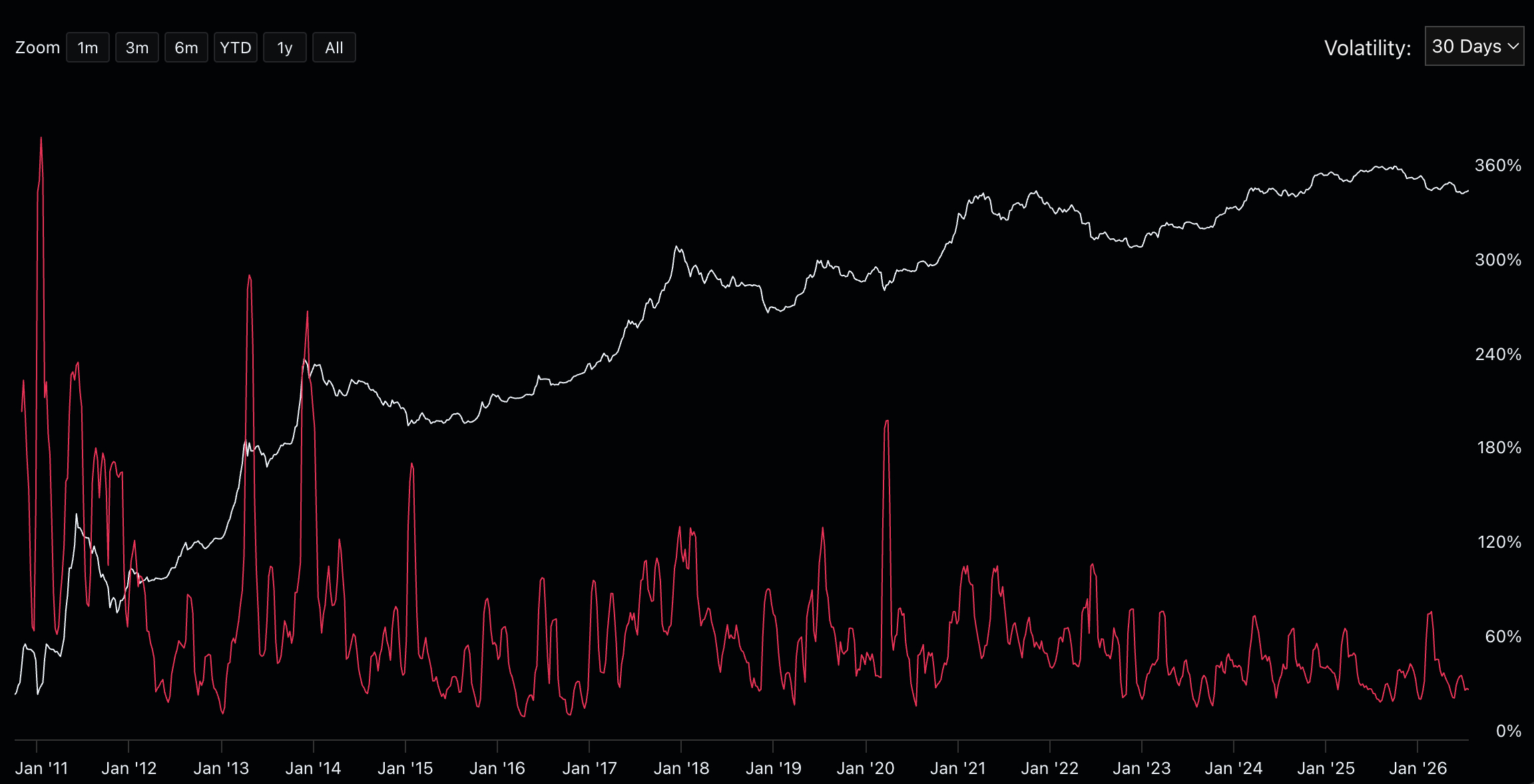
Bitcoin is trading around $66,100 after briefly climbing above $66,500 earlier in the session. Despite the recent rebound, the cryptocurrency's volatility has compressed to levels not seen since 2016, leaving many traders on edge.
CryptoQuant contributor Axel Adler Jr. noted on July 22 that Bitcoin's 30-day realized volatility fell to 28.3, down from 41.6 on June 25. Realized volatility tracks how much the asset has actually moved over a recent period, rather than how much options markets expect it to move in the future. This places BTC in the bottom 8% of its volatility range since 2016, meaning roughly 92% of trading days during that period experienced higher volatility. Such prolonged calm conditions have historically been short-lived, particularly following a steady price recovery.
Open interest has not expanded in tandem with Bitcoin's recent gains, suggesting that leverage remains relatively light. Open interest measures the value of outstanding derivatives contracts, so a muted reading can indicate that fewer traders are using borrowed exposure to chase the move. This reduces the immediate risk of large liquidation cascades. However, once volatility returns, price movements can accelerate rapidly and catch overleveraged positions off guard.
The market is now watching whether this quiet period precedes a breakout or a sharp reversal. Key technical levels and macroeconomic catalysts are expected to determine the next directional move.
Reclaiming $72,000 Before Volatility Forces a Decision
Bitcoin has gained more than 2% over the past seven days, trading in a range between $64,700 and $66,700. While the recovery appears encouraging, it has yet to confirm a sustained trend. The 20-day and 50-day moving averages remain below the spot price, providing near-term support. The 200-day moving average, situated near $72,700, continues to serve as the key resistance level. Traders often use the 200-day average as a broad gauge of long-term trend direction, which is why repeated failures near that level can weigh on momentum.
Adler's threshold is straightforward: if realized volatility rises above 35 while Bitcoin fails to reclaim the 200-day moving average, selling pressure could resurface. Meanwhile, the Fear Index remains in fear territory, and demand for gold and Treasuries suggests investors have not fully rotated back into risk assets.
Options traders are reflecting that uncertainty. Rather than placing aggressive directional bets, many continue hedging against sharp moves. This cautious positioning aligns with the current low-volatility environment, where sudden breakouts or breakdowns frequently occur with little warning.
In a bullish scenario, Bitcoin could clear $68,000 and build momentum toward the $72,000 to $72,700 zone. A successful breach of that area could open the path to $75,000 and potentially $78,000. In the base case, BTC continues trading between $65,000 and $68,000 while volatility stays muted.
The bearish outlook re-emerges if volatility jumps above 35 and the 200-day moving average rejects another rally attempt. Under those conditions, Bitcoin could revisit $61,800, followed by the $60,000 to $61,000 support area. If that floor breaks, $58,500 becomes the next level traders will likely monitor closely.
Bitcoin Hyper Positions for Early-Mover Window as BTC Consolidation Continues
With Bitcoin consolidating in the mid-$60,000s and its 200-day moving average nearly $7,000 overhead, the near-term risk/reward profile for traders pursuing upside remains unattractive. That ceiling is firmly in place, and the timeline for breaching it remains uncertain.
This dynamic is directing some capital toward earlier-stage projects within the Bitcoin ecosystem that do not require BTC to reach new all-time highs to generate returns. Interest in Bitcoin Layer 2 networks has grown as developers look for ways to expand Bitcoin-based activity beyond simple transfers, though early-stage token projects typically carry execution, liquidity, and smart-contract risks.
Bitcoin Hyper ($HYPER) is positioning itself as the first Bitcoin Layer 2 network with Solana Virtual Machine (SVM) integration. The project targets Bitcoin's core limitations: slow transaction finality, high fees, and the near-total absence of programmability. The SVM integration is designed to deliver smart contract execution speeds that reportedly exceed Solana's own performance, while anchoring security to Bitcoin's model through a decentralized canonical bridge for BTC transfers.
The project's presale has raised close to $33 million at a current token price of $0.0136835, with staking available at high APY for early participants.

