Bitcoin Holds Near Five-Week Highs as US-Iran Tensions Fail to Derail Risk Assets
Key Takeaways
- •Bitcoin traded near $65,975 after testing the $67,000 area earlier in the session, down approximately 1% on the day while holding close to five-week highs.
- •Cryptocurrency and US equity markets showed limited reaction to renewed US-Iran tensions, whereas oil prices responded more directly with WTI and Brent reaching their highest levels since June 11.
- •Short interest in the S&P 500 climbed to approximately 3.7% of free float and the Russell 3000 to around 6.1%, both near historically high levels according to Bloomberg data cited by The Kobeissi Letter.
- •Trader Daan Crypto Trades indicated that a decisive move above $67,000 would establish the first daily higher high for Bitcoin since its advance in May.
- •Some market participants observed strong weekly bullish divergence between Bitcoin and the S&P 500, suggesting potential relative outperformance for BTC based on patterns similar to those seen in 2022.
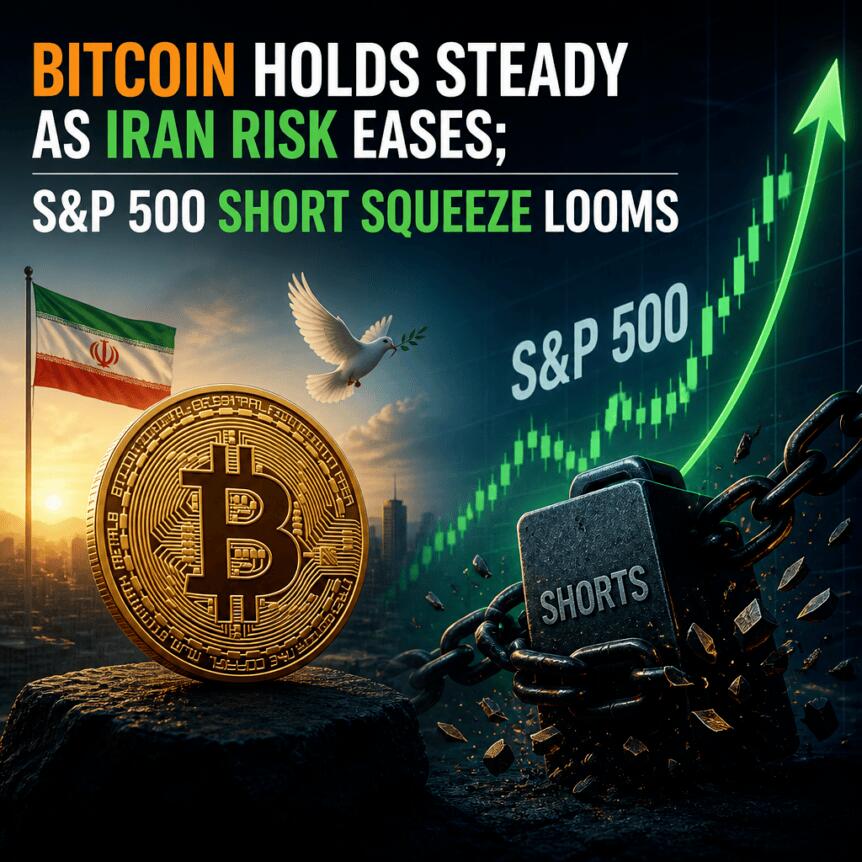
Bitcoin remained supported on Wednesday as cryptocurrency markets and broader risk assets showed limited reaction to renewed tensions between the United States and Iran. BTC/USD traded close to recent five-week highs even after fresh threats from the US raised concerns about a possible escalation in the Middle East.
TradingView data showed BTC/USD down about 1% on the day after the pair earlier tested the $67,000 area. At the time of publication, Bitcoin was trading near $65,975, while 24-hour trading volume exceeded $30.3 billion, according to CoinMarketCap.
Geopolitical headlines leave crypto and equities largely steady
Crypto assets and US stocks extended the tone seen on Tuesday, when both markets largely looked past an escalation in the Middle East, including direct strikes involving Iran and the United States. On Wednesday, the latest flare-up similarly failed to disrupt broader risk-asset trading.
US President Donald Trump said on Truth Social that the United States would target Iranian bridges and energy infrastructure if Iran fired on ships in the Strait of Hormuz. The post said the US would “bomb and destroy ONE BRIDGE OR POWER PLANT,” including targets near or in Tehran.
While crypto and equity markets remained comparatively stable, oil prices reacted more directly to the geopolitical risk. WTI crude and Brent crude rose to roughly $88.60 and $95.50, respectively, levels described as the highest since June 11. The Strait of Hormuz is closely watched by energy markets because it is a major chokepoint for global oil and fuel shipments, making threats around the waterway more immediately relevant for crude benchmarks than for crypto spot trading.
Elevated short interest raises focus on potential equity-market squeeze
Away from geopolitics, another factor in US markets drew attention: elevated short interest. Trading resource The Kobeissi Letter pointed to data suggesting short positioning is near historically high levels, which could increase the possibility of sharper moves if market conditions shift.
According to The Kobeissi Letter, citing Bloomberg data, short interest in the S&P 500 climbed to about 3.7% of free float, close to the upper end of the range in data going back to 2010. Short interest in the Russell 3000 was said to be around 6.1%, also near an all-time high. The account added that both readings have been rising steadily since the start of 2025.
“Both metrics have steadily increased since the start of 2025.”
The broader point from Kobeissi was that a “short squeeze” could penalize late short positions if bullish momentum in equities continues or accelerates. For crypto traders, equity-market positioning remains relevant because Bitcoin often trades alongside broader risk assets during macro-driven sessions, even when its own market structure is being judged on separate technical levels.
Bitcoin traders focus on the $67,000 level
For Bitcoin, attention has centered on the $67,000 region after the asset reached five-week highs earlier in the session. With BTC trading near $65,975 at publication time, the market had not yet confirmed whether it could reclaim and hold above that psychological and technical level.
Trader Daan Crypto Trades said a move above $67,000 would create a daily bullish market structure break and establish a higher high. In his assessment, such a move would represent the first daily higher high since the advance in May.
“This is the first daily higher high since the push up in May.”
That interpretation is important for how traders assess momentum. When resistance is viewed as a structural level rather than a brief price spike, a decisive close above it can affect expectations for continuation and influence risk management around narrow trading ranges.
Market participants compare Bitcoin with the S&P 500
Not all commentary focused on Bitcoin’s price in isolation. Some market participants compared BTC’s performance against US equities for signs of relative mispricing.
On X, an account using the name Osemka wrote that the weekly BTC-versus-S&P 500 relationship shows “strong weekly bullish divergence,” with Bitcoin “at the brink” of an RSI trend breakout. The post referred to the relative strength index, or RSI, and said the divergence lows are about five months apart, similar to patterns seen in 2022.
“Divergent lows are 5 months apart, similar to literal 2022 lows. $BTC should outperform the US stock market nicely for the foreseeable future from the most mis-priced territory in history, as the lows should already be in.”
The claim is comparative rather than solely directional, arguing that Bitcoin could outperform even if US equities remain strong, based on how the two charts have behaved relative to each other. Relative-performance charts are commonly used by traders to separate whether an asset is gaining outright or simply lagging or leading another benchmark during the same market cycle.
Cointelegraph previously reported that the broader consensus among many observers still points to Bitcoin’s next bear-market low arriving later this year or in early 2027. That view would frame the current period more around positioning and risk management than an immediate reversal.
What traders are watching
Market participants are likely to continue watching $67,000 for confirmation on higher timeframes. At the same time, traders are monitoring whether geopolitical headlines continue to raise oil volatility while crypto and equity markets remain insulated, or whether markets eventually reprice risk if the conflict escalates further.

