Claude AI Models Bitcoin Price Outlook If CLARITY Act Passage Slips to 2027
Key Takeaways
- •The CLARITY Act passed the House Agriculture Committee in 2025 but faces a slower-than-expected path through both chambers of Congress, raising the possibility that final passage could slip to 2027.
- •Claude AI forecasts a potential 5-10% short-term Bitcoin price decline to approximately $58,000-$60,000 if the legislation is delayed, though the model does not expect a market collapse.
- •Under its base case scenario, Claude AI projects Bitcoin to trade between $55,000 and $75,000 for the remainder of 2026, with a central year-end range of $58,000 to $78,000.
- •The CLARITY Act would give the CFTC primary jurisdiction over digital commodities and the SEC authority over digital assets marketed as investment contracts, addressing a regulatory gray area.
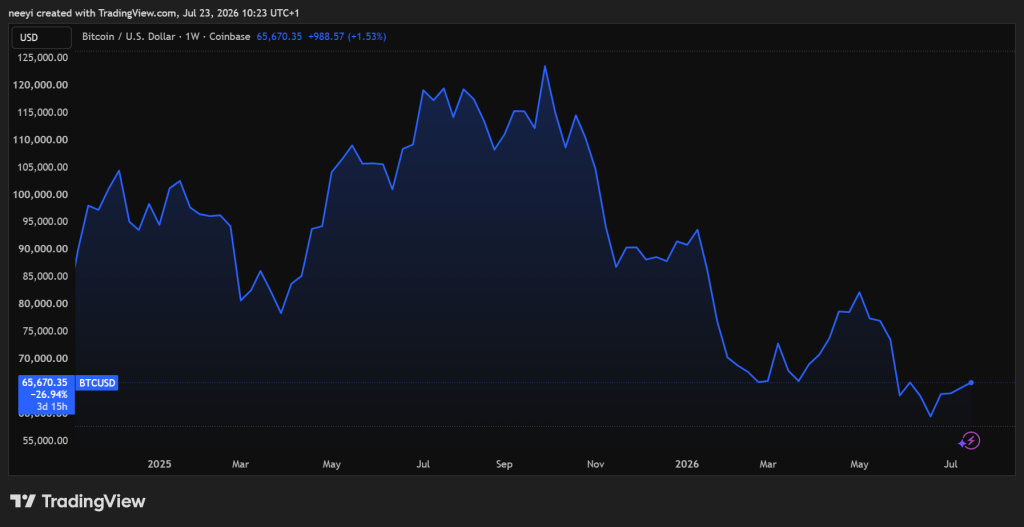
- •Bitcoin traded around $62,500-$66,000 as of late July 2026, down significantly from its October 2025 all-time high of $126,198, amid reduced ETF inflows and competition from AI-related investments.
Bitcoin has spent much of 2026 struggling to recover from a difficult start to the year. Now another question has entered the conversation among investors and analysts: What would happen if the CLARITY Act — one of the most closely watched pieces of crypto legislation in the United States — does not become law until 2027?
That possibility could weigh on market confidence, particularly among institutions that have been waiting for clearer regulatory rules before deepening their involvement in digital assets. The CLARITY Act passed the House Agriculture Committee in 2025, and supporters had hoped for floor votes later that year, but the path through both chambers has proven slower than expected. Claude AI examined this specific scenario. The forecast assumes the legislation is delayed, while most other major market conditions remain broadly unchanged, making it easier to isolate how regulatory uncertainty alone might influence Bitcoin and the broader BTC price.
Why the CLARITY Act Matters for Bitcoin and the Crypto Market
The CLARITY Act is designed to establish clearer rules for the US cryptocurrency industry. The proposal seeks to define which digital assets qualify as securities and which should be treated as commodities. It would also clarify the responsibilities of regulators such as the Securities and Exchange Commission (SEC) and the Commodity Futures Trading Commission (CFTC). The bill's approach would give the CFTC primary jurisdiction over digital commodities and the SEC authority over digital assets marketed as investment contracts, addressing a jurisdictional gray area that has fueled years of enforcement actions and legal disputes.
Clearer rules could ease the operational environment for crypto companies, investors, and developers. Many businesses have spent years navigating uncertain regulations, legal disputes, and compliance questions.
Many analysts believe Bitcoin stands to benefit even though BTC already receives relatively clear treatment as a commodity — a classification the CFTC affirmed well before the current legislative push. A stronger regulatory framework could encourage greater institutional participation, more investment products, improved market confidence, and faster blockchain development across the industry.
Even so, a delay would not automatically constitute a disaster for Bitcoin. ETF demand, interest rates, liquidity conditions, and corporate adoption remain major drivers of the BTC price.
Why Some Investors Are Watching a Possible Delay Closely
Passing major financial legislation often takes considerable time. Lawmakers still need to resolve questions involving digital asset classifications, consumer protections, and regulatory oversight before any final bill can advance through Congress.
Election priorities could further slow the process. If lawmakers fail to reach an agreement during the current session, the legislation could move into the next congressional cycle.
The CLARITY Act is not the only crypto-related bill in motion. The GENIUS Act, focused on stablecoin regulation, was signed into law in July 2025, demonstrating that targeted crypto legislation can advance even as broader market-structure reform stalls. However, stablecoin rules address a narrower segment of the industry, and many market participants view the CLARITY Act's comprehensive framework as the more consequential milestone.
Bitcoin has navigated similar periods before. Regulatory uncertainty has triggered temporary volatility across previous market cycles. BTC eventually recovered after many of those setbacks, although short-term price swings remained common.
What Claude AI Was Asked to Analyze
Claude AI was asked to examine one specific situation. The prompt assumed the CLARITY Act does not pass until 2027 and treated that delay as the primary variable affecting market sentiment. Most other conditions remained stable throughout the exercise.
Those assumptions included:
- Spot Bitcoin ETFs continue operating normally.
- Crypto exchanges and blockchain networks continue functioning.
- Institutional adoption progresses gradually.
- No major financial crisis or severe macroeconomic shock interrupts the market.
This structure allows the forecast to focus mainly on regulatory uncertainty rather than unrelated events.
Institutional Demand Could Still Support Bitcoin
A delayed CLARITY Act does not automatically eliminate institutional interest. Spot Bitcoin ETFs would still offer regulated access to BTC. Companies could continue adding Bitcoin to their balance sheets if their financial strategies support those purchases.
Global adoption could also soften the impact of slower legislative progress in Washington, as Bitcoin remains a globally traded asset.
Claude AI also noted that institutions now play a larger role in the Bitcoin market than ever before. Retail investors still influence price action during speculative periods, although sustained capital flows increasingly depend on institutional participation.
Bitcoin Has Faced a Difficult 2026
Bitcoin remains well below its October 2025 all-time high of $126,198. As of late July 2026, BTC trades around $62,500 to $66,000 after recovering from its recent lows.
The year has followed a challenging trajectory. January opened with optimism as Bitcoin climbed from roughly $88,600 to nearly $98,000, buoyed by hopes surrounding inflation data and possible regulatory progress.
Selling pressure returned quickly in February. Bitcoin dropped toward $60,000 before spending much of the spring oscillating between $66,000 and $76,000. Another decline arrived in June, with BTC revisiting the $60,000 area before buyers helped produce a modest rebound in July.
Several factors contributed to the weaker performance throughout 2026:
- Fewer expectations for Federal Reserve rate cuts
- Slower ETF inflows and institutional demand
- Competition from artificial intelligence-related investments
- Heavy derivatives activity rather than stronger spot buying
These conditions created a challenging backdrop well before questions about the CLARITY Act emerged.
Claude AI Expects Caution Rather Than Panic
Claude AI assesses that Bitcoin would probably face selling pressure if the CLARITY Act is delayed until 2027, though the model does not expect a market collapse. A short-term decline of approximately 5% to 10% appears possible under that scenario, which would place Bitcoin near the $58,000 to $60,000 region.
The model expects caution to dominate because much of the market has already navigated difficult conditions throughout 2026. Many institutions have already reduced exposure during the current cycle.
The forecast also suggests Bitcoin could spend several months moving between roughly $55,000 and $70,000 if no major catalyst alters the outlook. Support around $60,000 becomes especially important. Lower support could emerge near $58,000 and eventually the low $50,000 area if selling pressure intensifies.
Claude AI's Bitcoin Price Scenarios
Claude AI outlined several possible outcomes depending on how other market conditions evolve:
Bearish scenario: If ETF outflows continue and the Federal Reserve keeps interest rates elevated, Bitcoin could revisit its 2026 lows. BTC could even fall into the $45,000 to $55,000 range.
Base case: Claude AI considers this the most likely outcome. Bitcoin could spend the remainder of 2026 trading between roughly $55,000 and $75,000. The delayed CLARITY Act would reduce optimism without becoming the dominant force controlling the market.
Optimistic scenario: Better ETF demand, Federal Reserve rate cuts, or stronger global liquidity could still lift Bitcoin toward $85,000 to $95,000. That would bring BTC closer to its January 2026 peak even without legislative progress.
Most likely year-end range: Claude AI expects Bitcoin to finish 2026 somewhere between $58,000 and $78,000 under its central outlook.
Several Events Could Easily Alter the Forecast
Claude AI emphasizes that one piece of legislation cannot determine Bitcoin's future by itself.
Federal Reserve rate cuts could provide stronger support than regulatory progress if lower borrowing costs encourage investors to return to risk assets. ETF inflows also warrant close attention, as sustained institutional demand can absorb selling pressure during uncertain periods.
Global liquidity may become another powerful driver. Easier financial conditions often support Bitcoin, whereas tighter liquidity can reduce demand across many asset classes. Another country introducing favorable Bitcoin policies or reserve strategies could also bolster market confidence even if US legislation moves slowly.
Major risks remain as well. Persistent inflation, tighter monetary policy, exchange failures, excessive leverage, or another wave of ETF outflows could all weigh on the BTC price.
Historical Bitcoin Returns Context
A $1,000 investment in Bitcoin 15 years ago would be worth over $1.6 billion today. Back in 2011, Bitcoin was a little-known digital experiment trading for a fraction of a cent. Investing $10 in Bitcoin exactly 10 years ago would have yielded a return of over 21,000% to 30,000%, turning that initial $10 into more than $2,100 to $3,000 today.
Source: CaptainAltCoin

