Seven Stablecoins Compared for 2026: USDC, USDT, DAI, USDS, EURC, GHO and USDe
Key Takeaways
- •USDC is ranked as the top stablecoin for beginners because Circle publishes monthly reserve attestations and the token is available across most major exchanges and wallets.
- •USDT maintains the deepest liquidity of any stablecoin and is dominant in emerging markets such as Nigeria, Indonesia, and Turkey, where fast and low-cost transfers outperform traditional banking channels.
- •Nigeria ranks first globally for USDT and USDC ownership, ahead of the United States and the United Kingdom, as local currency depreciation drives demand for dollar-denominated savings tools.
- •USDe from Ethena generates yield through a perpetual futures derivatives strategy rather than cash reserves, making it a complex product with real failure conditions that is unsuitable for risk-averse users.
- •The stablecoin market tripled from $100 billion to $300 billion within a year, with regulation and mainstream trust increasingly influencing which stablecoins expand fastest.
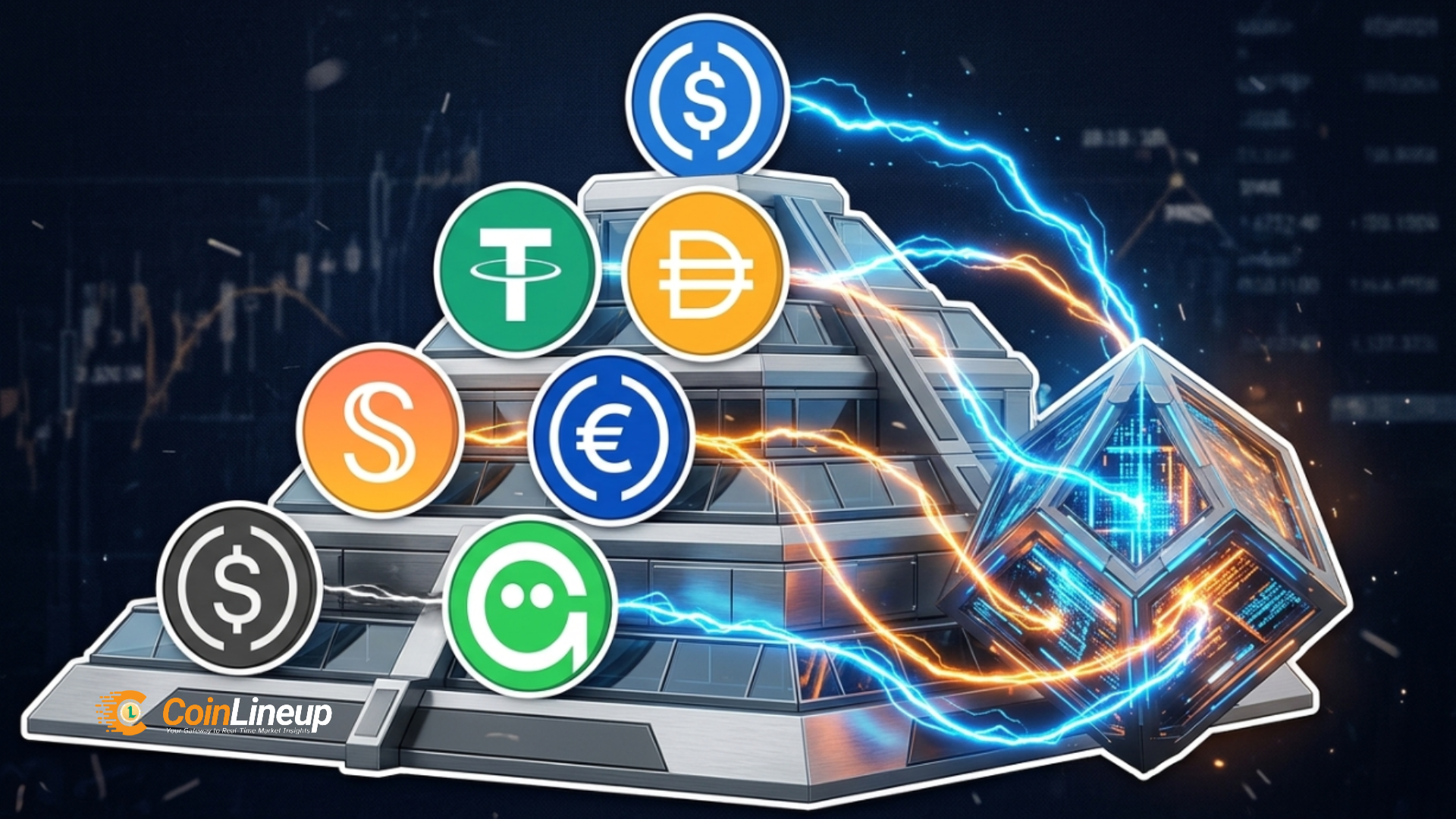
USDC, USDT, DAI, USDS, EURC, GHO and USDe are identified as the leading stablecoins for 2026, with each serving a different role across payments, trading, DeFi, euro-denominated savings and yield-focused crypto products.
USDC is presented as the safest starting point for many beginners, while USDT remains the most liquid option for exchange trading. DAI and USDS provide DeFi-native alternatives with collateral-backed structures, EURC offers a euro-backed option, and GHO and USDe require more technical understanding before users commit funds.
The comparison matters because the word stablecoin covers very different designs. Some tokens depend on an issuer holding cash and short-term government debt, some depend on crypto collateral in smart contracts, and some depend on trading strategies. For users, the practical question is not only whether a token usually trades near $1, but also what keeps it there, where it can be used and what can go wrong.
Seven stablecoins compared for 2026
1. USDC
USDC is described as one of the easiest stablecoins for new users to understand. Its issuer, Circle, explains the reserve model in relatively plain language, and USDC is available across most major exchanges and wallets.
The token is backed 1:1 by U.S. dollars and short-term U.S. Treasury holdings. Circle publishes monthly reserve attestations, which makes the backing model easier to review than many alternatives.
The principal trade-off is centralization. Users rely on Circle to maintain the reserves that support the token. That reliance is not presented as a reason to avoid USDC, but it is a risk factor users should understand.
The source also cites a CryptoCurrency Reddit post by a former insider who worked around Circle, Coinbase and Crossmint: https://www.reddit.com/r/CryptoCurrency/comments/1t6djf8/ive_worked_in_crypto_for_8_years_circle_messari/. The post is referenced because it explains the issuer model in accessible language for beginners.
For many Coinbase users, USDC is the first stablecoin they encounter. It appears as the platform’s default stablecoin in many common flows and is also used frequently in DAO payouts and in lower-risk segments of DeFi liquidity pools.
The comparison with USDT is framed less around performance and more around trust. USDC is portrayed as the option that fits a more conventional financial framing, while USDT is described as the token many active traders prefer.
A crypto insider who said they spent eight years at Circle, Coinbase and Crossmint wrote in the same CryptoCurrency Reddit post: “Almost none of the original thesis happened. But something else did.” The source describes that “something else” as infrastructure, with USDC becoming a stablecoin that runs on top of it.
Best for: first-time stablecoin users, payments and mainstream wallet use. Not ideal for: users seeking a fully decentralized stablecoin model.
2. USDT
USDT has the deepest liquidity of any stablecoin and is often the token with the most trading pairs on exchanges.
Tether, the issuer of USDT, has faced long-running questions about its reserves. Those questions have not produced a major peg break, but the reserve model is described as less transparently documented than USDC’s. For trading, USDT is difficult to avoid; for long-term savings, the source presents USDC as the cleaner choice.
The most common daily use case for USDT is parking funds between trades. A user may complete a trade on Binance, decide not to cash out, and avoid holding a volatile asset by moving into USDT while keeping funds on the exchange.
A second use case is transfers. In markets such as Vietnam, Indonesia, Nigeria and Turkey, the source says USDT can move faster and cheaper than a bank wire. It gives the example of a person in Lagos sending money to a supplier in Dubai: a bank transfer may take three days and cost 3% to 5%, while a USDT transfer on Tron may take two minutes and cost less than one dollar. That cost and speed gap is cited as a reason USDT is dominant in emerging markets.
One user in a Nigeria stablecoin thread on Reddit said: “When your currency loses 20-40% a year, stablecoins become the practical way to protect savings.” The thread referenced by the source is here: https://www.reddit.com/r/CryptoCurrency/comments/1sd734r/nigeria_is_ranked_1_in_global_usdt_and_usdc/.
Best for: active traders and moving value across exchanges. Not ideal for: users who want the clearest reserve story.
3. DAI
DAI is presented as the stablecoin to study for users who want to understand how DeFi works.
Unlike stablecoins backed by dollars in bank accounts, DAI is backed by crypto collateral locked in smart contracts on Ethereum. That makes it more complex than USDC, but also more native to blockchain-based finance.
For users who want a simple dollar substitute, USDC is described as easier. For users who want to understand how crypto collateral can be locked to create a stablecoin, DAI is described as the better place to start.
The source cites a CryptoCurrency Reddit discussion about how a GENIUS Act yield ban could push more demand toward DeFi stablecoins such as DAI: https://www.reddit.com/r/CryptoCurrency/comments/1m3woji/genius_ban_on_stablecoin_yield_will_drive_demand/. It says that regulatory changes may make DeFi-native stablecoins more relevant.
DAI is described as the token many users discover after moving beyond the basic exchange experience. A user may begin with USDC, later become uncomfortable with reliance on a company controlling whether the token exists, and then look for a more decentralized alternative.
The token’s collateral is held by code in smart contracts rather than by a bank or company. That makes it more complicated, but it is also why the source describes DAI as one of the stablecoins DeFi protocols trust most for their own liquidity.
The source also refers to an Ethereum community discussion on Reddit about the need for better decentralized stablecoins: https://www.reddit.com/r/ethereum/comments/1n0m2ax/we_need_better_decentralized_stablecoins/. The recurring argument is that users still want a dollar stablecoin that does not depend on a company keeping money in a bank. DAI is described as imperfect but as the most tested answer to that demand.
Best for: DeFi learners and users moving beyond exchange basics. Not ideal for: beginners who only want a simple stable dollar.
4. USDS
USDS is the newer stablecoin from Sky, the protocol formerly known as MakerDAO. The source presents it as a redesigned version of DAI for the next phase of the Maker ecosystem.
For users already holding DAI or following the Sky/Maker governance transition, USDS is described as a natural next step. For new stablecoin users, the source suggests USDC as the simpler starting point.
The governance transition from MakerDAO to Sky is still ongoing, which adds complexity for casual users. That transition is also why USDS is framed less as a generic first stablecoin and more as a product to watch inside the Maker/Sky ecosystem.
Best for: existing Sky or Maker ecosystem users. Not ideal for: beginners who need a simple first stablecoin.
5. EURC
EURC is a euro-backed stablecoin issued by Circle, the same company behind USDC.
Most stablecoin comparisons focus on U.S. dollar-denominated tokens. EURC is relevant for users whose savings, income or spending are denominated in euros and who want a stablecoin aligned with that currency.
Support for EURC is narrower than support for USDC or USDT. However, the source says its reserve model is transparent and follows the same Circle framework.
Best for: euro-based users and EUR-denominated payments. Not ideal for: users who need broad global exchange pairings.
6. GHO
GHO is created by the Aave protocol. It is a decentralized stablecoin that users can mint by depositing collateral in Aave’s lending markets.
The source does not describe GHO as a beginner stablecoin. It is designed for users who already understand Aave and want to borrow against their assets in a DeFi-native way.
For users just starting with stablecoins, the source says GHO should be revisited only after they understand DeFi lending. It also references a DeFi explainer: https://coinlineup.com/guides/defi/what-is-defi.
Best for: active Aave users and DeFi borrowers. Not ideal for: users who are still new to crypto.
7. USDe
USDe is a synthetic stablecoin from Ethena. Instead of relying on dollar reserves in a bank, it uses a hedged trading strategy to remain near $1.
That strategy can generate yield, which is why USDe receives attention. However, the yield comes from payments in the perpetual futures market. When those payments move against the trade, the model can come under stress.
The source emphasizes that USDe is not the same as holding cash. It is better understood as a more complex yield product that happens to trade near $1.
The main reason users hold USDe is the return it offers. The token is described as popular on trader-focused venues such as Bybit and yield-focused DeFi markets such as Pendle. Crypto-native users hold it specifically because it earns yield.
The yield comes from a derivatives strategy. If the derivatives market moves against that strategy, the yield can fall or disappear. The source states that this is not an overlooked flaw, but part of how the product works.
One user in a CryptoCurrency Reddit thread about bank savings losing to inflation said: “My bank gives me 4%. Inflation is 7%. How is this good?” The thread is here: https://www.reddit.com/r/CryptoCurrency/comments/1p6bq3b/my_bank_gives_me_4_inflation_is_7_how_is_this_good/.
The source says this frustration helps explain why USDe attracts attention, while noting that users must decide which type of risk they prefer.
Best for: advanced users who understand synthetic stablecoin risk. Not ideal for: anyone looking for a simple, safe stable dollar.
How the stablecoins were scored
The source says each stablecoin was scored out of 10 across several categories, with a total score out of 50.
Safety measures how clear and trustworthy the backing model is. Ease of use measures how simple it is to buy, hold and send the token. Liquidity measures how easily the token can be traded on major exchanges. DeFi access measures how many DeFi applications accept it. Beginner fit measures how much crypto knowledge is needed to use it safely.
USDC leads the ranking because it scores highest on the two factors the source says beginners need most: safety and ease of use.
Global stablecoin usage
The source says many people assume the United States leads the world in stablecoin use, but that is not the case.
Nigeria is described as the top country globally for USDT and USDC ownership, ahead of the United States, the United Kingdom and Singapore.
The explanation offered is currency instability. When a local currency loses 30% of its value in a year, the source says a dollar stablecoin is not merely a crypto product but a form of savings account that users can access.
The cited data comes from the CoinGecko / Tiger Research stablecoin issuance report, July 2026: The source notes that the numbers are approximate and change monthly.
USDT is described as dominant in markets where people need to move quickly out of a weak local currency, including Africa, Southeast Asia and Latin America. USDC is described as dominant where regulation and institutional trust matter more, including the United States, Europe and DeFi protocols.
Although both are dollar stablecoins, the source says they serve different populations.
One comment in a CryptoCurrency Reddit thread on Nigeria leading global USDT and USDC ownership said: “The holding part works. The spending part still forces people back into the same broken rails.” The source identifies the gap between holding a dollar stablecoin and spending it in the real economy as an important frontier.
The article also cites another CryptoCurrency Reddit discussion about the stablecoin market tripling from $100 billion to $300 billion in one year: https://www.reddit.com/r/CryptoCurrency/comments/1ssh7sg/the_stablecoin_market_tripled_from_100b_to_300b/. The source says the main takeaway was not only growth, but the growing role of regulation and mainstream trust in shaping which stablecoins expand fastest.
For readers comparing stablecoins over time, the areas to monitor are the same ones used in the ranking: issuer transparency, network support, DeFi adoption, peg behavior and the amount of friction new users face when they try to move funds.
Ranking criteria
The ranking is based on five criteria the source says beginners tend to care about most.
Exchange support: whether the stablecoin can be easily bought and held.
Transparency: whether the reserve or collateral model is clearly explained.
DeFi usefulness: whether the stablecoin connects to common DeFi tools.
Peg history: whether it has stayed close to $1.
Beginner friction: how difficult it is to understand the risk.
Size was considered helpful, but the source says a clear explanation of risk mattered more.
Common mistakes by new stablecoin users
The source says many stablecoin problems arise not from choosing the wrong token, but from the steps users take after choosing one.
Wrong network: sending USDC on Ethereum when the receiver expects Solana, or the reverse, can leave funds on a chain the recipient cannot access.
No gas: users need a small amount of the network’s native token, such as ETH or SOL, to pay transfer fees. Stablecoins do not pay their own gas fees.
Assuming all stablecoins carry the same risk: USDC and USDe are both called stablecoins, but their risk models are completely different.
Skipping the token contract check: users should confirm they are receiving the real contract address rather than a scam copy with a similar name.
Which stablecoin fits which use case
For new users, the source identifies USDC as the clearest option because of its issuer model, transparent reserves and broad availability.
For active traders, USDT is identified for its trading-pair depth, while the source says users should understand the reserve questions around it.
For DeFi learners, DAI is described as more educational than other stablecoins because it illustrates how collateral-backed DeFi systems work.
For users whose financial life is euro-based, EURC is described as the cleanest EUR option.
For people already using Aave, GHO is presented as a stablecoin worth exploring after understanding DeFi lending.
For users seeking yield and already familiar with the risks, USDe is identified as an option that requires reading the documentation first.
How a beginner might buy a first stablecoin
Using USDC as the example, the source says a beginner would open a crypto exchange account, with Coinbase described as the simplest starting point for many new users. The user would then complete identity verification, search for USDC, select Buy, enter the amount and confirm.
After purchase, USDC appears in the exchange wallet. When sending it to a friend, another wallet or a DeFi application, the user must select a network. The source identifies this as one of the steps that most often confuses beginners.
For transfers between friends or to DeFi applications, Solana or Base may reduce fees. If the receiver specifically requests Ethereum or Tron, the sender should use that network.
The key point is that both sides must support the same network. USDC sent on Solana cannot arrive in an Ethereum-only wallet.
What happens when a stablecoin loses its peg
The source discusses USDC’s March 2023 depeg as an example.
In March 2023, USDC fell to $0.87 after Silicon Valley Bank collapsed. Circle held $3.3 billion of USDC reserves at SVB. For roughly 48 hours, the market priced in the possibility that those reserves had been lost.
They were not lost. Banking regulators stepped in, and USDC returned to $1.00 within two days.
For a user holding $1,000 in USDC during that weekend, the balance may have temporarily appeared to be worth about $870. If the user did not sell, the source says they did not realize a loss. If the user sold at $0.87, they locked in a 13% loss on a stablecoin.
The source’s practical lesson is that stablecoin depegs for well-backed coins such as USDC and USDT are usually temporary, although the risk is real and historically has been short-lived.
Stablecoin yield
Stablecoins can generate yield, but the source says users should understand the source of that yield before committing funds.
Low-risk options: Coinbase offers approximately 4% to 5% APY on USDC held in an account. The source says this comes from Coinbase lending USDC to institutional borrowers. The main risk in that structure is Coinbase counterparty risk, not stablecoin risk.
Medium-risk options: DeFi lending protocols such as Aave allow users to deposit USDC and earn variable interest, typically 3% to 8% depending on demand. The risk is smart contract risk, meaning a code bug could affect funds.
Higher-risk options: USDe from Ethena targets higher yields through a derivatives strategy. The yield is real, but the mechanism is complex and depends on market conditions.
For beginners, the source describes holding USDC on Coinbase and earning the base rate as the simplest path, with DeFi lending considered only after the user understands how DeFi works.
Review process
The guide says it was based on live issuer pages and protocol documentation reviewed in July 2026. The source says public product pages, reserve explanations and visible positioning were checked directly before publication.
It also notes that anything requiring a full live transfer, a logged-in exchange workflow or a deeper blockchain-level test still needs final verification.
For the ranking, the source says it reviewed public product surfaces for the stablecoins and issuers so the comparison would not rely only on recycled summaries. That review did not replace full live transfer testing on every network, but it helped show which products are built to feel simple, which assume DeFi knowledge and where beginners encounter friction.
FAQ
Which stablecoin is safest for beginners?
USDC. The issuer model is clearly explained, reserves are attested monthly, and the token works on almost every major exchange and wallet.
Is USDT still one of the best stablecoins in 2026?
Yes, for liquidity and trading. USDT has the deepest exchange support of any stablecoin. Its reserve story is less transparent than USDC’s, which matters more for savings than for trading.
Is DAI better than USDC?
Not in every case. DAI is better for users who want to understand DeFi or avoid a centralized issuer. USDC is better for users who want the simplest and most beginner-friendly starting point.
Are yield-bearing stablecoins worth it?
Only for users who understand where the yield comes from. USDe yields come from payments inside the perpetual futures market, and that mechanism has real failure conditions.
What is the difference between DAI and USDS?
Both come from the same protocol, now called Sky and formerly known as MakerDAO. USDS is the newer product replacing DAI as the main stablecoin in the Sky ecosystem.