Big Tech's AI Spending Spree Rattles Wall Street as Alphabet and Tesla Post Heavy Capex
Key Takeaways
- •Alphabet reported record Q2 revenue of $119.8 billion, but its $44.9 billion in quarterly capital expenditure consumed all operating cash flow, resulting in the company's first-ever negative free cash flow.
- •Tesla delivered 480,126 vehicles, beating forecasts, yet its automotive gross margin of 16.3% fell well short of the 18.04% analysts expected, and shares dropped 13.5%.
- •A Reuters analysis found that Microsoft, Alphabet, Amazon, Meta, and Oracle collectively plan to allocate $1.57 toward capital expenditure for every $1 of projected operating cash flow growth between 2025 and 2027.
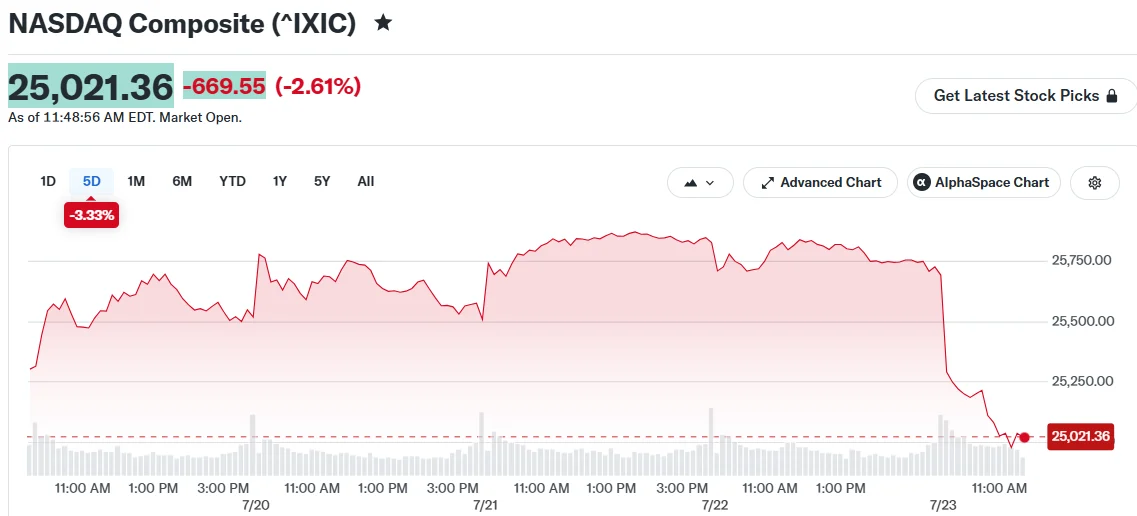
- •The selloff extended across Big Tech, with Amazon declining nearly 5%, Meta falling close to 4%, and Microsoft sliding more than 2%, while the Nasdaq Composite dropped 2.8%.
- •Alphabet raised its full-year capex guidance to a range of $195 to $205 billion, up from the previous $180 to $190 billion, and indicated spending would continue climbing into 2027.
Alphabet and Tesla delivered quarterly results on Thursday that unsettled Wall Street, with both companies reporting capital expenditure levels so steep they erased free cash flow and intensified scrutiny over whether AI investments can deliver returns fast enough to satisfy investors.
The broader market absorbed the blow. The Nasdaq Composite dropped 2.8% to close near 24,975, while the S&P 500 fell 1.5% and the Dow Jones Industrial Average declined 1.2%.
Alphabet: Record Revenue Offset by Record Spending
Alphabet's Q2 revenue reached $119.8 billion, surpassing the $116.9 billion consensus estimate. Google Cloud revenue surged to $24.8 billion, representing an 82% year-over-year increase — the clearest evidence yet that enterprise demand for AI compute is translating into top-line growth. Cloud has long operated as Alphabet's most capital-intensive segment, requiring continuous data center expansion, and the unit's profitability hinges on whether that infrastructure can be utilized efficiently enough to widen margins over time.
However, the headline figure that alarmed investors was capital expenditure: $44.9 billion in a single quarter, roughly double the year-ago amount. That outlay — driven primarily by data center construction, AI accelerators, and networking infrastructure — consumed all of the company's $39.1 billion in operating cash flow, resulting in negative free cash flow for the first time on record. For a company that has historically generated tens of billions in annual surplus cash, the result marks a structural shift in its financial profile.
Alphabet subsequently raised its full-year capex guidance to a range of $195–205 billion, up from the previous $180–190 billion, and indicated that spending would continue to climb in 2027.
Chief Executive Sundar Pichai stated that AI investments are "redefining what's possible across every part of our business." The market responded unfavorably, with Alphabet shares falling more than 7%.
Tesla: Deliveries Beat, Margins Disappoint
Tesla's results echoed a similar narrative. The company delivered 480,126 vehicles, beating forecasts, yet automotive gross margin landed at 16.3%, well short of the 18.04% analysts had anticipated.
Capital expenditure surged 142% year over year to $5.8 billion as Tesla ramps up its robotaxi and AI initiatives. Unlike Alphabet, Tesla's AI spending is directed at autonomous driving systems and a purpose-built robotaxi network rather than cloud infrastructure — bets that remain pre-revenue at scale. Elon Musk told analysts the company remains confident its investments will generate returns. Tesla shares dropped 13.5%.
Selloff Spreads Across Big Tech
The reaction extended well beyond the two companies. Amazon fell nearly 5%, Meta declined close to 4%, and Microsoft slid more than 2%. The Philadelphia Semiconductor Index had already retreated over 20% from its late-June peak before these earnings landed.
A Reuters analysis found that Microsoft, Alphabet, Amazon, Meta, and Oracle are collectively on pace to spend more on capex than they generate in free cash flow by 2027. Specifically, for every $1 of additional operating cash flow those companies project to generate between 2025 and 2027, they plan to allocate $1.57 toward capital expenditure.
That ratio was sustainable when these firms operated primarily on software margins with minimal infrastructure requirements. AI is fundamentally reshaping that economic model, as training and running large language models requires dense clusters of specialized chips — predominantly Nvidia GPUs — housed in power-hungry data centers. The buildout also places mounting demand on electricity grids, with several hyperscalers pursuing nuclear and renewable power contracts to meet projected energy needs.
Multiple Big Tech executives have acknowledged in recent earnings cycles that the competitive cost of underinvesting in AI exceeds the financial risk of overbuilding, effectively committing the industry to sustained outlays regardless of near-term return visibility.
Keith Lerner, chief investment officer at Truist, characterized the selloff as more of a sector rotation than a broader market exit, noting that Industrials, Energy, and Healthcare have demonstrated relative strength.
"The bull market still deserves the benefit of the doubt, but this reinforces our view from the past month that markets were entering a bumpier period," Lerner said.
Investors are now turning their attention to Meta and Microsoft, both scheduled to report earnings on July 29, followed by Amazon on July 31. Those results will help determine whether this week's declines represent an isolated reaction or the beginning of a wider recalibration of AI-driven valuations.
