Zcash Tests $512 Resistance as Shielded Pool Balances Reach 30% of Supply
Key Takeaways
- •ZEC is trading near $510 after failing to decisively break through the $512 resistance level, having briefly touched $515.
- •The derivatives market shows improving sentiment, with the funding rate turning mildly positive following a deeply negative period in June.
- •Analysis indicates that the share of circulating ZEC held in shielded balances grew to approximately 30% by May 2026, which could constrain the available tradable float.
- •Grayscale has filed for a United States-listed Zcash exchange-traded product, while Cypherpunk aims to acquire 5% of the total ZEC supply.
- •If the current rally fails, the price may retrace to technical support levels at $496, $477, and $470.
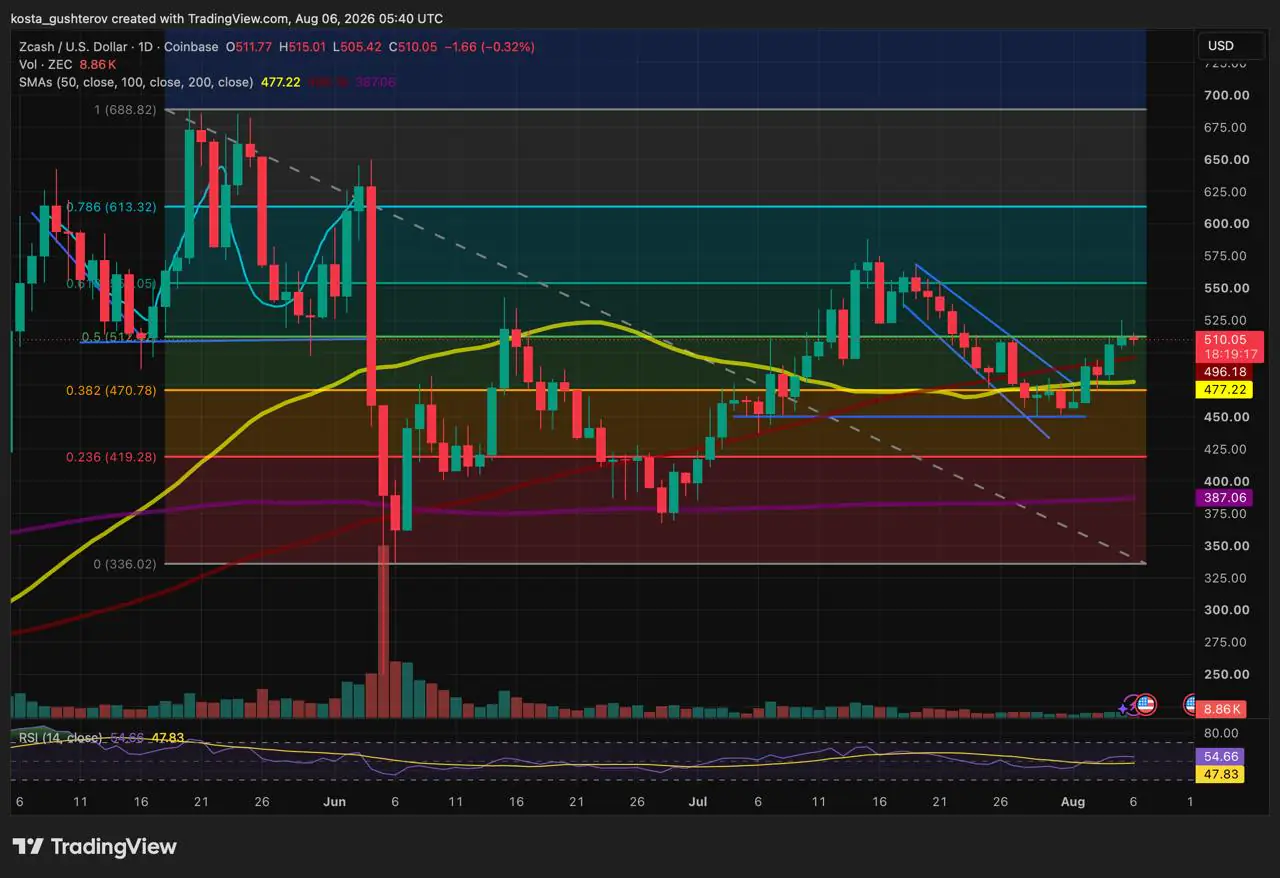
ZEC briefly touched $515 before retrading to approximately $510, leaving the breakout attempt unresolved and placing the daily close in focus. Zcash, one of the most prominent privacy-focused cryptocurrencies, uses zero-knowledge proofs to enable transactions that can shield sender, recipient, and amount information from public view.
ZEC's Six-Day Recovery Meets Key Technical Hurdle
The $512 resistance zone previously halted ZEC's rebound around July 26, after which the price retreated toward the lower end of its short-term trading range. A confirmed break above this area would clear both the Fibonacci retracement and the ceiling that capped the earlier recovery effort.
ZEC arrived at this level after breaking free from the descending channel that defined price action through the second half of July. The emerging pattern of higher highs signals modestly improving short-term momentum, while the Relative Strength Index has climbed back to approximately 54.7 — still well below overbought territory.
Trading volume, however, has remained muted throughout the advance, depriving the move of strong participation or conviction. The August 6 volume reading also reflects an incomplete daily session, meaning the final tally will be more instructive than the interim figure.
A daily close above $512 accompanied by stronger volume would place the 0.618 Fibonacci retracement near $554 as the next upside reference. Without broader market participation, the current advance remains exposed to the same type of rejection observed in late July.
Funding Rate Turns Mildly Positive
Zcash's eight-hour open-interest-weighted funding rate registered at 0.0081% as of 03:00 UTC on August 6. A positive funding rate indicates that traders holding long perpetual-futures positions are paying a premium to those positioned short.
The current rate sits below the elevated positive readings observed during portions of May, indicating that the long bias has not yet reached a conspicuous funding-rate extreme. This marks a notable shift from the June sell-off, when weighted funding briefly dropped toward -0.12% — a deeply negative reading consistent with aggressive short positioning or strong demand for downside protection.
The return above zero signals that derivatives market sentiment has shifted in tandem with the price recovery. Funding data alone, however, does not confirm whether spot buyers are actively accumulating ZEC. It merely demonstrates that funding conditions no longer reflect the pronounced downside bias that characterized the June decline. A rapid surge toward unusually elevated positive readings would elevate the risk of a long-liquidation reversal.
Funding data is sourced from Coinglass.
Shielded Balances May Be Constraining Liquid Supply
A separate, longer-term structural development involves the growing proportion of ZEC held within shielded balances. These addresses rely on zk-SNARK cryptography to verify transactions without revealing the parties or amounts involved, a feature that distinguishes Zcash from transparent-ledger cryptocurrencies where all transaction data is publicly visible. According to analysis shared by Delphi Digital, the share of circulating ZEC residing in the shielded pool climbed from approximately 8% in early 2024 to roughly 30% by May 2026. The analysis estimated that around 4.9 million ZEC had migrated into shielded balances over that period.
These coins are not permanently locked or removed from circulation. They remain transferable within the shielded pool and can be returned to transparent addresses at any time. The data does not confirm that every shielded balance is inactive or unavailable for trading.
Delphi's reasoning is that users who move funds into shielded balances for privacy purposes may be less inclined to swiftly return them to transparent addresses or exchanges. If a meaningful share of ZEC remains outside active exchange liquidity, the cryptocurrency's effective tradable float could be smaller than its circulating supply figure implies. Under such conditions, incremental demand could exert a more pronounced effect on price, as fewer coins would be immediately available for sale.
The available data, however, does not establish a causal link between shielded balances and the current price recovery.
Delphi also identified two potential catalysts for future demand. Nasdaq-listed Cypherpunk has set a target of owning 5% of the total ZEC supply, while Grayscale has filed for a United States-listed Zcash exchange-traded product. Grayscale already operates a private Zcash Trust as a vehicle for accredited investors, and a regulated ETF would make the asset accessible to a wider pool of capital if approved. These developments stand against a backdrop in which several major exchanges have delisted or restricted privacy coins, including Zcash, in certain jurisdictions amid regulatory scrutiny of assets designed to obscure transaction trails. Neither development guarantees recurring purchases or approved investment-product inflows. While both could contribute to future demand alongside a potential tightening of liquid supply, there is currently no evidence that a supply shortage is already driving ZEC's price.
Support Levels: $496, $477, and $470
A rejection near $512 would not immediately undermine the broader recovery thesis. The first support level sits at the 100-day simple moving average, currently near $496. Below that, the 50-day SMA at approximately $477 provides secondary support alongside the 0.382 Fibonacci retracement at $470. Buyers successfully defended the wider $471–$477 zone during the final days of July before the current recovery took hold.
The moving-average configuration is not unambiguously bullish, as the 50-day SMA continues to trade below the 100-day average. Nevertheless, price trading above both averages represents an improvement over the late-July structure and affords buyers two distinct support levels before a deeper retracement becomes probable.
If the 100-day SMA fails to hold, attention would shift to the 50-day SMA at $477 and the Fibonacci level at $470. The August 6 daily close will indicate whether buyers can sustain the recovery or whether market focus rotates back to the support levels below.
Chart data is derived from a Coinbase ZEC/USD daily chart captured on August 6, 2026.

