Zcash Pauses After 80% Rally as $755-$825 Range Comes Into Focus
Key Takeaways
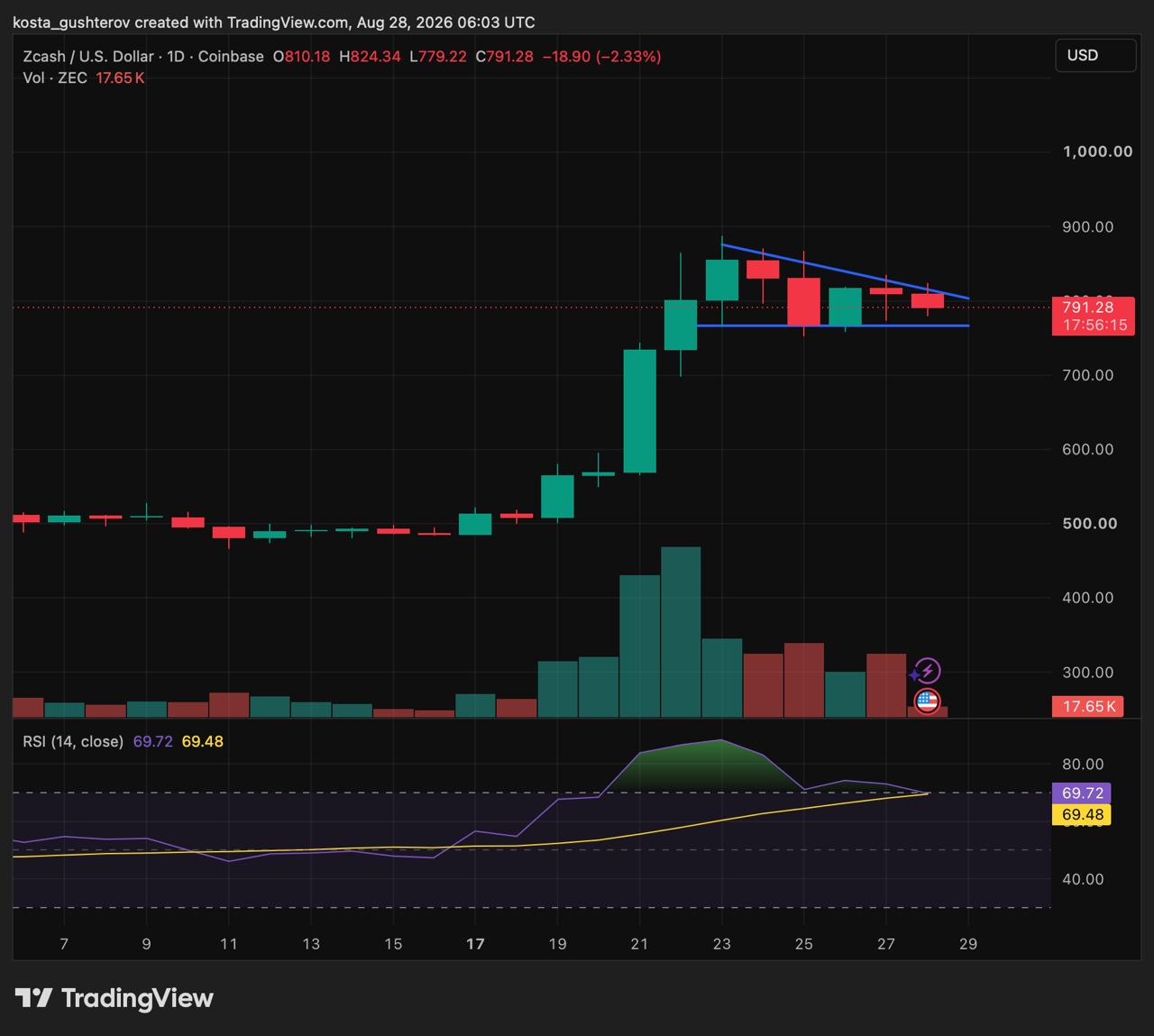
- •ZEC has consolidated between roughly $755 and $825 after its August advance, which began with a break above $512 and accelerated toward $880 before selling pressure produced a series of lower highs.
- •Daily RSI has declined from above 80 to about 69.7, indicating that momentum remains elevated even as the overbought reading has moderated.
- •Grayscale's Zcash ETF, listed under the ticker ZCSH, held approximately $316 million in assets as of August 27, reflecting the renaming and NYSE Arca uplisting of the existing trust rather than fresh inflows.
- •A Zcash Foundation Community Advisory Panel vote on unresolved NU7 upgrade topics, including issuance policy and faster block times, is scheduled to close on September 14 at 19:00 UTC.
- •CoinGlass data showed about $1.57 billion in ZEC open interest and roughly $3.54 billion in 24-hour futures turnover versus about $345 million in reported spot volume, making spot activity a stronger confirmation signal for any move beyond the range.
Key Takeaways
Immediate resistance sits around $815-$825.
The main support zone extends from $755 to $770.
Daily RSI has retreated from above 80 toward 70.
Futures turnover greatly exceeds reported spot activity.
ZEC’s rally narrows into a $755-$825 range
Zcash (ZEC), the native coin of a privacy-focused blockchain whose optional shielded transactions use zero-knowledge proofs to hide sender, recipient, and amount data, has entered a narrower trading range after clearing the resistance levels that had contained it through July and early August. In our previous analysis, the move began with a break above $512, at a point when buyers were still working to reclaim $550.
Price then moved through $550 and accelerated toward $880. During the strongest phase of the advance, daily volume increased, indicating that participation rose as ZEC moved beyond its earlier trading range.
Selling pressure began to appear after the August peak. The resulting series of lower highs has formed a descending line that currently runs through roughly $815-$825.
The lower boundary is near $765. Intraday wicks have extended below that line, widening the practical support area to about $755-$770. Even so, the range is now defined enough to mark the immediate decision zone, although a few more candles could still change the angle of the upper boundary.
Daily Relative Strength Index, a momentum oscillator conventionally read as overbought above 70 and oversold below 30, has declined from above 80 to about 69.7, showing that momentum remains elevated. The next direction will need to come from price action around the two range boundaries.
Important price levels for Zcash
The distance between these levels means that a single trendline break would not open a clear path. Buyers would still face $840-$850 before ZEC could revisit the August high.
Below support, the $720-$740 area could determine whether the move remains a pullback or develops into a deeper correction.
ETF trading and NU7 add context to the chart
The consolidation comes after a week of heightened attention around Zcash. Grayscale now lists The Zcash ETF under the ticker ZCSH, with approximately $316 million in assets under management as of August 27.
An SEC filing shows that ZCSH resulted from the planned renaming and NYSE Arca uplisting of the existing Grayscale Zcash Trust, the same trust-to-ETF conversion route Grayscale used to turn its Bitcoin Trust into the spot ETF GBTC in January 2024. As a result, the reported assets include holdings accumulated before the ETF listing and should not be described as fresh inflows.
Zcash governance is also active. Zcash ships protocol changes as named network-wide upgrades in the NU series, each activating at a set block height, and the Zcash Foundation has opened a Community Advisory Panel vote on unresolved parts of the NU7 network upgrade. The vote covers topics including issuance policy and faster block times and is scheduled to end on September 14 at 19:00 UTC.
Supply conditions may also shape how sharply ZEC reacts to new demand. Earlier, our team examined the growing amount of ZEC held in shielded pools. Shielded balances use zero-knowledge proofs so that addresses and amounts stay hidden, while the transparent pool operates like a conventional public ledger with holdings visible on-chain. Those coins remain transferable, although balances held away from transparent exchange addresses may reduce the amount immediately available for trading.
Taken together, these developments extend the story beyond the daily chart. Institutional access has changed, governance decisions are approaching, and some circulating ZEC may be less readily available on transparent markets.
Futures turnover makes confirmation more important
CoinGlass recorded approximately $1.57 billion in ZEC open interest, the total value of derivative contracts not yet closed or settled, at 06:10 UTC on August 28. Futures turnover reached roughly $3.54 billion over 24 hours, compared with about $345 million in reported spot volume.
That means futures turnover was a little more than 10 times the reported spot total. Roughly $5.4 million in positions were liquidated during the same period, equal to about 0.3% of open interest. By comparison with the amount of leverage still active in the market, that liquidation total appears modest.
At $1.57 billion, outstanding contracts represent substantial leveraged exposure around the current range. The aggregate includes both long and short positions and does not offer a reliable directional signal.
A futures-led move can travel quickly when stops and liquidations reinforce the initial direction. Spot volume, along with the market’s ability to remain outside the range, offers stronger evidence that traders are accepting a new price area.
How the next move gains confirmation
An upside break
A four-hour close above $815-$825 would provide early evidence that buyers have cleared the descending trendline. A daily close above the same zone would carry more weight because the pattern is drawn from the daily chart.
If price later retests the breakout area, holding it would strengthen the move. ZEC would then need to move through $840-$850 before challenging the August high near $880-$890. It would be premature to project a larger target before those barriers are cleared.
A loss of support
A daily close below $755-$770 would weaken the range and bring $720-$740 back into focus. That lower zone marks an area where the August advance paused before accelerating.
The reaction after a breakdown would be equally important. A quick recovery above $770 would weaken the breakdown signal and return price to the established range. Continued trading below the range would provide stronger evidence that the correction is extending.
The range remains the useful signal
ZEC is currently positioned between a defended base and resistance that declines with each passing session. That leaves $755-$825 as the key working range. Trading inside it changes little; acceptance beyond either boundary would mark the first meaningful shift in market structure. The chart is not the only dated reference point: the NU7 advisory vote closes on September 14 at 19:00 UTC, a fixed calendar date that can be checked against how the range resolves.
Methodology: Technical levels, RSI and chart observations are based on Coinbase ZEC/USD daily and four-hour charts captured on August 28, 2026, at 06:03 UTC and 05:58 UTC, respectively. Derivatives and spot-market figures were obtained from CoinGlass at approximately 06:10 UTC. Prices and market data can vary between exchanges and change rapidly.
This article is provided for informational and educational purposes only and does not constitute financial or investment advice.
